
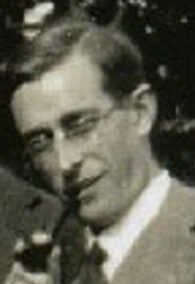
George Gamow
George Gamow was a Russian-American theoretical physicist and cosmologist. Born March 4, 1904, in Odesa. Died August 19, 1968, in Boulder. Known for Mr Tompkins, One Two Three... Infinity and cosmic microwave background. Educated at Faculty of Physics and Mathematics of the Saint Petersburg University and Odesa University. Awards include Kalinga Prize and Fellow of the American Physical Society.
Facts
45 facts · 2 confirmed by two sources · 10 cited · 33 from one source
Where this comes from
Papalocal keeps its own record. It started from these sources; what each one said is kept here as it was copied, so a change on their side never changes this page by itself. Tap one to read its version.
What Wikipedia says · copied November 13, 2026 · revision 1375151176
George Gamow (sometimes Gammoff; born Georgiy Antonovich Gamov; Russian: Гео́ргий Анто́нович Га́мов; 4 March [O.S. 20 February] 1904 – August 19, 1968) was a Soviet and American polymath, theoretical physicist and cosmologist. He was an early advocate and developer of Georges Lemaître's Big Bang theory. Gamow discovered a theoretical explanation of alpha decay by quantum tunneling, invented the liquid drop model (the first mathematical model of the atomic nucleus), worked on radioactive decay, star formation, stellar nucleosynthesis, Big Bang nucleosynthesis (which he collectively called nucleocosmogenesis), and predicted the existence of the cosmic microwave background radiation and molecular genetics.
In his middle and late career, Gamow directed much of his attention to teaching and wrote popular science, including One Two Three... Infinity and the Mr Tompkins series. Some of his books remain in print more than a half-century after their original publication. The George Gamow Memorial Lectures at the University of Colorado at Boulder are given in his honor.
- Born, in its opening lines
- March 4, 1904
- Died, in its opening lines
- August 19, 1968
From the Wikipedia article “George Gamow” (en.wikipedia.org/wiki/George_Gamow), by its contributors, under CC BY-SA 4.0 (creativecommons.org/licenses/by-sa/4.0/). Copied November 13, 2026; not changed.
What Wikidata says · copied November 14, 2026 · revision 2569083853
- Described as
- Russian-American theoretical physicist and cosmologist (1904–1968)
- Other names
- Georgy Gamov, Georgy Antonovich Gamov, George Gammoff
- Born
- March 4, 1904 · 10 references
- Died
- August 19, 1968 · 9 references
- Born in
- Odesa · 4 references
- Died in
- Boulder · 2 references
- Buried in
- Green Mountain Cemetery · 1 reference
- Name at birth
- Геóргий Анто́нович Га́мов
- Citizen of
- Russian Empire; Soviet Union; United States (1940–)
- Occupation
- physicist; inventor; writer; nuclear physicist; university teacher; cosmologist; biochemist · 1 reference; astronomer
- Worked for
- University of California, Berkeley (1954–1956); George Washington University (1934–1954); University of Copenhagen Niels Bohr Institute (1928–1931); V.G. Khlopin Radium Institute (1931–1933); University of Colorado Boulder (1956–1968); Ioffe Institute · 1 reference
- Education
- Faculty of Physics and Mathematics of the Saint Petersburg University; Odesa University; Saint Petersburg State University · 1 reference
- Member of
- Academy of Sciences of the USSR; American Physical Society · 1 reference; National Academy of Sciences
- Known for
- Mr Tompkins; One Two Three... Infinity; cosmic microwave background; Alpher–Bethe–Gamow theory
- Awards
- Kalinga Prize (1956) · 1 reference; Fellow of the American Physical Society
- Field
- theoretical physics; astrophysics · 1 reference; nuclear physics · 1 reference; physical cosmology · 1 reference; biochemistry · 1 reference; literary activity · 1 reference
- Spouse
- Barbara Perkins Gamow (1958–)
- Children
- Igor Gamow
- Religion
- atheism
- Lived in
- Odesa
- Wikipedias with a page
- 66
Wikidata item Q59478 (wikidata.org/wiki/Q59478), public domain (CC0). Copied November 14, 2026.
Confirmed Two sources agree. Cited One source, and it names where it got it. One source One source, without a reference of its own. Sources disagree The sources disagree. We show the best-supported value and keep theirs below.
