
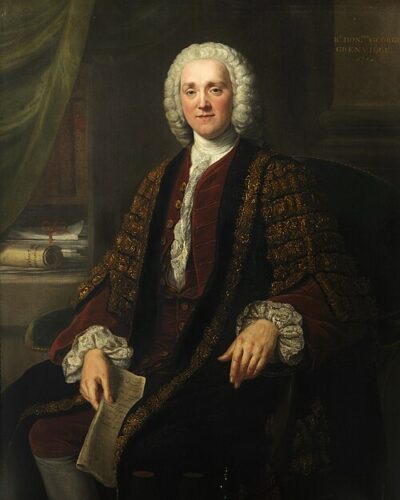
George Grenville
George Grenville was a Prime Minister of Great Britain. Born October 14, 1712, in Westminster. Died November 13, 1770, in London. Positions held include Prime Minister of the United Kingdom (1763–1765), Chancellor of the Exchequer (1763–1765) and Secretary of State for the Northern Department (1762). Educated at Christ Church and Eton College.
Facts
36 facts · 2 confirmed by two sources · 17 cited · 17 from one source
Where this comes from
Papalocal keeps its own record. It started from these sources; what each one said is kept here as it was copied, so a change on their side never changes this page by itself. Tap one to read its version.
What Wikidata says · copied November 16, 2026 · revision 2567896591
- Described as
- Prime Minister of Great Britain (1712-1770)
- Other names
- Gentle Shepherd
- Born
- October 14, 1712 · 6 references
- Died
- November 13, 1770 · 7 references
- Born in
- Westminster
- Died in
- London · 1 reference
- Buried in
- Church of All Saints, Wotton Underwood
- Citizen of
- Kingdom of Great Britain
- Occupation
- politician · 1 reference
- Positions held
- Prime Minister of the United Kingdom (1763–1765); Chancellor of the Exchequer (1763–1765); Secretary of State for the Northern Department (1762); member of the 9th Parliament of Great Britain; member of the 10th Parliament of Great Britain; member of the 11th Parliament of Great Britain; member of the 12th Parliament of Great Britain; member of the 13th Parliament of Great Britain; First Lord of the Admiralty (1762–1763); Leader of the House of Commons (1761–1765) · 1 reference
- Political party
- Whigs
- Education
- Christ Church; Eton College · 1 reference
- Spouse
- Elizabeth Wyndham (1749–) · 2 references
- Children
- George Nugent-Temple-Grenville, 1st Marquess of Buckingham · 1 reference; Thomas Grenville · 1 reference; Hester Grenville · 2 references; William Wyndham Grenville, 1st Baron Grenville · 1 reference; Charlotte Williams-Wynn · 2 references; Elizabeth Grenville · 1 reference; Catherine Grenville · 1 reference
- Father
- Richard Grenville · 1 reference
- Mother
- Hester Grenville, 1st Countess Temple · 1 reference
- Siblings
- Richard Grenville-Temple, 2nd Earl Temple · 1 reference; Hester Pitt, Countess of Chatham · 1 reference; James Grenville · 1 reference; Henry Grenville · 1 reference; Thomas Grenville · 1 reference
- Religion
- Church of England
- Wikipedias with a page
- 52
Wikidata item Q244616 (wikidata.org/wiki/Q244616), public domain (CC0). Copied November 16, 2026.
What Wikipedia says · copied November 16, 2026 · revision 1379429272
George Grenville (14 October 1712 – 13 November 1770) was a British Whig statesman who served as Prime Minister of Great Britain, during the early reign of the young King George III. He served for only two years (1763–1765), and attempted to solve the problem of the massive debt resulting from the Seven Years' War. He instituted a series of measures to increase revenue to the crown, including new taxes and enforcement of collection, and sought to bring the North American colonies under tighter crown control.
Born into an influential political family, Grenville first entered Parliament in 1741 as an MP for Buckingham. He emerged as one of the Cobhamites, a group of young members of Parliament associated with Lord Cobham. In 1754, Grenville became Treasurer of the Navy, a position he held twice until 1761. In October 1761 he chose to stay in government and accepted the new role of Leader of the Commons causing a rift with his brother-in-law and political ally William Pitt who had resigned. Grenville was subsequently made Northern Secretary and First Lord of the Admiralty by the new prime minister Lord Bute. On 8 April 1763, Lord Bute resigned, and Grenville assumed his position as prime minister.
His government tried to bring public spending under control and pursued an assertive policy over the North American colonies and colonial settlers. His best-known policy is the Stamp Act, a long-standing tax in Great Britain which Grenville extended to the colonies in America, but which instigated widespread opposition in Britain's American colonies and was later repealed. Grenville had increasingly strained relations with his colleagues and the King. In 1765, he was dismissed by George III and replaced by Lord Rockingham. For the last five years of his life, Grenville led a group of his supporters in opposition and staged a public reconciliation with Pitt.
Grenville married Elizabeth Wyndham, the granddaughter of Charles Seymour, 6th Duke of Somerset, the great-great-grandson of Lady Katherine Grey, who was herself a great-granddaughter of Henry VII and Elizabeth of York, and sister of Lady Jane Grey.
- Born, in its opening lines
- October 14, 1712
- Died, in its opening lines
- November 13, 1770
From the Wikipedia article “George Grenville” (en.wikipedia.org/wiki/George_Grenville), by its contributors, under CC BY-SA 4.0 (creativecommons.org/licenses/by-sa/4.0/). Copied November 16, 2026; not changed.
Confirmed Two sources agree. Cited One source, and it names where it got it. One source One source, without a reference of its own. Sources disagree The sources disagree. We show the best-supported value and keep theirs below.
