
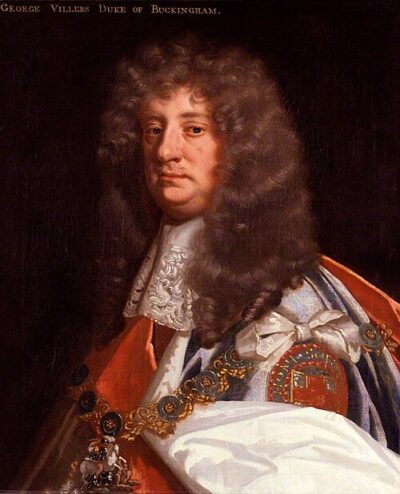
George Villiers, 2nd Duke of Buckingham
George Villiers, 2nd Duke of Buckingham was an English statesman and poet. Born January 30, 1628, in London. Died April 16, 1687, in Yorkshire. Positions held include Member of the Privy Council of the United Kingdom, Lord Lieutenant of the West Riding of Yorkshire (1661–1674) and Master of the Horse (England) (1668–1674). Educated at Trinity College. Awards include Order of the Garter.
Facts
22 facts · 2 confirmed by two sources · 6 cited · 14 from one source
What’s different
- Born: we show January 30, 1628 (Confirmed). Wikidata also lists January 30, 1627
Where this comes from
Papalocal keeps its own record. It started from these sources; what each one said is kept here as it was copied, so a change on their side never changes this page by itself. Tap one to read its version.
What Wikidata says · copied November 18, 2026 · revision 2568692428
- Described as
- English statesman and poet (1628-1687)
- Other names
- George Villiers, George Villiers, Duke of Buckingham
- Born
- January 30, 1628 · 3 references; January 30, 1627 · 1 reference
- Died
- April 16, 1687 · 5 references
- Born in
- London · 1 reference
- Died in
- Yorkshire
- Buried in
- Westminster Abbey
- Citizen of
- Kingdom of England
- Occupation
- politician; poet; playwright; bretteur
- Positions held
- Member of the Privy Council of the United Kingdom; Lord Lieutenant of the West Riding of Yorkshire (1661–1674); Master of the Horse (England) (1668–1674); Chancellor of the University of Cambridge (1671–1674)
- Education
- Trinity College
- Member of
- Royal Society of London (1663–1685)
- Awards
- Order of the Garter · 1 reference
- Spouse
- Mary Villiers, Duchess of Buckingham (1657–) · 2 references
- Father
- George Villiers, 1st Duke of Buckingham · 2 references
- Mother
- Katherine Villiers, Duchess of Buckingham · 2 references
- Siblings
- Mary Stewart, Duchess of Richmond · 1 reference; Francis Villiers · 1 reference
- Wikipedias with a page
- 21
Wikidata item Q336101 (wikidata.org/wiki/Q336101), public domain (CC0). Copied November 18, 2026.
What Wikipedia says · copied November 18, 2026 · revision 1380717477
George Villiers, 2nd Duke of Buckingham, 19th Baron de Ros (30 January 1628 – 16 April 1687) was an English statesman and poet who exerted considerable political power during the reign of Charles II of England.
A Royalist during the English Civil War, in 1651 he joined Charles II's court-in-exile in France. He returned to England in 1657 after a disagreement with the king, but subsequently supported the Stuart Restoration in 1660. Buckingham was imprisoned by Charles on several occasions before rising to be one of his most influential advisors, becoming a key member of the Cabal ministry in 1668. In 1674 he was dismissed and joined the opposition.
He was restored to the king's favour in 1684, but took no major part in public life after the accession of James II a year later. Buckingham had a lifelong interest in science and poetry, and was the author of several satires and plays.
- Born, in its opening lines
- January 30, 1628
- Died, in its opening lines
- April 16, 1687
From the Wikipedia article “George Villiers, 2nd Duke of Buckingham” (en.wikipedia.org/wiki/George_Villiers,_2nd_Duke_of_Buckingham), by its contributors, under CC BY-SA 4.0 (creativecommons.org/licenses/by-sa/4.0/). Copied November 18, 2026; not changed.
Confirmed Two sources agree. Cited One source, and it names where it got it. One source One source, without a reference of its own. Sources disagree The sources disagree. We show the best-supported value and keep theirs below.
