
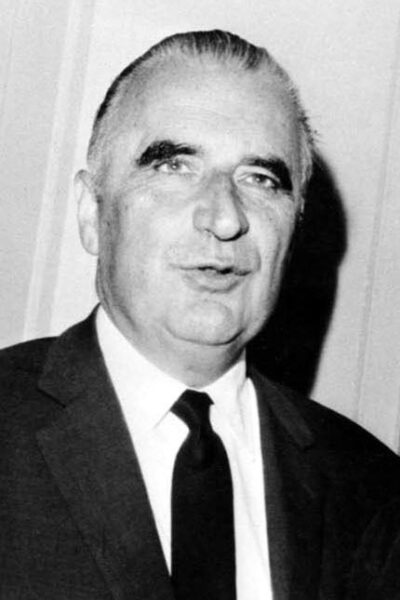
Georges Pompidou
Georges Pompidou was a President of France from 1969 to 1974. Born July 5, 1911, in Montboudif. Died April 2, 1974, in 4th arrondissement of Paris. Positions held include Prime Minister of France (1962–1968), President of the French Republic (1969–1974) and French co-prince of Andorra (1969–1974). Educated at Lycée Louis-le-Grand and École Normale Supérieure. Awards include Grand Cross of the Legion of Honour, Grand Cross of the National Order of Merit and Grand Master of the Legion of Honour.
Facts
42 facts · 2 confirmed by two sources · 6 cited · 33 from one source · 1 where the sources disagree
What’s different
- Cause of death: we show leukemia (Sources disagree). Wikidata also lists lymphoma
Where this comes from
Papalocal keeps its own record. It started from these sources; what each one said is kept here as it was copied, so a change on their side never changes this page by itself. Tap one to read its version.
What Wikidata says · copied November 16, 2026 · revision 2565223829
- Described as
- President of France from 1969 to 1974
- Other names
- Georges Jean Raymond Pompidou
- Born
- July 5, 1911 · 14 references
- Died
- April 2, 1974 · 14 references
- Born in
- Montboudif · 3 references
- Died in
- 4th arrondissement of Paris · 2 references
- Buried in
- Orvilliers
- Cause of death
- leukemia; lymphoma
- Name at birth
- Georges Jean Raymond Pompidou · 1 reference
- Citizen of
- France · 1 reference
- Occupation
- politician · 2 references; banker
- Positions held
- Prime Minister of France (1962–1968); President of the French Republic (1969–1974); French co-prince of Andorra (1969–1974)
- Political party
- Union of Democrats for the Republic (1968–1974); Union for the New Republic (1958–1968); Rally of the French People (1947–1955)
- Worked for
- N M Rothschild & Sons
- Education
- Lycée Louis-le-Grand; École Normale Supérieure; Paris Institute of Political Studies; lycée Pierre-de-Fermat · 1 reference
- Awards
- Grand Cross of the Legion of Honour; Grand Cross of the National Order of Merit; Grand Master of the Legion of Honour; Concours général (1927); Knight Grand Cross with Collar of the Order of Merit of the Italian Republic; Officer of the Legion of Honour · 1 reference; Knight of the Legion of Honour · 1 reference; Grand Cross of the Order of Polonia Restituta · 1 reference; Croix de guerre 1939–1945 · 1 reference; Order of the Gold Lion of the House of Nassau · 1 reference; National Order of Merit · 1 reference; Legion of Honour · 1 reference; Order of Merit of the Italian Republic · 1 reference
- Field
- politics
- Spouse
- Claude Pompidou
- Children
- Alain Pompidou
- Father
- Léon Pompidou
- Mother
- Marie-Louise Pompidou · 1 reference
- Siblings
- Madeleine Domerg
- Religion
- Catholic Church
- Military rank
- lieutenant
- Wikipedias with a page
- 143
Wikidata item Q2185 (wikidata.org/wiki/Q2185), public domain (CC0). Copied November 16, 2026.
What Wikipedia says · copied November 16, 2026 · revision 1383448047
Georges Jean Raymond Pompidou ( POMP-id-oo; French: [ʒɔʁʒ(ə) pɔ̃pidu] ; 5 July 1911 – 2 April 1974) was President of France from 1969 until his death in 1974. He had previously served from 1962 to 1968 as Prime Minister of France under President Charles de Gaulle, with whom he was closely associated throughout his career.
In the context of the strong growth of the last years of the Trente Glorieuses, Pompidou continued De Gaulle's policy of modernisation, which was symbolised by the presidential use of the Concorde, the creation of large industrial groups and the launch of the high-speed train project (TGV). The government invested heavily in the automobile, agribusiness, steel, telecommunications, nuclear and aerospace sectors and also created the minimum wage (SMIC) and the Ministry of the Environment.
His foreign policy was pragmatic but in line with the Gaullist principle of French autonomy within the Western Bloc. It was marked by a warming of relations with Richard Nixon's United States, close relations with Leonid Brezhnev's Soviet Union, the launch of the 'snake in the tunnel' and the relaunching of European construction by facilitating the United Kingdom's entry to the EEC in contrast to de Gaulle's opposition. Pompidou died in office in 1974 of Waldenström's disease, a rare form of blood cancer.
An admirer of contemporary art, Pompidou's name remains known worldwide for the Centre Pompidou, which he initiated and which was inaugurated in 1977; it subsequently spread the name with its branches in Metz (France), Málaga (Spain), Brussels (Belgium) and Shanghai (China). A Georges Pompidou Museum is also dedicated to him in his hometown.
- Born, in its opening lines
- July 5, 1911
- Died, in its opening lines
- April 2, 1974
From the Wikipedia article “Georges Pompidou” (en.wikipedia.org/wiki/Georges_Pompidou), by its contributors, under CC BY-SA 4.0 (creativecommons.org/licenses/by-sa/4.0/). Copied November 16, 2026; not changed.
Confirmed Two sources agree. Cited One source, and it names where it got it. One source One source, without a reference of its own. Sources disagree The sources disagree. We show the best-supported value and keep theirs below.
