
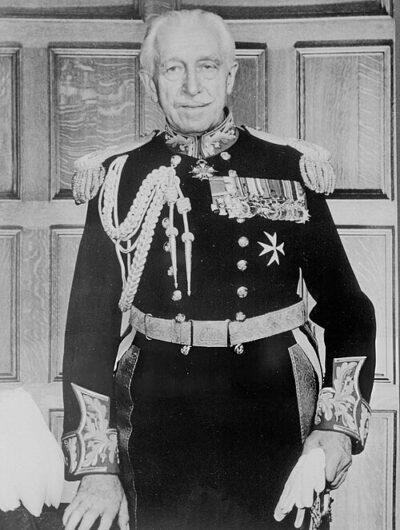
Georges Vanier
Georges Vanier was a Canadian governor general. Born April 23, 1888, in Montreal. Died March 5, 1967, in Ottawa. Positions held include Governor General of Canada (1959–1967), Member of the Privy Council of the United Kingdom and ambassador. Educated at Laval University and Université de Montréal. Awards include Military Cross, Distinguished Service Order and Legion of Honour.
Facts
41 facts · 2 confirmed by two sources · 3 cited · 36 from one source
Where this comes from
Papalocal keeps its own record. It started from these sources; what each one said is kept here as it was copied, so a change on their side never changes this page by itself. Tap one to read its version.
What Wikidata says · copied November 18, 2026 · revision 2565512377
- Described as
- Canadian governor general (1888–1967)
- Other names
- Georges-Philias Vanier, Georges P. Vanier, Georges-Philéas Vanier
- Born
- April 23, 1888 · 4 references
- Died
- March 5, 1967 · 5 references
- Born in
- Montreal
- Died in
- Ottawa
- Buried in
- Citadelle of Quebec · 1 reference
- Citizen of
- Canada
- Occupation
- diplomat; military personnel; politician · 1 reference; lawyer · 1 reference
- Positions held
- Governor General of Canada (1959–1967); Member of the Privy Council of the United Kingdom; ambassador
- Education
- Laval University; Université de Montréal · 1 reference; Faculté de droit de l'Université de Montréal · 1 reference; Loyola College; Balliol College
- Member of
- Académie des sciences, belles-lettres et arts de Rouen
- Awards
- Military Cross; Distinguished Service Order; Legion of Honour; Order of Saint John; King George VI Coronation Medal; Queen Elizabeth II Coronation Medal; 1939–45 Star; Africa Star; Inter-Allied Victory Medals; France and Germany Star; Sovereign Military Order of Malta; King George V Silver Jubilee Medal · 1 reference; Legion of Merit · 1 reference; honorary doctorate at the Laval University (1946) · 1 reference; doctor honoris causa from the University of Lyon (1946) · 1 reference
- Spouse
- Pauline Vanier
- Children
- Thérèse Vanier; Jean Vanier; Bernard Vanier
- Religion
- Catholicism
- Military branch
- Canadian Army · 1 reference
- Military rank
- major-general
- Wikipedias with a page
- 15
Wikidata item Q974089 (wikidata.org/wiki/Q974089), public domain (CC0). Copied November 18, 2026.
What Wikipedia says · copied November 18, 2026 · revision 1383939038
Georges-Philias Vanier (French: [ʒɔʁʒ(ə) vanje]; 23 April 1888 – 5 March 1967) was a Canadian military officer, diplomat, and statesman who served as the 19th governor general of Canada from 1959 to 1967, the first Quebecker and second Canadian-born person to hold the position.
Vanier was born and educated in Quebec. In 1906, he was valedictorian when he graduated with a BA from Loyola College. After earning a university degree in law, he served in the Canadian army during the First World War; on the European battlefields, he lost a leg and was commended for his actions with a number of decorations from King George V.
Subsequently, Vanier returned to Canada and remained in the military until the early 1930s, when he was posted to diplomatic missions in Europe. With the outbreak of the Second World War, Vanier once again became active in the military, commanding troops on the home front until the cessation of hostilities in 1945, whereupon he returned to diplomatic circles.
Vanier was appointed to replace Vincent Massey as governor general in 1959 by Queen Elizabeth II, on the recommendation of Canadian Prime Minister John Diefenbaker, and he occupied the post until his death in 1967. Vanier proved to be a popular governor general, with his war record earning respect from the majority of Canadians; however, as a Quebecer, he was met with hostility by Quebec separatists.
- Born, in its opening lines
- April 23, 1888
- Died, in its opening lines
- March 5, 1967
From the Wikipedia article “Georges Vanier” (en.wikipedia.org/wiki/Georges_Vanier), by its contributors, under CC BY-SA 4.0 (creativecommons.org/licenses/by-sa/4.0/). Copied November 18, 2026; not changed.
Confirmed Two sources agree. Cited One source, and it names where it got it. One source One source, without a reference of its own. Sources disagree The sources disagree. We show the best-supported value and keep theirs below.
