
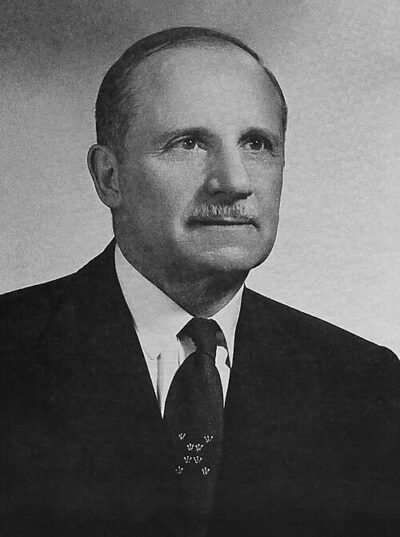
Georgios E. Mylonas
Georgios E. Mylonas was a Greek archaeologist. Born December 9, 1898, in İzmir. Died April 15, 1988, in Athens. Positions held include President of the Academy of Athens. Educated at Johns Hopkins University and National and Kapodistrian University of Athens. Awards include Guggenheim Fellowship and Gold Medal of the Archaeological Institute of America.
Facts
26 facts · 1 confirmed by two sources · 2 cited · 22 from one source · 1 where the sources disagree
What’s different
- Born: we show December 9, 1898 (Sources disagree). Wikipedia says December 21, 1898
Where this comes from
Papalocal keeps its own record. It started from these sources; what each one said is kept here as it was copied, so a change on their side never changes this page by itself. Tap one to read its version.
What Wikidata says · copied November 20, 2026 · revision 2568149640
- Described as
- Greek archaeologist (1898–1988)
- Other names
- George Emmanuel Mylonas
- Born
- December 9, 1898 · 2 references
- Died
- April 15, 1988 · 2 references
- Born in
- İzmir · 1 reference
- Died in
- Athens
- Buried in
- Cemetery of Agios Georgios
- Citizen of
- United States; Greece
- Occupation
- anthropologist; archaeologist · 1 reference; art historian; classical philologist; university teacher
- Positions held
- President of the Academy of Athens
- Worked for
- University of Chicago; University of Washington; American School of Classical Studies at Athens; Washington University in St. Louis (1933–1969); University of Illinois Urbana-Champaign
- Education
- Johns Hopkins University; National and Kapodistrian University of Athens
- Member of
- German Archaeological Institute; American Academy of Arts and Sciences; Academy of Athens
- Awards
- Guggenheim Fellowship (1955) · 1 reference; Gold Medal of the Archaeological Institute of America
- Military branch
- Hellenic Army
- Wikipedias with a page
- 10
Wikidata item Q1507264 (wikidata.org/wiki/Q1507264), public domain (CC0). Copied November 20, 2026.
What Wikipedia says · copied November 20, 2026 · revision 1379620523
George Emmanuel Mylonas (Greek: Γεώργιος Μυλωνάς, romanized: Georgios Mylonas, Greek pronunciation: [/ʝe'oɾʝios milo'nas/], ye-OR-yios mee-loh-NAS; 21 December [O.S. 9 December] 1898 – April 15, 1988) was a Greek archaeologist of ancient Greece and of Aegean prehistory. He excavated widely, particularly at Olynthus, Eleusis and Mycenae, where he made the first archaeological study and publication of Grave Circle B, the earliest known monumentalized burials at the site.
Mylonas was born in Smyrna, then part of the Ottoman Empire, and received an elite education. He enrolled in 1919 at the University of Athens to study classics, joined the Greek Army, and fought in the Greco-Turkish War of 1919–1922. He witnessed the destruction of Smyrna in September 1922, and was subsequently taken prisoner; he was recaptured after a brief escape, but was released in 1923 after bribing his captors with money sent by his American contacts.
In 1924, Mylonas began working for the American School of Classical Studies at Athens, with which he retained a lifelong association. He became its first bursar the following year, and took part in excavations at Corinth, Nemea, and Olynthus under its auspices. After receiving his Ph.D. from the University of Athens in 1927, he moved to Johns Hopkins University in the United States to study under David Moore Robinson, his excavation director from Olynthus. He subsequently taught at the University of Chicago. After a brief return to Greece, during which he taught at a gymnasium and made his first excavations at Eleusis, he was hired by the University of Illinois at Urbana-Champaign in 1931, before moving to Washington University in St. Louis in 1933, where he remained until returning permanently to Greece in 1969. There, he was prominent in the Archaeological Society of Athens and in efforts to conserve the monuments of the Acropolis of Athens.
Mylonas's excavation work included the sites of Pylos, Artemision, Mekyberna, Polystylos and Aspropotamos. Along with John Papadimitriou, he was given responsibility for the excavation of Mycenae's Grave Circle B in the early 1950s, and from 1957 until 1985 excavated on the citadel of the site. His excavations helped to establish the chronological relationships between Mycenae's structures, which had been excavated piecemeal over the preceding century, and to determine the religious function of the site's Cult Center, to which he gave its name. He was awarded the Order of George I, the Royal Order of the Phoenix and the Gold Medal of the Archaeological Institute of America, of which he was the first foreign-born president. His work at Mycenae has been credited with bringing coherence to the previously scattered and sporadically published record of excavation at the site. At the same time, his belief that ancient Greek mythical traditions, particularly concerning the Trojan War and the Eleusinian Mysteries, could be verified by archaeological excavation was controversial in his day and has generally been discredited since.
- Born, in its opening lines
- December 21, 1898
- Died, in its opening lines
- April 15, 1988
From the Wikipedia article “George E. Mylonas” (en.wikipedia.org/wiki/George_E._Mylonas), by its contributors, under CC BY-SA 4.0 (creativecommons.org/licenses/by-sa/4.0/). Copied November 20, 2026; not changed.
Confirmed Two sources agree. Cited One source, and it names where it got it. One source One source, without a reference of its own. Sources disagree The sources disagree. We show the best-supported value and keep theirs below.
