
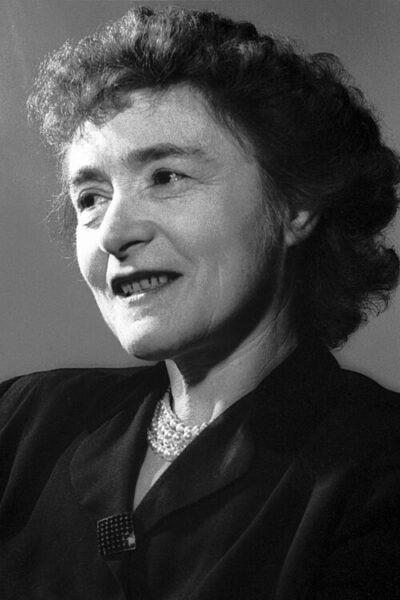
Gerty Cori
Gerty Cori was an Austro-Hungarian-American biochemist. Born August 15, 1896, in Prague. Died October 26, 1957, in St. Louis. Educated at German University in Prague and German University in Prague Medical School. Awards include Nobel Prize in Physiology or Medicine, National Women's Hall of Fame and Garvan–Olin Medal.
Facts
36 facts · 2 confirmed by two sources · 18 cited · 14 from one source · 2 where the sources disagree
What’s different
- Died in: we show St. Louis (Sources disagree). Wikidata also lists Glendale
- Cause of death: we show kidney failure (Sources disagree). Wikidata also lists myelofibrosis
Where this comes from
Papalocal keeps its own record. It started from these sources; what each one said is kept here as it was copied, so a change on their side never changes this page by itself. Tap one to read its version.
What Wikidata says · copied November 13, 2026 · revision 2563197256
- Described as
- Austro-Hungarian-American biochemist (1896–1957)
- Other names
- Gerty Theresa Cori, Gerty T. Cori, Gerty Theresa Radnitz
- Born
- August 15, 1896 · 12 references
- Died
- October 26, 1957 · 9 references
- Born in
- Prague · 4 references
- Died in
- Glendale · 1 reference; St. Louis · 2 references
- Buried in
- Bellefontaine Cemetery · 1 reference
- Cause of death
- myelofibrosis; kidney failure · 1 reference
- Name at birth
- Gerty Theresa Radnitz · 1 reference
- Citizen of
- Cisleithania; Czechoslovakia; United States (1928–)
- Occupation
- biochemist · 2 references; psychologist; physician · 1 reference; chemist; physiologist; researcher
- Worked for
- Washington University in St. Louis · 1 reference
- Education
- German University in Prague · 1 reference; German University in Prague Medical School · 1 reference
- Member of
- National Academy of Sciences (1948–) · 2 references; American Academy of Arts and Sciences; National Science Board (1950–1957) · 2 references; American Philosophical Society (1948–) · 1 reference
- Awards
- Nobel Prize in Physiology or Medicine (1947) · 3 references; National Women's Hall of Fame (1998) · 1 reference; Garvan–Olin Medal (1948) · 1 reference; Women in Technology Hall of Fame (1997) · 1 reference; Fellow of the American Academy of Arts and Sciences
- Field
- biochemistry · 2 references; medicine · 1 reference
- Spouse
- Carl Ferdinand Cori (1920–1957)
- Father
- Otto Radnitz
- Mother
- Marta Radnitzová
- Siblings
- Charlotte Schrötter-Radnitz
- Lived in
- United States; Cori House · 1 reference
- Wikipedias with a page
- 89
Wikidata item Q204733 (wikidata.org/wiki/Q204733), public domain (CC0). Copied November 13, 2026.
What Wikipedia says · copied November 13, 2026 · revision 1383231957
Gerty Theresa Cori (née Radnitz; August 15, 1896 – October 26, 1957) was a Czech and American biochemist who in 1947 was the third woman to win a Nobel Prize in science, and the first woman to be awarded the Nobel Prize in Physiology or Medicine, for her role in the "discovery of the course of the catalytic conversion of glycogen".
Cori was born in Prague, the capital of Bohemia within the Austro-Hungarian Empire. Growing up at a time when women were marginalized and allowed few educational opportunities, she gained admittance to medical school, where she met her future husband Carl Ferdinand Cori in an anatomy class. Upon their graduation in 1920, they married. Because of deteriorating conditions in Europe, the couple emigrated to the United States in 1922. Gerty Cori continued her early interest in medical research, collaborating in the laboratory with Carl. She published research coauthored with her husband, as well as publishing singly. Unlike her husband, she had difficulty securing research positions, and the ones she obtained provided meager pay. Her husband insisted on continuing their collaboration, though he was discouraged from doing so by the institutions that employed him.
Together with her husband Carl and Argentine physiologist Bernardo Houssay, Gerty Cori received the Nobel Prize in 1947 for the discovery of the mechanism by which glycogen—a polysaccharide made from glucose—is broken down in muscle tissue into lactic acid and then resynthesized in the body and stored as a source of energy (known as the Cori cycle). They also identified the important catalyzing compound, the Cori ester. The Coris were the third ever married couple to win the Nobel Prize. In 2004, both Gerty and Carl Cori were designated a National Historic Chemical Landmark in recognition of their work in clarifying carbohydrate metabolism.
In 1957, Gerty Cori died after a ten-year struggle with myelosclerosis. She remained active in the research laboratory until the end of her life. She received recognition for her achievements through multiple awards and honors.
- Born, in its opening lines
- August 15, 1896
- Died, in its opening lines
- October 26, 1957
From the Wikipedia article “Gerty Cori” (en.wikipedia.org/wiki/Gerty_Cori), by its contributors, under CC BY-SA 4.0 (creativecommons.org/licenses/by-sa/4.0/). Copied November 13, 2026; not changed.
Confirmed Two sources agree. Cited One source, and it names where it got it. One source One source, without a reference of its own. Sources disagree The sources disagree. We show the best-supported value and keep theirs below.
