
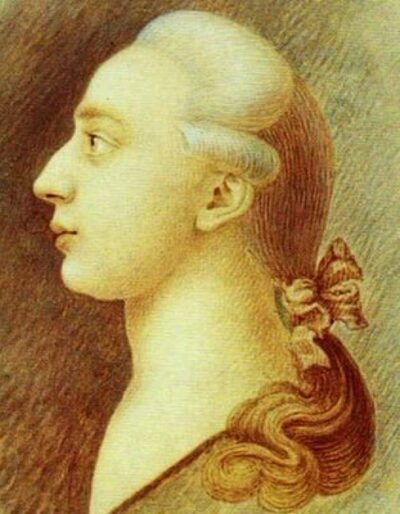
Giacomo Casanova
Giacomo Casanova was a Venetian adventurer and writer. Born April 2, 1725, in Venice. Died June 4, 1798, in Duchcov. Known for Histoire de ma vie and Story of my flight from the prisons of the Venetian Republic. Educated at University of Padua. Awards include Knight of the Golden Spur.
Facts
29 facts · 2 confirmed by two sources · 12 cited · 14 from one source · 1 where the sources disagree
What’s different
- Father: we show Gaetano Casanova (Sources disagree). Wikidata also lists Michele Grimani
Where this comes from
Papalocal keeps its own record. It started from these sources; what each one said is kept here as it was copied, so a change on their side never changes this page by itself. Tap one to read its version.
What Wikidata says · copied November 16, 2026 · revision 2569091824
- Described as
- Venetian adventurer and writer (1725–1798)
- Other names
- Giovanni Giacomo Casanova de Seingalt, Giacomo Girolamo Casanova di Seingalt, Jacques Casanova de Seingalt, Casanova de Seingalt, Джакомо Казанова, ג'אקומו קאזאנובה, Dzhiakomo Kasanova, Giacomo Girolamo Casanova De Seingalt, Jacques Casanova, Giovanni Giacomo Casanova, Casanova, Giacomo Girolamo Casanova
- Born
- April 2, 1725 · 14 references
- Died
- June 4, 1798 · 12 references
- Born in
- Venice · 3 references
- Died in
- Duchcov · 2 references
- Buried in
- Duchcov · 1 reference
- Name at birth
- Giacomo Girolamo Casanova · 1 reference
- Citizen of
- Republic of Venice
- Occupation
- translator; poet; librarian · 1 reference; banker; novelist; diplomat · 1 reference; writer · 3 references; adventurer · 2 references
- Education
- University of Padua (–1742)
- Instrument
- violin
- Known for
- Histoire de ma vie; Story of my flight from the prisons of the Venetian Republic
- Awards
- Knight of the Golden Spur · 1 reference
- Field
- creative and professional writing · 1 reference; diplomacy · 1 reference
- Children
- Leonilda Castelli; Cesarino Lanti
- Father
- Gaetano Casanova; Michele Grimani
- Mother
- Zanetta Farussi
- Siblings
- Francesco Giuseppe Casanova; Giovanni Battista Casanova · 1 reference
- Religion
- Catholic Church
- Wikipedias with a page
- 106
Wikidata item Q83321 (wikidata.org/wiki/Q83321), public domain (CC0). Copied November 16, 2026.
What Wikipedia says · copied November 16, 2026 · revision 1384493332
Giacomo Girolamo Casanova (; Italian: [ˈdʒaːkomo dʒiˈrɔːlamo kazaˈnɔːva, kasa-]; 2 April 1725 – 4 June 1798) was an Italian adventurer and writer who was born in the Republic of Venice and travelled extensively throughout Europe. He is chiefly remembered for his autobiography, written in French and published posthumously as Histoire de ma vie ("The Story of My Life"). That work has come to be regarded as a unique and provocative source of information on the customs and norms of European social life in the 18th century.
Born to a family of actors, Casanova studied law at the University of Padua and received minor orders in the Catholic Church with a view towards pursuing a career as a canon lawyer. However, he had no enthusiasm for the law or vocation for the church, and he soon abandoned those plans and launched instead upon an itinerant life as a gambler, violinist, confidence trickster, and man of letters. Throughout his life, Casanova obtained money and other advantages from various aristocratic patrons by pretending to possess alchemical, cabbalistic, and magical secret knowledge. Among other exploits, Casanova escaped from the Piombi prison, to which he had been confined by order of the Venetian Council of Ten for offenses against religion and morals, and later helped convince the authorities of the Kingdom of France to establish a state lottery as a source of revenue.
Casanova, who often misrepresented himself as an aristocrat, used a variety of pseudonyms, including Baron or Count of Farussi (his mother's maiden name) and the invented title Chevalier de Seingalt (French pronunciation: [sɛ̃ɡɑl]). After he began writing in French, following his second exile from Venice, he often signed his works as "Jacques Casanova de Seingalt". In his autobiography, Casanova reports encounters with popes, cardinals, and monarchs, as well as with major intellectual and artistic figures such as Voltaire, Goethe, and Mozart.
The most notorious aspect of Casanova's career are his many complicated sexual affairs with women, stretching from his early adolescence to his old age, which he described in detail in his autobiography. As a consequence of this, Casanova's name has become a byword for a male seducer and libertine, like "Lothario" or "Don Juan". He spent his final years in Bohemia, where he served as librarian to the household of Count Waldstein and resided at Dux Castle, where he wrote his autobiography.
- Born, in its opening lines
- April 2, 1725
- Died, in its opening lines
- June 4, 1798
From the Wikipedia article “Giacomo Casanova” (en.wikipedia.org/wiki/Giacomo_Casanova), by its contributors, under CC BY-SA 4.0 (creativecommons.org/licenses/by-sa/4.0/). Copied November 16, 2026; not changed.
Confirmed Two sources agree. Cited One source, and it names where it got it. One source One source, without a reference of its own. Sources disagree The sources disagree. We show the best-supported value and keep theirs below.
