
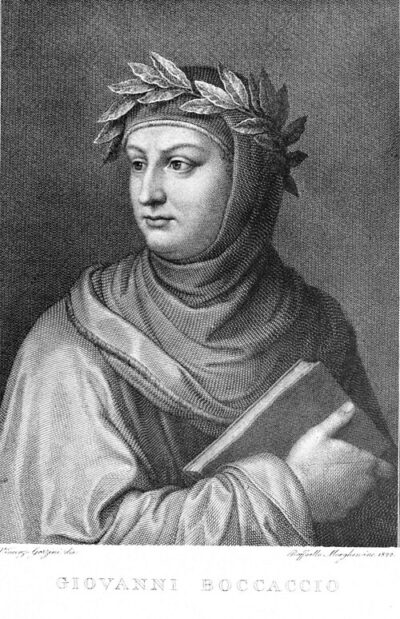
Giovanni Boccaccio
Giovanni Boccaccio was an Italian author and poet. Born 1313, in Florence. Died December 21, 1375, in Certaldo. Known for The Decameron, Elegia di Madonna Fiammetta and Buccolicum carmen.
Facts
24 facts · 2 confirmed by two sources · 5 cited · 17 from one source
Where this comes from
Papalocal keeps its own record. It started from these sources; what each one said is kept here as it was copied, so a change on their side never changes this page by itself. Tap one to read its version.
What Wikidata says · copied November 16, 2026 · revision 2565593830
- Described as
- Italian author and poet (1313–1375)
- Other names
- Joanni B. de Certaldo, Boccaccio, Boccace, Giovanni Boccace
- Born
- 1313 · 7 references
- Died
- December 21, 1375 · 8 references
- Born in
- Florence · 6 references
- Died in
- Certaldo · 10 references
- Buried in
- Santi Jacopo e Filippo
- Cause of death
- edema
- Citizen of
- Republic of Florence
- Occupation
- short story writer · 1 reference; poet · 3 references; diplomat; translator; biographer; mythographer; writer · 6 references
- Known for
- The Decameron; Elegia di Madonna Fiammetta; Buccolicum carmen; De casibus virorum illustrium; De mulieribus claris; De montibus; Genealogia deorum gentilium; Corbaccio; Il Filostrato; La caccia di Diana
- Wikipedias with a page
- 151
Wikidata item Q1402 (wikidata.org/wiki/Q1402), public domain (CC0). Copied November 16, 2026.
What Wikipedia says · copied November 16, 2026 · revision 1385562600
Giovanni Boccaccio (16 June 1313 – 21 December 1375) was an Italian writer, poet, correspondent of Petrarch, and an important Renaissance humanist. Born in the town of Certaldo, he gained sufficient notoriety to be known simply as "the Certaldese". Boccaccio ranked among the most important figures in the European literary panorama of the fourteenth century. Some scholars (including Vittore Branca) define him as the greatest European prose writer of his time, a versatile writer who amalgamated different literary trends and genres, making them converge in original works, thanks to a creative activity exercised under the banner of experimentalism.
His most notable works are The Decameron, a collection of short stories, and On Famous Women. The Decameron became a determining element for the Italian literary tradition, especially after Pietro Bembo elevated the Boccaccian style to a model of Italian prose in the sixteenth century. Boccaccio wrote his imaginative literature mostly in Tuscan vernacular, as well as other works in Latin, and is particularly noted for his realistic dialogue that differed from that of his contemporaries, medieval writers who usually followed formulaic models for character and plot. The influence of Boccaccio's works was not limited to the Italian cultural scene, but extended to the rest of Europe, exerting influence on authors such as Geoffrey Chaucer, a key figure in English literature, and the later writers Miguel de Cervantes, Lope de Vega, and classical theatre in Spain.
Boccaccio is considered one of the "Three Crowns" of Italian literature along with Dante Alighieri and Petrarch. He is remembered for being one of the precursors of humanism, of which he helped lay the foundations in the city of Florence, in conjunction with the activity of his friend and teacher, Petrarch. He was the one who initiated Dante's criticism and philology: Boccaccio devoted himself to copying codices of the Divine Comedy and was a promoter of Dante's work and figure.
In the twentieth century, Boccaccio was the subject of critical-philological studies by Vittore Branca and Giuseppe Billanovich, and his Decameron was transposed to the big screen by the director and writer Pier Paolo Pasolini.
- Born, in its opening lines
- June 16, 1313
- Died, in its opening lines
- December 21, 1375
From the Wikipedia article “Giovanni Boccaccio” (en.wikipedia.org/wiki/Giovanni_Boccaccio), by its contributors, under CC BY-SA 4.0 (creativecommons.org/licenses/by-sa/4.0/). Copied November 16, 2026; not changed.
Confirmed Two sources agree. Cited One source, and it names where it got it. One source One source, without a reference of its own. Sources disagree The sources disagree. We show the best-supported value and keep theirs below.
