
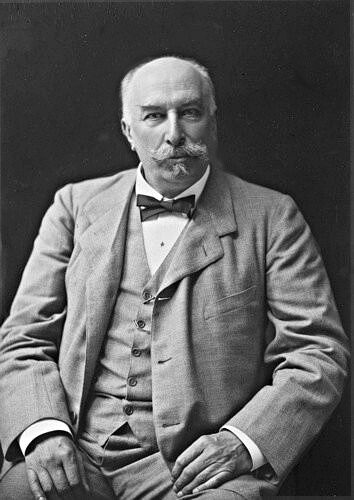
Giovanni Giolitti
Giovanni Giolitti was an Italian statesman. Born October 27, 1842, in Mondovì. Died July 17, 1928, in Cavour. Positions held include Prime Minister of the Kingdom of Italy (4 times) (1892–1921), minister of Interior of the Kingdom of Italy (4 times) (1892–1921) and minister of Public Works of the Kingdom of Italy (2 times) (1893–1907). Educated at University of Turin. Awards include Knight of the Seraphim, Order of St. Andrew and Knight Grand Cross of the Order of Saints Maurice and Lazarus.
Facts
32 facts · 2 confirmed by two sources · 8 cited · 22 from one source
Where this comes from
Papalocal keeps its own record. It started from these sources; what each one said is kept here as it was copied, so a change on their side never changes this page by itself. Tap one to read its version.
What Wikidata says · copied November 16, 2026 · revision 2568027041
- Described as
- Italian statesman (1842–1928)
- Born
- October 27, 1842 · 6 references
- Died
- July 17, 1928 · 10 references
- Born in
- Mondovì · 2 references
- Died in
- Cavour · 2 references
- Buried in
- cemetery of Cavour · 1 reference
- Name at birth
- Giovanni Giolitti
- Citizen of
- Kingdom of Italy (1861–)
- Occupation
- politician · 1 reference; statesperson · 1 reference
- Positions held
- Prime Minister of the Kingdom of Italy (4 times) (1892–1921); minister of Interior of the Kingdom of Italy (4 times) (1892–1921); minister of Public Works of the Kingdom of Italy (2 times) (1893–1907); minister of Justice of the Kingdom of Italy (1893); minister of Finance of the Kingdom of Italy (1890); minister of Treasury of the Kingdom of Italy (1889–1890); minister of the Navy of the Kingdom of Italy (1903–1904); member of the Chamber of Deputies of the Kingdom of Italy (1882–1929) · 1 reference
- Political party
- Historical Left · 1 reference; Italian Liberal Party · 1 reference
- Education
- University of Turin
- Awards
- Knight of the Seraphim (1911) · 1 reference; Order of St. Andrew; Knight Grand Cross of the Order of Saints Maurice and Lazarus (1904); Knight of the Order of the Most Holy Annunciation (1904); Order of Saint Stephen of Hungary · 1 reference; Knight of the Order of St. Alexander Nevsky · 1 reference; Knight grand cross of the order of the crown of Italy (1904); Knight Grand Cross of the Colonial Order of the Star of Italy (1920)
- Field
- politics · 1 reference
- Children
- Enrichetta Chiaraviglio-Giolitti; Maria Giolitti
- Religion
- Catholic Church
- Wikipedias with a page
- 49
Wikidata item Q297190 (wikidata.org/wiki/Q297190), public domain (CC0). Copied November 16, 2026.
What Wikipedia says · copied November 16, 2026 · revision 1383892482
Giovanni Giolitti (Italian pronunciation: [dʒoˈvanni dʒoˈlitti]; 27 October 1842 – 17 July 1928) was an Italian statesman who was the prime minister of Italy five times between 1892 and 1921. He is the longest-serving democratically elected prime minister in Italian history, and the second-longest serving overall after Benito Mussolini. A prominent leader of the Historical Left and the Liberals, he is widely considered one of the most wealthy, powerful and important politicians in Italian history; due to his dominant position in Italian politics, Giolitti was accused by critics of being an authoritarian leader and a parliamentary dictator.
Giolitti was a master in the political art of trasformismo, the method of making a flexible and centrist coalition of government which isolated the extremes of the Left and the Historical Right in Italian politics after the unification. Under his influence, the Liberals did not develop as a structured party and were a series of informal personal groupings with no formal links to political constituencies. The period between the start of the 20th century and the start of World War I, when he was prime minister and Minister of the Interior from 1901 to 1914, with only brief interruptions, is often referred to as the "Giolittian Era".
A liberal, with strong ethical concerns, Giolitti's periods in office were notable for the passage of a wide range of progressive social reforms, together with the enactment of several policies of government intervention. Besides putting in place several tariffs, subsidies, and government projects, Giolitti also nationalized the private telephone and railroad operators. Liberal proponents of free trade criticized the "Giolittian System", although Giolitti himself saw the development of the national economy as essential in the production of wealth.
The primary focus of Giolittian politics was to rule from the centre with slight and well-controlled fluctuations between conservatism and progressivism, trying to preserve the institutions and the existing social order. Right-wing critics like Luigi Albertini considered him a socialist due to the courting of leftist votes in Parliament in exchange for political favours, while left-wing critics like Gaetano Salvemini accused him of being a corrupt politician and of winning elections with the support of criminals. Nonetheless, his highly complex legacy continues to stimulate intense debate among writers and historians.
- Born, in its opening lines
- October 27, 1842
- Died, in its opening lines
- July 17, 1928
From the Wikipedia article “Giovanni Giolitti” (en.wikipedia.org/wiki/Giovanni_Giolitti), by its contributors, under CC BY-SA 4.0 (creativecommons.org/licenses/by-sa/4.0/). Copied November 16, 2026; not changed.
Confirmed Two sources agree. Cited One source, and it names where it got it. One source One source, without a reference of its own. Sources disagree The sources disagree. We show the best-supported value and keep theirs below.
