
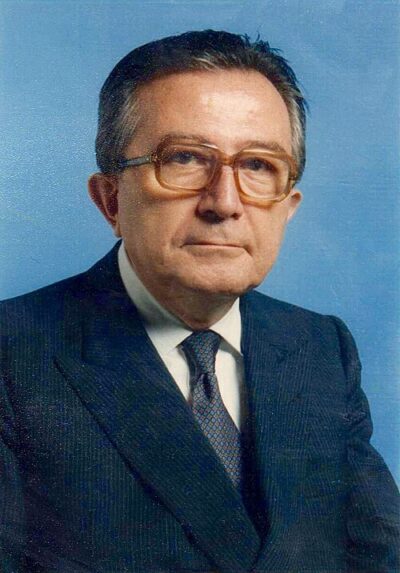
Giulio Andreotti
Giulio Andreotti was an Italian politician and statesman. Born January 14, 1919, in Rome. Died May 6, 2013, in Rome. Positions held include Italian senator for life (1991–2013), Prime Minister of Italy (3 times) (1972–1992) and member of the Senate of the Italian Republic (1991–2013). Educated at Sapienza University of Rome. Awards include Knight Grand Cross of the Order of the Falcon, Grand Cross of the Order of Prince Henry and Order of Merit (South Tyrol).
Facts
62 facts · 2 confirmed by two sources · 12 cited · 48 from one source
Where this comes from
Papalocal keeps its own record. It started from these sources; what each one said is kept here as it was copied, so a change on their side never changes this page by itself. Tap one to read its version.
What Wikidata says · copied November 16, 2026 · revision 2569158102
- Described as
- Italian politician and statesman (1919–2013)
- Born
- January 14, 1919 · 11 references
- Died
- May 6, 2013 · 9 references
- Born in
- Rome · 3 references
- Died in
- Rome · 2 references
- Buried in
- Campo Verano · 1 reference
- Cause of death
- acute respiratory distress syndrome
- Name at birth
- Giulio Andreotti
- Citizen of
- Italy (1946–); Kingdom of Italy (–1946)
- Occupation
- writer · 1 reference; politician · 2 references; diplomat; reporter; journalist · 1 reference
- Positions held
- Italian senator for life (1991–2013); Prime Minister of Italy (3 times) (1972–1992); member of the Senate of the Italian Republic (1991–2013); Undersecretary to the Presidency of the Council (1947–1954); Minister of Treasury (1958–1959); Italian Minister of Foreign Affairs (1983–1989); Italian Minister of the Interior (2 times) (1954–1978); Italian Minister of Defence (2 times) (1959–1974); Italian Minister of Economic Development (1966–1968); Minister of state investments (2 times) (1972–1992); שר המורשת התרבותית והסביבתית (2 times) (1979–1992); Italian minister for EU Affairs (1987); Minister of Budget (2 times) (1974–1979); minister without portfolio responsible for extraordinary measures in the South of the Italy (1974–1976); Italian Finance Minister (1955–1958)
- Political party
- Christian Democracy; Italian People's Party; European Democracy; Union of the Centre
- Education
- Sapienza University of Rome
- Member of
- Chamber of Deputies of Italy; Pontifical Academia Mariana Internationalis; Equestrian Order of the Holy Sepulchre; Academia Latinitati Fovendae (1990–); Parliamentary Assembly of the Council of Europe; National Council of the Kingdom of Italy; Accademia delle Arti del Disegno
- Awards
- Knight Grand Cross of the Order of the Falcon; Grand Cross of the Order of Prince Henry (1990) · 2 references; Order of Merit (South Tyrol); Grand Cross of the Order of Isabella the Catholic (1985) · 1 reference; Gold Olympic Order (1990) · 1 reference; Robert Schuman Medal (1987); Knight Grand Cross in the Order of the Holy Sepulchre; Ischia International Journalism Award (1987); Knight of the Military Order of Italy; Knight Grand Cross with Collar of the Order of Merit of the Italian Republic; Grand Cross of the Order of Merit of Portugal (1987) · 2 references; Grand Cross 1st class of the Order of Merit of the Federal Republic of Germany; honorary doctor of the Peking University (1991) · 1 reference; Grand Cross of the Military Order of Christ (1990) · 1 reference; Grand Cross of Naval Merit with white badge (1959) · 1 reference
- Spouse
- Livia Andreotti (1945–) · 1 reference
- Children
- Lamberto Andreotti; Serena Andreotti · 1 reference
- Religion
- Catholicism
- Lived in
- Rome
- Website
- https://www.giulioandreotti.org
- Wikipedias with a page
- 87
Wikidata item Q50005 (wikidata.org/wiki/Q50005), public domain (CC0). Copied November 16, 2026.
What Wikipedia says · copied November 16, 2026 · revision 1385918772
Giulio Andreotti (US: AHN-dray-OT-ee; Italian: [ˈdʒuːljo andreˈɔtti]; 14 January 1919 – 6 May 2013) was an Italian politician and statesman who served as the 41st prime minister of Italy in seven governments (1972–1973, 1976–1979, and 1989–1992). He was leader of the Christian Democracy party and its conservative faction; he was the sixth-longest-serving prime minister since the Italian unification and the second-longest-serving post-war prime minister. Andreotti is widely considered the most powerful and prominent politician of the First Republic.
Beginning as a protégé of Alcide De Gasperi, Andreotti achieved cabinet rank at a young age and occupied all the major offices of the state over the course of a 40-year political career, being seen as a reassuring figure by the civil service, the business community, and the Vatican. Domestically, he contained inflation following the 1973 oil crisis, founded the National Healthcare Service (Sistema Sanitario Nazionale) and combated terrorism during the Years of Lead. In foreign policy, he guided Italy's European Union integration and established closer relations with the Arab world. Admirers of Andreotti saw him as having mediated political and social contradictions, enabling the transformation of a substantially rural country into the world's fifth-largest economy. Critics said he had done nothing to challenge a system of patronage that had led to pervasive corruption. Andreotti staunchly supported the Vatican and a capitalist structure and opposed the Italian Communist Party. Following the popular Italian sentiment of the time, he supported the development of a strong European community playing host to neoliberal economics. He was not opposed to the implementation of the European Social Fund and the European Regional Development Fund in building the European economy.
At the height of his career as a statesman, Andreotti was subjected to criminal prosecutions and charged with colluding with Cosa Nostra. Courts managed to prove that he was undoubtedly linked with them until 1980; however, the case was closed due to past statutes of limitations. The most sensational allegation came from prosecutors in Perugia, who charged him with ordering the murder of a journalist. He was found guilty at trial, which led to complaints that the justice system had "gone mad". After being acquitted of all charges, in part due to statute-barred limitations, Andreotti remarked: "Apart from the Punic Wars, for which I was too young, I have been blamed for everything that's happened in Italy."
In addition to his prime ministerial posts, Andreotti served in numerous ministerial positions, among them as Minister of the Interior (1954 and 1978), Minister of Finance (1955–1958), Minister of Treasury (1958–1959), Minister of Defence (1959–1966 and 1974), Minister of Budget and Economic Planning (1974–1976), and Minister of Foreign Affairs (1983–1989), and was a senator for life from 1991 until his death in 2013. He was also a journalist and author. Andreotti was sometimes called Divo Giulio (from Latin Divus Iulius, "Divine Julius", an epithet of Julius Caesar after his posthumous deification), or simply Il divo.
- Born, in its opening lines
- January 14, 1919
- Died, in its opening lines
- May 6, 2013
From the Wikipedia article “Giulio Andreotti” (en.wikipedia.org/wiki/Giulio_Andreotti), by its contributors, under CC BY-SA 4.0 (creativecommons.org/licenses/by-sa/4.0/). Copied November 16, 2026; not changed.
Confirmed Two sources agree. Cited One source, and it names where it got it. One source One source, without a reference of its own. Sources disagree The sources disagree. We show the best-supported value and keep theirs below.
