
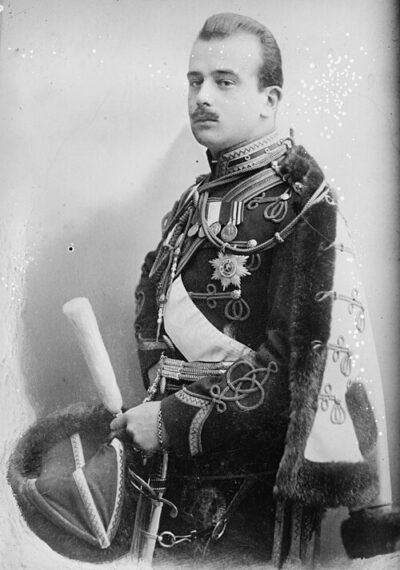
Grand Duke Boris Vladimirovich of Russia
Grand Duke Boris Vladimirovich of Russia was a Russian grand duke (1877–1943); son of Grand Duke Vladimir Alexandrovich of Russia, a grandson of Tsar Alexander II of Russia, and a first cousin of Tsar Nicholas II. Born November 12, 1877, in Pushkin. Died November 9, 1943, in Paris. Educated at Nikolaevskaya Cavalry School. Awards include Knight of the Order of St. Alexander Nevsky, Order of Saint Anna, 1st class and Order of Saint Stanislaus, 1st class.
Facts
25 facts · 1 confirmed by two sources · 0 cited · 23 from one source · 1 where the sources disagree
What’s different
- Born: we show November 12, 1877 (Sources disagree). Wikipedia says November 24, 1877
Where this comes from
Papalocal keeps its own record. It started from these sources; what each one said is kept here as it was copied, so a change on their side never changes this page by itself. Tap one to read its version.
What Wikidata says · copied November 18, 2026 · revision 2553678237
- Described as
- Russian grand duke (1877–1943); son of Grand Duke Vladimir Alexandrovich of Russia, a grandson of Tsar Alexander II of Russia, and a first cousin of Tsar Nicholas II
- Other names
- Boris Vladimirovich of Russia, Boris Vladimirovich Romanov, Boris Romanov
- Born
- November 12, 1877
- Died
- November 9, 1943 · 1 reference
- Born in
- Pushkin · 1 reference
- Died in
- Paris
- Buried in
- Chapelle Saint-Vladimir-et-Sainte-Marie-Madeleine de Contrexéville
- Cause of death
- disease
- Citizen of
- Russian Empire
- Occupation
- military personnel
- Education
- Nikolaevskaya Cavalry School
- Awards
- Knight of the Order of St. Alexander Nevsky; Order of Saint Anna, 1st class; Order of Saint Stanislaus, 1st class; Order of St. Vladimir, 4th class; Order of St. Andrew; Order of St. George, 4th class
- Spouse
- Zinaida Rashevskaya (1919–) · 1 reference
- Children
- Boris Lacroix
- Father
- Grand Duke Vladimir Alexandrovich of Russia · 1 reference
- Mother
- Duchess Marie of Mecklenburg-Schwerin
- Siblings
- Grand Duchess Elena Vladimirovna of Russia; Grand Duke Kirill Vladimirovich of Russia; Grand Duke Alexander Vladimirovich of Russia; Grand Duke Andrei Vladimirovich of Russia
- Military branch
- Imperial Russian Army · 1 reference
- Military rank
- general · 1 reference
- Wikipedias with a page
- 20
Wikidata item Q373048 (wikidata.org/wiki/Q373048), public domain (CC0). Copied November 18, 2026.
What Wikipedia says · copied November 18, 2026 · revision 1375169653
Grand Duke Boris Vladimirovich of Russia (Russian: Борис Владимирович; 24 November 1877 – 9 November 1943) was a son of Grand Duke Vladimir Alexandrovich of Russia, a grandson of Tsar Alexander II of Russia and a first cousin of Tsar Nicholas II.
He followed a military career. After graduating from the Nicholas Cavalry College in 1896, he served as cornet in the Life Guards Hussar regiment. He took part in the Russo-Japanese War in 1904 and became a major general in the Russian Army in 1914. During World War I, he commanded the regiment of the Ataman Cossacks in 1915. He was known in Imperial Russia for his restless behavior and as a notorious playboy.
After the fall of the Russian monarchy, he was put under house arrest in Petrograd by the provisional government in March 1917, but he managed to escape the former Imperial capital in September that year and joined his mother and younger brother in the Caucasus. He departed revolutionary Russia in March 1919 with his longtime mistress, whom he married in exile. Eventually, he settled in France where he spent the rest of his life. He died in Occupied Paris in 1943.
- Born, in its opening lines
- November 24, 1877
- Died, in its opening lines
- November 9, 1943
From the Wikipedia article “Grand Duke Boris Vladimirovich of Russia” (en.wikipedia.org/wiki/Grand_Duke_Boris_Vladimirovich_of_Russia), by its contributors, under CC BY-SA 4.0 (creativecommons.org/licenses/by-sa/4.0/). Copied November 18, 2026; not changed.
Confirmed Two sources agree. Cited One source, and it names where it got it. One source One source, without a reference of its own. Sources disagree The sources disagree. We show the best-supported value and keep theirs below.
