
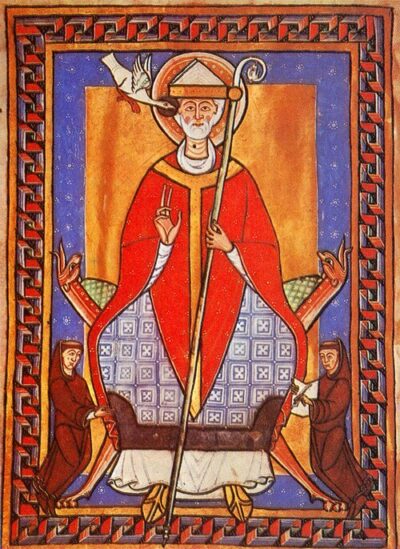
Gregory I
Gregory I was the 6th-century Roman Pope, theologian and Church Father, Catholic and Orthodox saint, 64th Bishop of Rome and Doctor of the Church. Born 540, in Rome. Died March 12, 604, in Rome. Positions held include Pope (590–604) and papal apocrisiarius to Constantinople. Known for Dialogi, Registrum Gregorii and Pastoral Care.
Facts
23 facts · 2 confirmed by two sources · 8 cited · 13 from one source
Where this comes from
Papalocal keeps its own record. It started from these sources; what each one said is kept here as it was copied, so a change on their side never changes this page by itself. Tap one to read its version.
What Wikidata says · copied November 16, 2026 · revision 2567580946
- Described as
- 6th-century Roman Pope, theologian and Church Father, Catholic and Orthodox saint, 64th Bishop of Rome and Doctor of the Church
- Other names
- Saint Gregorius Magnus, St Gregory I, Saint Gregory the Dialogist, Saint Gregory the Great, St Gregory, St Gregory the Great, Gregorius Magnus, St. Gregory the Dialogist, Pope Gregory the Great, Pope Saint Gregory I, Gregorius Anicius, Pope St. Gregory I
- Born
- 540 · 2 references; 540 · 1 reference
- Died
- March 12, 604 · 3 references
- Born in
- Rome · 1 reference
- Died in
- Rome · 2 references
- Buried in
- St. Peter's Basilica
- Occupation
- diplomat; Latin Catholic priest; writer · 1 reference; Doctor of the Church · 1 reference; monk · 1 reference
- Positions held
- Pope (590–604) · 2 references; papal apocrisiarius to Constantinople
- Known for
- Dialogi; Registrum Gregorii; Pastoral Care; Moralia in Job; Omelie super Ezechielem; Expositio in librum primum Regum; Expositio super Cantica Canticorum
- Father
- Gordianus · 1 reference
- Mother
- Saint Silvia
- Religion
- Catholic Church · 1 reference
- Lived in
- Rome
- Wikipedias with a page
- 112
Wikidata item Q42827 (wikidata.org/wiki/Q42827), public domain (CC0). Copied November 16, 2026.
What Wikipedia says · copied November 16, 2026 · revision 1385794971
Pope Gregory I (Latin: Gregorius I; Gregorio I; c. 540 – 12 March 604), commonly known as Saint Gregory the Great (Latin: Sanctus Gregorius Magnus; Italian: San Gregorio Magno), was the 64th Bishop of Rome from 3 September 590 until his death on 12 March 604.
Gregory was originally from Rome, a Roman senator's son, and himself the prefect of Rome at 30. He lived in a monastery that he established on his family estate before becoming a papal ambassador and then pope. During his papacy, his administration greatly surpassed that of the emperors Maurice and Theodosius in improving the welfare of the people of Rome. Gregory regained papal authority in Spain and France and sent missionaries to England, including Augustine of Canterbury and Paulinus of York. Gregory saw Franks, Lombards, and Visigoths align with Rome in religion from their Arian Christian alliances. The realignment of barbarian allegiance to Rome shaped medieval Europe. He also combated the Donatist heresy, popular particularly in North Africa at the time.
Gregory is also well known for his writings, which were more prolific than those of any of the previous popes. The epithet Saint Gregory the Dialogist has been attached to him in Eastern Christianity because of his Dialogues. Throughout the Middle Ages, he was known as "the Father of Christian Worship" because of his exceptional efforts in revising the Roman worship of his day. His contributions to the development of the Divine Liturgy of the Presanctified Gifts, still in use in the Byzantine Rite, were so significant that he is generally recognized as its de facto author.
Gregory is honored, along with Augustine, Jerome and Ambrose, as one of the four Great Latin Church Fathers. Immediately after his death, Gregory was canonized by popular acclaim. He is the second of the three Popes listed in the Annuario Pontificio with the title "the Great", alongside Popes Leo I and Nicholas I.
- Born, in its opening lines
- c. 540
- Died, in its opening lines
- March 12, 604
From the Wikipedia article “Pope Gregory I” (en.wikipedia.org/wiki/Pope_Gregory_I), by its contributors, under CC BY-SA 4.0 (creativecommons.org/licenses/by-sa/4.0/). Copied November 16, 2026; not changed.
Confirmed Two sources agree. Cited One source, and it names where it got it. One source One source, without a reference of its own. Sources disagree The sources disagree. We show the best-supported value and keep theirs below.
