
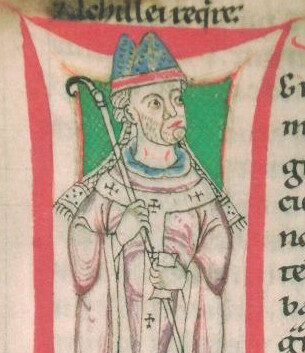
Gregory VII
Gregory VII was a Pope of the Catholic Church from 1073 to 1085. Born 11th century, in Sovana. Died May 25, 1085, in Salerno. Positions held include cardinal (1059–), Pope (1073–1085) and cardinal-deacon.
Facts
15 facts · 1 confirmed by two sources · 5 cited · 8 from one source · 1 where the sources disagree
What’s different
- Born: we show 11th century (Sources disagree). Wikipedia says c. 1015
Where this comes from
Papalocal keeps its own record. It started from these sources; what each one said is kept here as it was copied, so a change on their side never changes this page by itself. Tap one to read its version.
What Wikidata says · copied November 16, 2026 · revision 2568964194
- Described as
- Pope of the Catholic Church from 1073 to 1085
- Other names
- Ildebrando da Soana, Pope Gregory VII, Hildebrand, Hildebrand of Sovana, Pope Saint Gregory VII, Gregorius VII, Ildebrando di Soana
- Born
- 11th century
- Died
- May 25, 1085 · 2 references
- Born in
- Sovana
- Died in
- Salerno · 1 reference
- Buried in
- Salerno Cathedral
- Name at birth
- Ildebrando di Soana
- Occupation
- diplomat; Catholic priest; writer · 1 reference; Latin Catholic monk
- Positions held
- cardinal (1059–) · 1 reference; Pope (1073–1085) · 1 reference; cardinal-deacon; Abbot of Saint Paul Outside the Walls
- Religion
- Catholic Church · 1 reference
- Wikipedias with a page
- 91
Wikidata item Q133063 (wikidata.org/wiki/Q133063), public domain (CC0). Copied November 16, 2026.
What Wikipedia says · copied November 16, 2026 · revision 1379371758
Pope Gregory VII (Latin: Gregorius VII; c. 1015 – 25 May 1085), born Hildebrand of Sovana (Italian: Ildebrando di Soana), was head of the Catholic Church and ruler of the Papal States from 22 April 1073 to his death in 1085. He is venerated as a saint in the Catholic Church.
One of the great reforming popes, he initiated the Gregorian Reform, and is perhaps best known for the part he played in the Investiture Controversy, his dispute with Emperor Henry IV to establish the primacy of papal authority and the new canon law governing the election of the pope by the College of Cardinals. He was also at the forefront of developments in the relationship between the Holy Roman Emperor and the papacy in the years preceding his election as pope. He was the first pope to introduce a policy of obligatory celibacy for the clergy, which had until then commonly married, and also attacked the practice of simony.
During the power struggles between the papacy and the Empire, Gregory excommunicated Henry IV three times, and Henry appointed Antipope Clement III to oppose him. Although Gregory was hailed as one of the greatest of the Roman pontiffs after his reforms proved successful, during his own reign, he was denounced by some for his autocratic exercise of papal power.
In later times, Gregory VII became an exemplar of papal supremacy to both supporters and opponents of the papacy. Beno of Santi Martino e Silvestro, who opposed Gregory VII in the Investiture Controversy, accused him of necromancy, cruelty, tyranny, and blasphemy. This was eagerly repeated by later opponents of the Catholic Church, such as the English Protestant John Foxe. In contrast, the modern historian and Anglican priest H. E. J. Cowdrey writes, "[Gregory VII] was surprisingly flexible, feeling his way and therefore perplexing both rigorous collaborators ... and cautious and steady-minded ones ... His zeal, moral force, and religious conviction, however, ensured that he should retain to a remarkable degree the loyalty and service of a wide variety of men and women."
- Born, in its opening lines
- c. 1015
- Died, in its opening lines
- May 25, 1085
From the Wikipedia article “Pope Gregory VII” (en.wikipedia.org/wiki/Pope_Gregory_VII), by its contributors, under CC BY-SA 4.0 (creativecommons.org/licenses/by-sa/4.0/). Copied November 16, 2026; not changed.
Confirmed Two sources agree. Cited One source, and it names where it got it. One source One source, without a reference of its own. Sources disagree The sources disagree. We show the best-supported value and keep theirs below.
