
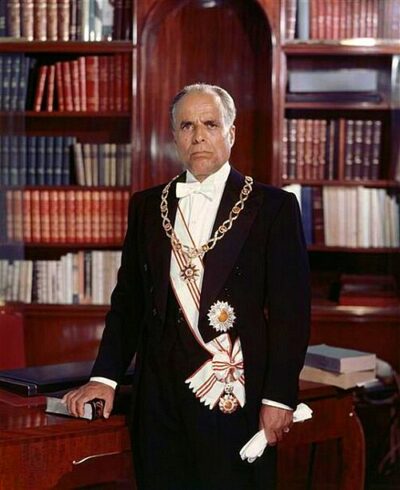
Habib Bourguiba
Habib Bourguiba was a Tunisian politician. Born August 3, 1903, in Monastir. Died April 6, 2000, in Monastir. Positions held include Speaker of the Assembly of the Representatives of the People (1956), President of Tunisia (1957–1987) and Prime Minister of Tunisia (1956–1957). Educated at University of Paris and Carnot high school Tunis. Awards include Collar of the Order of Isabella the Catholic, Knight Grand Cross with Collar of the Order of Saint Olav and Order of the Republic.
Facts
36 facts · 2 confirmed by two sources · 10 cited · 24 from one source
Where this comes from
Papalocal keeps its own record. It started from these sources; what each one said is kept here as it was copied, so a change on their side never changes this page by itself. Tap one to read its version.
What Wikidata says · copied November 16, 2026 · revision 2567936033
- Described as
- Tunisian politician (1903–2000)
- Other names
- Habib Ben Ali Bourguiba
- Born
- August 3, 1903 · 10 references
- Died
- April 6, 2000 · 10 references
- Born in
- Monastir · 3 references
- Died in
- Monastir · 2 references
- Buried in
- Bourguiba Mausoleum
- Citizen of
- French protectorate of Tunisia (–1956); Tunisia (1956–)
- Occupation
- politician · 2 references; lawyer
- Positions held
- Speaker of the Assembly of the Representatives of the People (1956); President of Tunisia (1957–1987); Prime Minister of Tunisia (1956–1957); Minister of Foreign Affairs (1956–1957); Minister of Defence (1956–1957) · 1 reference
- Political party
- Neo Destour
- Education
- University of Paris; Carnot high school Tunis; Sadiki College
- Awards
- Collar of the Order of Isabella the Catholic (1983) · 2 references; Knight Grand Cross with Collar of the Order of Saint Olav (1963–) · 1 reference; Order of the Republic; Order of Independence; Knight of the Order of the Elephant (1963); Grand Cross with Collar of the Order of the White Rose of Finland (1963) · 1 reference; Knight Grand Cross with Collar of the Order of Merit of the Italian Republic (1962) · 1 reference; Royal Order of the Seraphim; honorary doctor of Sofia University; Collar of the Spanish Order of the Civil Merit (1968) · 1 reference; Honorary doctor of Lebanese University; Grand Cross of the Order of Wissam Alaouite (1957)
- Spouse
- Wassila Ben Ammar · 2 references; Moufida Bourguiba
- Children
- Habib Bourguiba, Jr.; Hajer · 1 reference
- Religion
- Islam
- Website
- https://www.bourguiba.com
- Wikipedias with a page
- 79
Wikidata item Q643348 (wikidata.org/wiki/Q643348), public domain (CC0). Copied November 16, 2026.
What Wikipedia says · copied November 16, 2026 · revision 1382592511
Habib Bourguiba (3 August 1903 – 6 April 2000) was a Tunisian politician and statesman who served as the prime minister of the Kingdom of Tunisia from 1956 to 1957, and then as the first president of Tunisia from 1957 to 1987. Prior to his presidency, he led the nation to independence from France, ending the 75-year-old protectorate and earning the title of "Supreme Combatant".
Born in Monastir to a poor family, he attended Sadiki College and Lycée Carnot in Tunis before obtaining his baccalaureate in 1924. He graduated from the University of Paris and the Paris Institute of Political Studies (Sciences Po) in 1927 and returned to Tunis to practice law. In the early 1930s, he became involved in anti-colonial and Tunisian national politics, joining the Destour party and co-founding the Neo Destour in 1934. He became a key figure of the independence movement and was repeatedly arrested by the colonial administration. His involvement in the riots of 9 April 1938 resulted in his exile to Marseille during World War II.
In 1945, following Bourguiba's release, he moved to Cairo, Egypt to seek the support of the Arab League. He returned to Tunisia in 1949 and rose to prominence as the leader of the national movement. Although initially committed to peaceful negotiations with the French government, he had an effective role in the armed unrest that started in 1952 when they proved to be unsuccessful. He was arrested and imprisoned on La Galite Island for two years, before being exiled in France. There, he led negotiations with Prime Minister Pierre Mendès France and obtained internal autonomy agreements in exchange for the end of the unrest. Bourguiba returned victorious to Tunis on 1 June 1955, but was challenged by Salah Ben Youssef for the party leader position. Ben Youssef and his supporters disagreed with Bourguiba's "soft" policies and demanded full independence of the Maghreb. This resulted in a civil war that pitted Bourguibists, who favored a gradual policy and modernism, against Youssefists, the conservative Arab nationalist supporters of Ben Youssef. The conflict ended in favor of Bourguiba with the Sfax Congress of 1955.
Following the country's independence in 1956, Bourguiba was appointed prime minister by king Muhammad VIII al-Amin and acted as de facto ruler before proclaiming the Republic on 25 July 1957. He was elected interim President of Tunisia by Parliament until the ratification of the Constitution. During his rule, he implemented a strong education system, worked on developing the economy, supported gender equality, and proclaimed a neutral foreign policy, making him an exception among Arab leaders. The main reform that was passed was the Code of Personal Status. He established a strong presidential system which turned into a twenty-year one-party state dominated by his own party, the Socialist Destourian Party. A cult of personality also developed around him, before he proclaimed himself president for life in 1975, during his fourth 5-year term.
The end of his 30-year rule was marked by his declining health, a war of succession, and the rise of clientelism and Islamism. On 7 November 1987, he was removed from power by his prime minister, Zine El Abidine Ben Ali, and kept under house arrest in a residence in Monastir. He remained there until his death and was buried in a mausoleum he had previously built.
- Born, in its opening lines
- August 3, 1903
- Died, in its opening lines
- April 6, 2000
From the Wikipedia article “Habib Bourguiba” (en.wikipedia.org/wiki/Habib_Bourguiba), by its contributors, under CC BY-SA 4.0 (creativecommons.org/licenses/by-sa/4.0/). Copied November 16, 2026; not changed.
Confirmed Two sources agree. Cited One source, and it names where it got it. One source One source, without a reference of its own. Sources disagree The sources disagree. We show the best-supported value and keep theirs below.
