
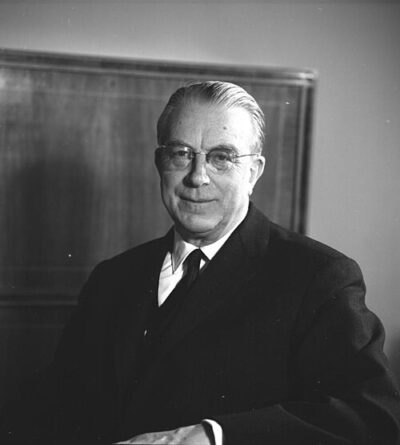
Hans Globke
Hans Globke was a German politician. Born September 10, 1898, in Düsseldorf. Died February 13, 1973, in Bad Godesberg. Positions held include Chancellery Chief of Staff (1953–1963). Educated at University of Bonn and University of Cologne. Awards include Grand Cross 1st class of the Order of Merit of the Federal Republic of Germany, Faithfull Service Award 2nd Grade and Sudetenland Medal.
Facts
30 facts · 2 confirmed by two sources · 10 cited · 18 from one source
Where this comes from
Papalocal keeps its own record. It started from these sources; what each one said is kept here as it was copied, so a change on their side never changes this page by itself. Tap one to read its version.
What Wikidata says · copied November 18, 2026 · revision 2569222193
- Described as
- German politician (1898-1973)
- Other names
- Hans Josef Maria Globke
- Born
- September 10, 1898 · 3 references
- Died
- February 13, 1973 · 3 references
- Born in
- Düsseldorf · 1 reference
- Died in
- Bad Godesberg
- Buried in
- Zentralfriedhof Bad Godesberg
- Name at birth
- Hans Josef Maria Globke
- Citizen of
- Germany
- Occupation
- jurist · 1 reference; politician · 1 reference; lawyer · 1 reference; civil servant · 1 reference; adviser · 1 reference; local government officer · 1 reference
- Positions held
- Chancellery Chief of Staff (1953–1963)
- Political party
- Centre Party
- Education
- University of Bonn; University of Cologne; University of Giessen
- Member of
- KDStV Bavaria Bonn · 1 reference
- Awards
- Grand Cross 1st class of the Order of Merit of the Federal Republic of Germany (1963) · 1 reference; Faithfull Service Award 2nd Grade (1941) · 1 reference; Sudetenland Medal (1939); Knight Grand Cross of the Order of Merit of the Italian Republic; Grand Cross of the Order of the Oak Crown; Grand Cross of the Order of Christ
- Field
- state governance · 2 references; politics · 1 reference; law · 1 reference; interior ministry · 1 reference
- Lived in
- Aachen (1947)
- Wikipedias with a page
- 20
Wikidata item Q77341 (wikidata.org/wiki/Q77341), public domain (CC0). Copied November 18, 2026.
What Wikipedia says · copied November 18, 2026 · revision 1386106540
Hans Josef Maria Globke (10 September 1898 – 13 February 1973) was a high-ranking German civil servant and lawyer who played a central role in both the Nazi regime and the early West German government. While not himself a member of the Nazi party (his application was rejected), he was one of the regime's most influential civil servants.
Globke worked in the Prussian and Reich Ministry of the Interior in the Reich, under the Weimar Republic and Nazism. Later, he was the Under-Secretary of State and Chief of Staff of the German Chancellery in West Germany from 28 October 1953 to 15 October 1963 under Chancellor Konrad Adenauer. He is the most prominent example of the continuity of the administrative elites between Nazi Germany and the early West Germany.
In 1936, Globke wrote a legal annotation on the antisemitic Nuremberg Race Laws that did not express any objection to the discrimination against Jews, placing the Nazi Party on a firmer legal ground and setting the path to the Holocaust during World War II. By 1938, Globke had been promoted to Ministerialdirigent in the Office for Jewish Affairs in the Ministry of the Interior, where he produced the Name Change Ordinance, a law that forced Jewish men to take the middle name Israel and Jewish women Sara for easier identification. In 1941, during the Nazi period, he issued another statute that stripped Jews in occupied territories of their statehood and possessions. Globke was identified as the author of an interior ministry report from France, written in racist language, that complained of "coloured blood into Europe" and called for the "elimination" of its "influences" on the gene pool.
Globke later had a controversial career as Secretary of State and Chief of Staff of the West German Chancellery. A strident anti-communist, Globke became a powerful éminence grise of the West German government, and was widely regarded as one of the most influential public officials in the government of Chancellor Konrad Adenauer. Globke had a major role in shaping the course and structure of the state and West Germany's alignment with the United States. He was also an important figure in West Germany's anti-communist policies at the domestic and international level and in the Western intelligence community, and was the German government's main liaison with NATO and other Western intelligence services, especially the Central Intelligence Agency (CIA).
- Born, in its opening lines
- September 10, 1898
- Died, in its opening lines
- February 13, 1973
From the Wikipedia article “Hans Globke” (en.wikipedia.org/wiki/Hans_Globke), by its contributors, under CC BY-SA 4.0 (creativecommons.org/licenses/by-sa/4.0/). Copied November 18, 2026; not changed.
Confirmed Two sources agree. Cited One source, and it names where it got it. One source One source, without a reference of its own. Sources disagree The sources disagree. We show the best-supported value and keep theirs below.
