
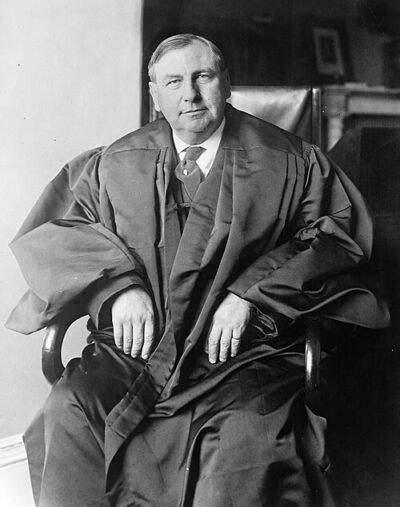
Harlan F. Stone
Harlan F. Stone was a chief justice of the United States from 1941 to 1946. Born October 11, 1872, in Chesterfield. Died April 22, 1946, in Washington, D.C.. Positions held include Associate Justice of the Supreme Court of the United States (1925–1941), United States Attorney General (1924–1925) and Chief Justice of the United States (1941–1946). Educated at Amherst College and Columbia Law School.
Facts
26 facts · 2 confirmed by two sources · 3 cited · 21 from one source
Where this comes from
Papalocal keeps its own record. It started from these sources; what each one said is kept here as it was copied, so a change on their side never changes this page by itself. Tap one to read its version.
What Wikidata says · copied November 15, 2026 · revision 2551790889
- Described as
- chief justice of the United States from 1941 to 1946
- Other names
- Harlan Fiske Stone, Harlan Stone
- Born
- October 11, 1872 · 5 references
- Died
- April 22, 1946 · 5 references
- Born in
- Chesterfield
- Died in
- Washington, D.C.
- Buried in
- Rock Creek Cemetery · 1 reference
- Cause of death
- cerebral hemorrhage
- Citizen of
- United States
- Occupation
- lawyer; judge; university teacher; politician; jurist · 1 reference
- Positions held
- Associate Justice of the Supreme Court of the United States (1925–1941); United States Attorney General (1924–1925); Chief Justice of the United States (1941–1946)
- Political party
- Republican Party
- Worked for
- Columbia Law School; Adelphi University · 1 reference
- Education
- Amherst College; Columbia Law School
- Member of
- American Academy of Arts and Sciences; Phi Beta Kappa Society; American Philosophical Society (1939–)
- Spouse
- Agnes Harvey Stone
- Children
- Marshall Harvey Stone
- Father
- Frederic Lauson Stone · 1 reference
- Wikipedias with a page
- 25
Wikidata item Q942386 (wikidata.org/wiki/Q942386), public domain (CC0). Copied November 15, 2026.
What Wikipedia says · copied November 15, 2026 · revision 1381755887
Harlan Fiske Stone (October 11, 1872 – April 22, 1946) was an American attorney who served as an associate justice of the U.S. Supreme Court from 1925 to 1941 and then as the 12th chief justice of the United States from 1941 until his death in 1946. He also served as the U.S. Attorney General from 1924 to 1925 under President Calvin Coolidge, with whom he had attended Amherst College as a young man. His most famous dictum was that "Courts are not the only agency of government that must be assumed to have capacity to govern."
Raised in Western Massachusetts, Stone practiced law in New York City after graduating from Columbia Law School. He became the Dean of Columbia Law School and a partner with Sullivan & Cromwell. During World War I, he served on the U.S. Department of War's Board of Inquiry, which evaluated the sincerity of conscientious objectors. In 1924, President Calvin Coolidge appointed Stone as the Attorney General. Stone sought to reform the U.S. Department of Justice in the aftermath of several scandals that occurred during the administration of President Warren G. Harding. He also pursued several antitrust cases against large corporations.
In 1925, President Calvin Coolidge nominated Stone to the Supreme Court to succeed retiring Associate Justice Joseph McKenna, and Stone won U.S. Senate confirmation with little opposition. On the Taft Court, Stone joined with Justices Oliver Wendell Holmes Jr. and Louis Brandeis in calling for judicial restraint and deference to the legislative will. On the Hughes Court, Stone and Justices Brandeis and Benjamin N. Cardozo formed a liberal bloc called the Three Musketeers that generally voted to uphold the constitutionality of the New Deal. His majority opinions in United States v. Darby Lumber Co. (1941) and United States v. Carolene Products Co. (1938) were influential in shaping standards of judicial scrutiny.
In 1941, President Franklin D. Roosevelt nominated Stone to succeed the retiring Chief Justice Charles Evans Hughes and Stone was promptly confirmed by the Senate. The Stone Court presided over several cases during World War II, and Stone's majority opinion in Ex parte Quirin upheld the jurisdiction of a U.S. military tribunal over the trial of eight German saboteurs. His majority opinion in International Shoe Co. v. Washington (1945) was influential with regard to personal jurisdiction. Stone was the chief justice in Korematsu v. United States (1944), ruling the exclusion of Japanese Americans into internment camps as constitutional. Stone served as Chief Justice until his death in 1946. He had one of the shortest terms of any chief justice, and was the first chief justice not to have served in an elected office.
- Born, in its opening lines
- October 11, 1872
- Died, in its opening lines
- April 22, 1946
From the Wikipedia article “Harlan F. Stone” (en.wikipedia.org/wiki/Harlan_F._Stone), by its contributors, under CC BY-SA 4.0 (creativecommons.org/licenses/by-sa/4.0/). Copied November 15, 2026; not changed.
Confirmed Two sources agree. Cited One source, and it names where it got it. One source One source, without a reference of its own. Sources disagree The sources disagree. We show the best-supported value and keep theirs below.
