
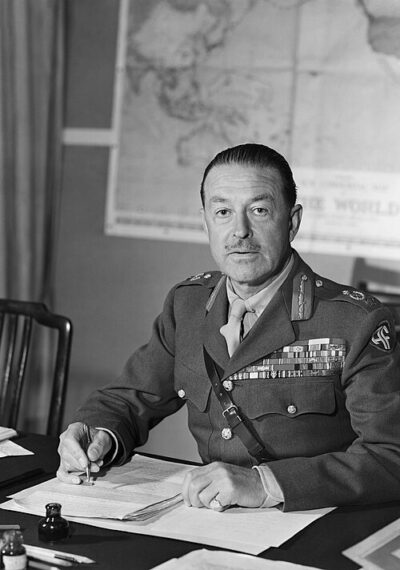
Harold Alexander, 1st Earl Alexander of Tunis
Harold Alexander, 1st Earl Alexander of Tunis was a British military commander and field marshal; Governor General of Canada. Born December 10, 1891, in London. Died June 16, 1969, in Slough. Positions held include Governor General of Canada (1946–1952), member of the House of Lords (1946–1969) and Member of the Privy Council of the United Kingdom. Educated at Harrow School and Royal Military College, Sandhurst. Awards include Grand Cross of the Legion of Honour, Military Cross and Medal "For the Victory over Germany in the Great Patriotic War 1941–1945".
Facts
50 facts · 2 confirmed by two sources · 11 cited · 37 from one source
Where this comes from
Papalocal keeps its own record. It started from these sources; what each one said is kept here as it was copied, so a change on their side never changes this page by itself. Tap one to read its version.
What Wikidata says · copied November 16, 2026 · revision 2568938172
- Described as
- British military commander and field marshal; Governor General of Canada (1891-1969)
- Other names
- Harold Alexander, Colonel Hon. Harold Rupert Leofric George Alexander, Harold Rupert Leofric George Alexander, 1st Viscount Alexander of Tunis
- Born
- December 10, 1891 · 14 references
- Died
- June 16, 1969 · 13 references
- Born in
- London · 1 reference
- Died in
- Slough · 1 reference
- Buried in
- Hertfordshire
- Name at birth
- Harold Rupert Leofric George Alexander
- Citizen of
- United Kingdom; United Kingdom of Great Britain and Ireland
- Occupation
- politician · 2 references; military officer (1911–1946); aristocrat; governor-general · 1 reference; Generalfeldmarschall · 1 reference
- Positions held
- Governor General of Canada (1946–1952); member of the House of Lords (1946–1969); Member of the Privy Council of the United Kingdom; Constable of the Tower (1960–1965); Secretary of State for Defence (1952–1954) · 1 reference; Lord Lieutenant of Greater London (1965–1966); Lord Lieutenant of the County of London (1957–1965); defence minister · 1 reference
- Education
- Harrow School · 1 reference; Royal Military College, Sandhurst; Hawtreys · 1 reference
- Awards
- Grand Cross of the Legion of Honour; Military Cross (1917); Medal "For the Victory over Germany in the Great Patriotic War 1941–1945"; Knight Grand Cross of the Order of the Bath; Knight Grand Cross of the Royal Victorian Order; Chief Commander of the Legion of Merit; Distinguished Service Order (1916); Knight Grand Cross of the Order of St Michael and St George; Order of Suvorov, 1st class; Legionnaire of Legion of Merit; Order of Saint Anna, 2nd class; Knight of the Garter (1946); Order of Merit; Order of Saint John; King George VI Coronation Medal
- Spouse
- Margaret Alexander, Countess Alexander of Tunis (1931–) · 1 reference
- Children
- Shane Alexander, 2nd Earl Alexander of Tunis · 1 reference; Lady Rose Alexander · 1 reference; Brian Alexander · 1 reference; Lady Susan Alexander · 1 reference
- Father
- James Alexander, 4th Earl of Caledon
- Mother
- Lady Elizabeth Graham-Toler · 1 reference
- Siblings
- Eric Alexander, 5th Earl of Caledon
- Military branch
- British Army
- Military rank
- field marshal; general
- Wikipedias with a page
- 46
Wikidata item Q39168 (wikidata.org/wiki/Q39168), public domain (CC0). Copied November 16, 2026.
What Wikipedia says · copied November 16, 2026 · revision 1377684174
Field Marshal Harold Rupert Leofric George Alexander, 1st Earl Alexander of Tunis (10 December 1891 – 16 June 1969) was a British Army officer who served in both of the world wars. Alexander was born in London and was educated at Harrow school before moving on to the Royal Military College, Sandhurst, for training as an army officer of the Irish Guards. He rose to military prominence through his service in the First World War, and continued his career through various British campaigns across Europe and Asia during the interwar period.
In the Second World War, Alexander, initially in command of a division, oversaw the final stages of the Allied evacuation from Dunkirk and subsequently held field commands in Britain, Burma, North Africa and Italy, including serving as Commander-in-Chief Middle East and commanding the 18th Army Group in Tunisia. He then commanded the 15th Army Group for the capture of Sicily and again in Italy before being promoted to field marshal and being made Supreme Allied Commander Mediterranean in late 1944.
In 1946, after being created Viscount Alexander of Tunis, he was appointed as Governor General of Canada by King George VI, on the recommendation of the Prime Minister of Canada, William Lyon Mackenzie King, to replace the Earl of Athlone as viceroy. In 1952, he was elevated in the British peerage, becoming Earl Alexander of Tunis, and was succeeded by Vincent Massey as Governor General of Canada. Alexander proved to be enthusiastic about the Canadian wilderness and popular with Canadians. He was the last Governor General who was born in the United Kingdom as well as the last Governor General to be a peer.
After the end of his viceregal tenure, Alexander was sworn into the Queen's Privy Council for Canada and thereafter, in order to serve as the British Minister of Defence in the Cabinet of Winston Churchill, into the Imperial Privy Council. Alexander retired in 1954 and died in 1969.
- Born, in its opening lines
- December 10, 1891
- Died, in its opening lines
- June 16, 1969
From the Wikipedia article “Harold Alexander, 1st Earl Alexander of Tunis” (en.wikipedia.org/wiki/Harold_Alexander,_1st_Earl_Alexander_of_Tunis), by its contributors, under CC BY-SA 4.0 (creativecommons.org/licenses/by-sa/4.0/). Copied November 16, 2026; not changed.
Confirmed Two sources agree. Cited One source, and it names where it got it. One source One source, without a reference of its own. Sources disagree The sources disagree. We show the best-supported value and keep theirs below.
