
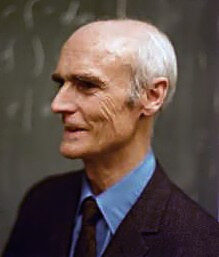
Harold Scott MacDonald Coxeter
Harold Scott MacDonald Coxeter was a Canadian mathematician. Born February 9, 1907, in Kensington. Died March 31, 2003, in Toronto. Known for Regular Polytopes, The Fifty-Nine Icosahedra and Coxeter–Dynkin diagram. Educated at Trinity College and University of Cambridge. Awards include Fellow of the Royal Society, Companion of the Order of Canada and Henry Marshall Tory Medal.
Facts
40 facts · 2 confirmed by two sources · 19 cited · 19 from one source
Where this comes from
Papalocal keeps its own record. It started from these sources; what each one said is kept here as it was copied, so a change on their side never changes this page by itself. Tap one to read its version.
What Wikidata says · copied November 15, 2026 · revision 2569199070
- Described as
- Canadian mathematician (1907–2003)
- Other names
- H.S.M. Coxeter, Harold Scott Macdonald Coxeter, H. S. M. Coxeter
- Born
- February 9, 1907 · 8 references
- Died
- March 31, 2003 · 7 references
- Born in
- Kensington · 1 reference
- Died in
- Toronto · 3 references
- Name at birth
- Harold Scott MacDonald Coxeter
- Citizen of
- United Kingdom · 1 reference; Canada
- Occupation
- mathematician · 1 reference; university teacher
- Worked for
- University of Toronto (1936–1996) · 1 reference; University of East Anglia (1968) · 1 reference; University of Amsterdam (1966) · 1 reference
- Education
- Trinity College (1926–1928) · 1 reference; University of Cambridge (1928–1931) · 1 reference; St George's School (1919–1923) · 1 reference; Princeton University (1931–1933) · 1 reference; The King Alfred School (–1919) · 1 reference; Marlborough College (1923–1925) · 1 reference
- Member of
- Royal Society of London; Royal Society of Canada; American Academy of Arts and Sciences; Royal Netherlands Academy of Arts and Sciences · 1 reference
- Known for
- Regular Polytopes; The Fifty-Nine Icosahedra; Coxeter–Dynkin diagram; Boerdijk–Coxeter helix; Coxeter group; Coxeter matroid; Coxeter–Todd lattice; Todd–Coxeter algorithm; Coxeter's loxodromic sequence of tangent circles; Goldberg–Coxeter construction
- Awards
- Fellow of the Royal Society (1950) · 1 reference; Companion of the Order of Canada (1997) · 1 reference; Henry Marshall Tory Medal (1949); CRM-Fields-PIMS prize (1995) · 1 reference; Fellow of the Royal Society of Canada (1948) · 1 reference; Jeffery–Williams Prize (1973) · 1 reference; Sylvester Medal (1997) · 2 references
- Field
- geometry · 1 reference
- Wikipedias with a page
- 27
Wikidata item Q129916 (wikidata.org/wiki/Q129916), public domain (CC0). Copied November 15, 2026.
What Wikipedia says · copied November 15, 2026 · revision 1374245824
Harold Scott MacDonald "Donald" Coxeter () (9 February 1907 – 31 March 2003) was a British-Canadian geometer and mathematician. He is regarded as one of the greatest geometers of the 20th century.
Coxeter was born in England and educated at the University of Cambridge, with student visits to Princeton University. He worked for 60 years at the University of Toronto in Canada, from 1936 until his retirement in 1996, becoming a full professor there in 1948. His many honours included membership in the Royal Society of Canada, the Royal Society, and the Order of Canada.
He was an author of 12 books, including The Fifty-Nine Icosahedra (1938) and Regular Polytopes (1947). Many concepts in geometry and group theory are named after him, including the Coxeter graph, Coxeter groups, Coxeter's loxodromic sequence of tangent circles, Coxeter–Dynkin diagrams, and the Todd–Coxeter algorithm.
- Born, in its opening lines
- February 9, 1907
- Died, in its opening lines
- March 31, 2003
From the Wikipedia article “H. S. M. Coxeter” (en.wikipedia.org/wiki/H._S._M._Coxeter), by its contributors, under CC BY-SA 4.0 (creativecommons.org/licenses/by-sa/4.0/). Copied November 15, 2026; not changed.
Confirmed Two sources agree. Cited One source, and it names where it got it. One source One source, without a reference of its own. Sources disagree The sources disagree. We show the best-supported value and keep theirs below.
