
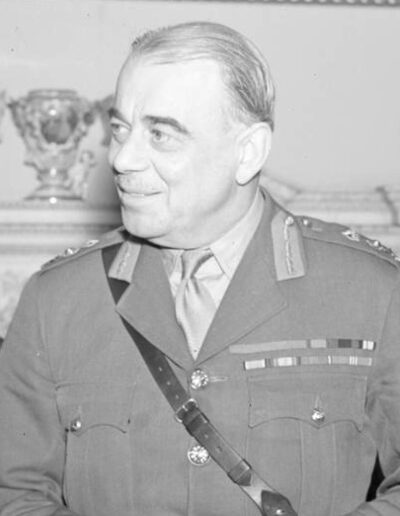
Hastings Ismay, 1st Baron Ismay
Hastings Ismay, 1st Baron Ismay was a British army officer and diplomat, 1st Secretary General of NATO. Born June 21, 1887, in Nainital. Died December 17, 1965, in Wormington Grange. Positions held include Secretary General of NATO (1952–1957), Secretary of State for Commonwealth Relations (1951–1952) and member of the House of Lords (1947–1965). Educated at Royal Military College, Sandhurst and Charterhouse School. Awards include Distinguished Service Order, Knight Grand Cross of the Order of the Bath and Legionnaire of Legion of Merit.
Facts
34 facts · 2 confirmed by two sources · 19 cited · 13 from one source
Where this comes from
Papalocal keeps its own record. It started from these sources; what each one said is kept here as it was copied, so a change on their side never changes this page by itself. Tap one to read its version.
What Wikidata says · copied November 16, 2026 · revision 2562735028
- Described as
- British army officer and diplomat, 1st Secretary General of NATO (1887-1965)
- Other names
- Hastings Ismay, General Hastings Lionel Ismay, Lord Ismay, Hastings Lionel Ismay
- Born
- June 21, 1887 · 7 references
- Died
- December 17, 1965 · 7 references
- Born in
- Nainital · 2 references
- Died in
- Wormington Grange · 1 reference
- Buried in
- Tewkesbury Abbey · 1 reference
- Name at birth
- Hastings Lionel Ismay
- Citizen of
- United Kingdom
- Occupation
- politician; diplomat; army officer · 1 reference; military commander · 1 reference
- Positions held
- Secretary General of NATO (1952–1957); Secretary of State for Commonwealth Relations (1951–1952); member of the House of Lords (1947–1965); Member of the Privy Council of the United Kingdom (1951–) · 1 reference
- Education
- Royal Military College, Sandhurst · 1 reference; Charterhouse School · 1 reference
- Awards
- Distinguished Service Order (1920) · 1 reference; Knight Grand Cross of the Order of the Bath (1946) · 1 reference; Legionnaire of Legion of Merit; Companion of Honour (1945) · 1 reference; Knight of the Garter (1957) · 1 reference; Knight Commander of the Order of the Bath (1940) · 1 reference; Companion of the Order of the Bath (1931) · 1 reference; Knight of Justice of the Order of Saint John
- Spouse
- Laura Kathleen Clegg (1921–) · 1 reference
- Children
- Susan Katherine Lucy Ismay · 1 reference; Sarah Field Ismay · 1 reference; Mary Ismay · 1 reference
- Father
- Stanley Ismay · 1 reference
- Mother
- Beatrice Ellen Read · 2 references
- Military branch
- British Army · 1 reference
- Military rank
- general
- Nickname
- Pug
- Wikipedias with a page
- 38
Wikidata item Q335004 (wikidata.org/wiki/Q335004), public domain (CC0). Copied November 16, 2026.
What Wikipedia says · copied November 16, 2026 · revision 1385475031
General Hastings Lionel "Pug" Ismay, 1st Baron Ismay (21 June 1887 – 17 December 1965) was a British politician, diplomat and general in the British Indian Army who was the first secretary general of NATO. He also was Winston Churchill's chief military assistant during the Second World War.
Ismay was born in Nainital, India, in 1887, and educated in the United Kingdom at Charterhouse School and the Royal Military College, Sandhurst. After Sandhurst, he joined the British Indian Army as an officer of the 21st Prince Albert Victor's Own Cavalry. During the First World War, he served with the Camel Corps in British Somaliland, where he joined in the British fight against Somali military leader and founder of the anti-colonial Dervish movement Mohammed Abdullah Hassan. In 1925, Ismay became an Assistant Secretary of the Committee of Imperial Defence (CID). After being promoted to the rank of colonel, he served as the military secretary for Lord Willingdon, the Viceroy of India, then returned to the CID as Deputy Secretary in 1936.
On 1 August 1938, shortly before the outbreak of the Second World War, Ismay became the committee's secretary and began planning for the impending war. In May 1940, when Winston Churchill became Prime Minister of the United Kingdom, he selected Ismay as his chief military assistant and staff officer. In that capacity, Ismay served as the principal link between Churchill and the Chiefs of Staff Committee. Ismay also accompanied Churchill to many of the Allied war conferences. For Ismay's advice and aid, "Churchill owed more, and admitted that he owed more" to him "than to anybody else, military or civilian, in the whole of the war."
After the end of the war, Ismay remained in the army for another year, and helped to reorganise the Ministry of Defence. He then retired from the military and served as Lord Mountbatten of Burma's chief of staff in India, helping to oversee its partition. From 1948 to 1951, he served as chairman of the council of the Festival of Britain, helping to organise and promote the event. Then, in 1951, when Churchill again became prime minister, he appointed Ismay Secretary of State for Commonwealth Relations.
Ismay accepted the position, but resigned after only six months to become the first secretary general of NATO in 1952. While Secretary General, Ismay is also credited as having been the first person to say that the purpose of NATO was "to keep the Soviet Union out, the Americans in, and the Germans down," a saying that has since become a common way to describe the dynamics of NATO. He served in this role until 1957, and helped establish and define the position. After retiring from NATO, Ismay wrote his memoirs, The Memoirs of General the Lord Ismay, served on a variety of corporate boards, and co-chaired the Ismay–Jacob Committee, which reorganised the Ministry of Defence once again. He died on 17 December 1965, at his home, Wormington Grange, Gloucestershire.
- Born, in its opening lines
- June 21, 1887
- Died, in its opening lines
- December 17, 1965
From the Wikipedia article “Hastings Ismay, 1st Baron Ismay” (en.wikipedia.org/wiki/Hastings_Ismay,_1st_Baron_Ismay), by its contributors, under CC BY-SA 4.0 (creativecommons.org/licenses/by-sa/4.0/). Copied November 16, 2026; not changed.
Confirmed Two sources agree. Cited One source, and it names where it got it. One source One source, without a reference of its own. Sources disagree The sources disagree. We show the best-supported value and keep theirs below.
