
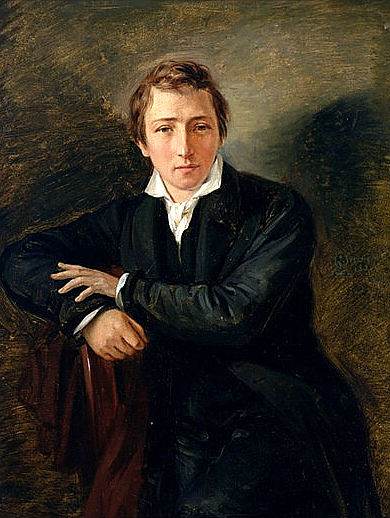
Heinrich Heine
Heinrich Heine was a German poet, writer and literary critic. Born December 13, 1797, in Düsseldorf. Died February 17, 1856, in Paris. Known for Germany. A Winter's Tale, Atta Troll and Die Harzreise. Educated at University of Bonn and Frederick William University Berlin.
Facts
39 facts · 2 confirmed by two sources · 17 cited · 20 from one source
Where this comes from
Papalocal keeps its own record. It started from these sources; what each one said is kept here as it was copied, so a change on their side never changes this page by itself. Tap one to read its version.
What Wikidata says · copied November 16, 2026 · revision 2568987670
- Described as
- German poet, writer and literary critic (1797–1856)
- Other names
- Christian Johann Heinrich Heine, Christian Heine, Christian Johann Heinrich "Harry" Heine
- Born
- December 13, 1797 · 16 references
- Died
- February 17, 1856 · 18 references
- Born in
- Düsseldorf · 15 references
- Died in
- Paris · 13 references
- Buried in
- Montmartre Cemetery · 3 references
- Name at birth
- Harry Heine (–1825) · 2 references
- Citizen of
- Kingdom of Prussia
- Occupation
- poet · 5 references; writer · 3 references; journalist · 2 references; literary critic; poet lawyer; essayist; opinion journalist · 1 reference; playwright · 2 references
- Education
- University of Bonn; Frederick William University Berlin (1821–1823); University of Göttingen; Humboldt-Universität zu Berlin
- Member of
- Corps Hildeso-Guestphalia Göttingen
- Genre
- poetry; satire
- Known for
- Germany. A Winter's Tale; Atta Troll; Die Harzreise; Book of Songs; The rabbi of Bacherach
- Field
- creative and professional writing · 1 reference; prose · 1 reference; poetry · 1 reference; opinion journalism · 1 reference; literary criticism · 1 reference; essay · 1 reference
- Spouse
- Mathilde Heine (1841–) · 1 reference
- Father
- Samson Heine · 1 reference
- Mother
- Betty Heine · 1 reference
- Siblings
- Charlotte Embden; Gustav Heine von Geldern · 1 reference; Maximilian Meyer Heine · 1 reference
- Wikipedias with a page
- 168
Wikidata item Q44403 (wikidata.org/wiki/Q44403), public domain (CC0). Copied November 16, 2026.
What Wikipedia says · copied November 16, 2026 · revision 1385836268
Christian Johann Heinrich Heine (born Harry Heine; 13 December 1797 – 17 February 1856) was a German poet, writer and literary critic. He is best known outside Germany for his early lyric poetry, which was set to music in the form of Lieder (art songs) by composers such as Felix Mendelssohn, Robert Schumann and Franz Schubert.
Heine's later verse and prose are distinguished by their satirical wit and irony. He is considered a member of the Young Germany movement. His radical political views led to many of his works being banned by German authorities—which, however, only added to his fame. He spent the last 25 years of his life as an expatriate in Paris.
As an exile in Paris, Heine became a celebrity avatar reflective of the liberal and cosmopolitan values of the mainstream press. In the Third Reich, Heine's name was invoked as an archetype of an influential Jewish opinion columnist. Heine is remembered for his phrase "Where they burn books, they will ultimately burn people also", which ultimately came true in the Holocaust.
- Born, in its opening lines
- December 13, 1797
- Died, in its opening lines
- February 17, 1856
From the Wikipedia article “Heinrich Heine” (en.wikipedia.org/wiki/Heinrich_Heine), by its contributors, under CC BY-SA 4.0 (creativecommons.org/licenses/by-sa/4.0/). Copied November 16, 2026; not changed.
Confirmed Two sources agree. Cited One source, and it names where it got it. One source One source, without a reference of its own. Sources disagree The sources disagree. We show the best-supported value and keep theirs below.
