
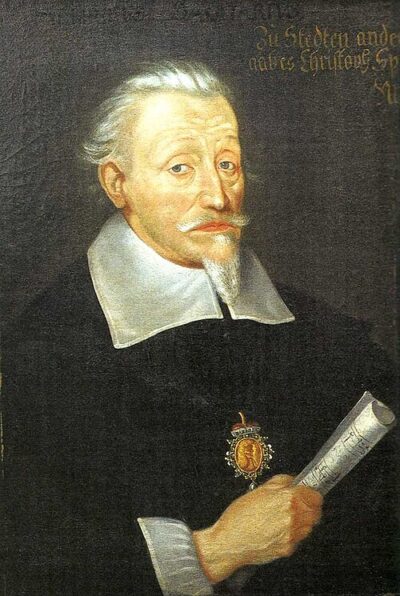
Heinrich Schütz
Heinrich Schütz was a German composer and organist. Born October 18, 1585, in Bad Köstritz. Died November 6, 1672, in Dresden. Known for Dafne, Musikalische Exequien and Psalmen Davids.
Facts
24 facts · 2 confirmed by two sources · 9 cited · 13 from one source
What’s different
- Born: we show October 18, 1585 (Confirmed). Wikidata also lists October 14, 1585
Where this comes from
Papalocal keeps its own record. It started from these sources; what each one said is kept here as it was copied, so a change on their side never changes this page by itself. Tap one to read its version.
What Wikidata says · copied November 16, 2026 · revision 2565146749
- Described as
- German composer and organist (1585–1672)
- Other names
- Henrich Schütz, Henricus Sagittarius, Heinrich Schutz
- Born
- October 18, 1585 · 3 references; October 14, 1585 · 1 reference
- Died
- November 6, 1672 · 9 references; November 6, 1672 · 1 reference
- Born in
- Bad Köstritz · 4 references
- Died in
- Dresden · 4 references
- Cause of death
- myocardial infarction
- Citizen of
- Germany · 1 reference; Electorate of Saxony
- Occupation
- composer · 4 references; organist; independent publisher · 2 references; chapelmaster · 2 references; court chapel master · 2 references
- Genre
- opera; motet; cantata; madrigal
- Instrument
- organ
- Known for
- Dafne; Musikalische Exequien; Psalmen Davids; Cantiones sacrae; Die sieben Worte Jesu Christi am Kreuz
- Children
- Euphrosyna Pincker · 1 reference
- Father
- Christoph Schütz · 1 reference
- Wikipedias with a page
- 51
Wikidata item Q153643 (wikidata.org/wiki/Q153643), public domain (CC0). Copied November 16, 2026.
What Wikipedia says · copied November 16, 2026 · revision 1384369697
Heinrich Schütz (German: [ʃʏt͡s]; 18 October [O.S. 8 October] 1585 – 6 November 1672) was a German early Baroque composer and organist, generally regarded as the most important German composer before Johann Sebastian Bach and one of the most important composers of the 17th century. He is credited with bringing the Italian style to Germany and continuing its evolution from the Renaissance into the early Baroque. Most of his surviving music was written for the Lutheran church, primarily for the Electoral Chapel in Dresden. He wrote what is traditionally considered the first German opera, Dafne, performed at Torgau in 1627, the music of which has since been lost, along with nearly all of his ceremonial and theatrical scores. Schütz was a prolific composer, with more than 500 surviving works.
He is commemorated as a musician in the Calendar of Saints of some North American Lutheran churches on 28 July with Johann Sebastian Bach and George Frideric Handel.
- Born, in its opening lines
- October 18, 1585
- Died, in its opening lines
- November 6, 1672
From the Wikipedia article “Heinrich Schütz” (en.wikipedia.org/wiki/Heinrich_Schütz), by its contributors, under CC BY-SA 4.0 (creativecommons.org/licenses/by-sa/4.0/). Copied November 16, 2026; not changed.
Confirmed Two sources agree. Cited One source, and it names where it got it. One source One source, without a reference of its own. Sources disagree The sources disagree. We show the best-supported value and keep theirs below.
