
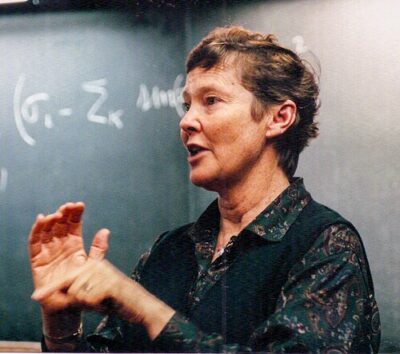
Helen Quinn
Helen Quinn is an Australian physicist. Born May 19, 1943, in Melbourne. Educated at Stanford University and DESY. Awards include Oskar Klein Medal, Fellow of the American Physical Society and Sakurai Prize.
Facts
24 facts · 1 confirmed by two sources · 10 cited · 13 from one source
Where this comes from
Papalocal keeps its own record. It started from these sources; what each one said is kept here as it was copied, so a change on their side never changes this page by itself. Tap one to read its version.
What Wikidata says · copied November 15, 2026 · revision 2530403910
- Described as
- Australian physicist (born 1943)
- Other names
- Helen Rhoda Quinn, Helen R. Quinn, Helen Rhoda Arnold Quinn, Helen Arnold Quinn, Quinn
- Born
- May 19, 1943 · 1 reference
- Born in
- Melbourne · 3 references
- Citizen of
- United States · 3 references; Australia
- Occupation
- physicist · 3 references; university teacher
- Worked for
- Harvard University; Stanford University
- Education
- Stanford University · 1 reference; DESY; University of Melbourne; Tintern Grammar
- Member of
- National Academy of Sciences (2003–) · 1 reference; American Academy of Arts and Sciences; American Philosophical Society
- Awards
- Oskar Klein Medal (2008) · 1 reference; Fellow of the American Physical Society; Sakurai Prize (2013) · 2 references; Benjamin Franklin Medal (2018); ICTP Dirac Medal (2000) · 1 reference; Fellow of the American Academy of Arts and Sciences; Honorary Officer of the Order of Australia (2005) · 1 reference; Compton Medal for Leadership in Physics (2016) · 2 references
- Field
- physics
- Wikipedias with a page
- 26
Wikidata item Q450304 (wikidata.org/wiki/Q450304), public domain (CC0). Copied November 15, 2026.
What Wikipedia says · copied November 15, 2026 · revision 1382761449
Helen Rhoda Arnold Quinn (born 19 May 1943) is an Australian-born particle physicist and educator who has made major contributions to both fields. Her contributions to theoretical physics include the Peccei–Quinn theory which implies a corresponding symmetry of nature(related to matter-antimatter symmetry and the possible source of the dark matter that pervades the universe) and contributions to the search for a unified theory for the three types of particle interactions (strong, electromagnetic, and weak). As Chair of the Board on Science Education of the National Academy of Sciences, Quinn led the effort that produced A Framework for K-12 Science Education: Practices, Crosscutting Concepts, and Core Ideas—the basis for the Next Generation Science Standards adopted by many states. Her honours include the Dirac Medal of the International Center for Theoretical Physics, the Oskar Klein Medal from the Royal Swedish Academy of Sciences, appointment as an Honorary Officer of the Order of Australia, the J. J. Sakurai Prize for Theoretical Particle Physics from the American Physical Society, the Karl Taylor Compton Medal for Leadership in Physics from the American Institute of Physics, the 2018 Benjamin Franklin Medal in Physics from the Franklin Institute, and the 2023 Harvey Prize from Technion -- Israel Institute of Technology.
- Born, in its opening lines
- May 19, 1943
From the Wikipedia article “Helen Quinn” (en.wikipedia.org/wiki/Helen_Quinn), by its contributors, under CC BY-SA 4.0 (creativecommons.org/licenses/by-sa/4.0/). Copied November 15, 2026; not changed.
Confirmed Two sources agree. Cited One source, and it names where it got it. One source One source, without a reference of its own. Sources disagree The sources disagree. We show the best-supported value and keep theirs below.
