
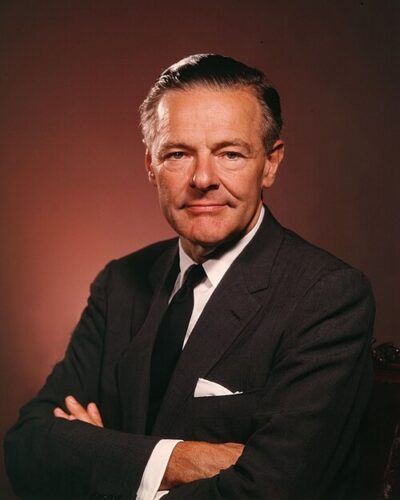
Henry Cabot Lodge Jr.
Henry Cabot Lodge Jr. was an American politician. Born July 5, 1902, in Nahant. Died February 27, 1985, in Beverly. Positions held include member of the Massachusetts House of Representatives (1933–1936), United States Ambassador to the United Nations (1953–1960) and United States Ambassador to South Vietnam (1963–1967). Educated at Harvard University and St. Albans School. Awards include Legionnaire of Legion of Merit, honorary doctorate at the Laval University and Bronze Star Medal.
Facts
36 facts · 2 confirmed by two sources · 19 cited · 15 from one source
Where this comes from
Papalocal keeps its own record. It started from these sources; what each one said is kept here as it was copied, so a change on their side never changes this page by itself. Tap one to read its version.
What Wikidata says · copied November 15, 2026 · revision 2567356919
- Described as
- American politician (1902–1985)
- Other names
- Henry Cabot Lodge, H. C. Lodge, Henry Lodge, Henry C. Lodge, Henry C. Lodge Jr., Henry C. Lodge, Jr., Henry Cabot Lodge, Jr.
- Born
- July 5, 1902 · 7 references
- Died
- February 27, 1985 · 7 references
- Born in
- Nahant · 1 reference
- Died in
- Beverly · 1 reference
- Buried in
- Mount Auburn Cemetery · 1 reference
- Name at birth
- Henry Cabot Lodge, Jr. · 1 reference
- Citizen of
- United States
- Occupation
- politician · 1 reference; diplomat · 2 references; journalist (1924–1931) · 1 reference; military officer
- Positions held
- member of the Massachusetts House of Representatives (1933–1936) · 1 reference; United States Ambassador to the United Nations (1953–1960) · 1 reference; United States Ambassador to South Vietnam (1963–1967) · 1 reference; ambassador-at-large (1967–1968) · 1 reference; ambassador to West Germany (1968–1969) · 1 reference; leader · 1 reference; United States Ambassador to the Holy See (1970–1977) · 1 reference; United States senator (2 times) (1937–1953) · 1 reference
- Political party
- Republican Party
- Education
- Harvard University; St. Albans School; Middlesex School
- Awards
- Legionnaire of Legion of Merit · 1 reference; honorary doctorate at the Laval University (1952) · 1 reference; Bronze Star Medal · 1 reference
- Field
- mass media · 1 reference
- Children
- George C. Lodge · 1 reference
- Father
- George Cabot Lodge · 1 reference
- Mother
- Mathilda Elizabeth Frelinghuysen Davis · 1 reference
- Siblings
- John Davis Lodge · 1 reference
- Religion
- Episcopal Church
- Military branch
- United States Army · 1 reference
- Military rank
- Lieutenant Colonel
- Lived in
- Massachusetts · 1 reference; Beverly · 1 reference
- Wikipedias with a page
- 30
Wikidata item Q450984 (wikidata.org/wiki/Q450984), public domain (CC0). Copied November 15, 2026.
What Wikipedia says · copied November 15, 2026 · revision 1385902783
Henry Cabot Lodge Jr. (July 5, 1902 – February 27, 1985) was an American diplomat and politician who represented Massachusetts in the United States Senate and served as United States Ambassador to the United Nations in the administration of President Dwight D. Eisenhower. In 1960, he was the Republican nominee for Vice President. Lodge later served as a diplomat in the administrations of John F. Kennedy, Lyndon B. Johnson, Richard Nixon, and Gerald Ford. Lodge was a contender in the Republican primary of the 1964 presidential election.
Born in Nahant, Massachusetts, Lodge was the grandson of Senator Henry Cabot Lodge and the great-grandson of Secretary of State Frederick T. Frelinghuysen. After graduating from Harvard University, Lodge won election to the Massachusetts House of Representatives. He defeated Democratic governor James Michael Curley in 1936 to represent Massachusetts in the United States Senate. He resigned from the Senate in 1944 to serve in Italy and France during World War II. Lodge remained in the Army Reserve after the war and eventually rose to the rank of major general. In 1946, Lodge defeated incumbent Democratic senator David I. Walsh to return to the Senate.
He led the Draft Eisenhower movement before the 1952 election and managed Eisenhower's successful campaign for the Republican presidential nomination at the 1952 Republican National Convention. Eisenhower defeated Democratic nominee Adlai Stevenson II in the general election, but Lodge lost his own re-election campaign to then-congressman John F. Kennedy. Lodge was named as ambassador to the United Nations in 1953 and became a member of Eisenhower's Cabinet. Vice President Richard Nixon chose Lodge as his running mate in the 1960 presidential election but they narrowly lost to Democrat ticket of then-senator Kennedy and Lyndon B. Johnson.
In 1963, the now-President Kennedy appointed Lodge to the position of Ambassador to South Vietnam, where Lodge supported the 1963 South Vietnamese coup. In 1964, Lodge won by a plurality a number of that year's party presidential primaries and caucuses on the strength of his name, reputation, and respect among many voters, though the nomination went to Barry Goldwater. This effort was encouraged and directed by a low-budget but high-impact grassroots campaign by academic and political amateurs. He continued to represent the United States in various countries under Presidents Johnson, Nixon, and Ford. Lodge led the U.S. delegation that signed the Paris Peace Accords with North Vietnam, leading to the end of the Vietnam War. He died in Beverly, Massachusetts, in 1985.
- Born, in its opening lines
- July 5, 1902
- Died, in its opening lines
- February 27, 1985
From the Wikipedia article “Henry Cabot Lodge Jr.” (en.wikipedia.org/wiki/Henry_Cabot_Lodge_Jr.), by its contributors, under CC BY-SA 4.0 (creativecommons.org/licenses/by-sa/4.0/). Copied November 15, 2026; not changed.
Confirmed Two sources agree. Cited One source, and it names where it got it. One source One source, without a reference of its own. Sources disagree The sources disagree. We show the best-supported value and keep theirs below.
