
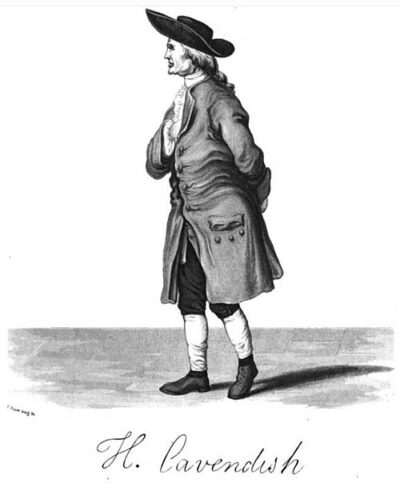
Henry Cavendish
Henry Cavendish was an English natural philosopher, and scientist. Born October 10, 1731, in Nice. Died February 24, 1810, in London. Educated at Peterhouse and University of Cambridge. Awards include Fellow of the Royal Society and Copley Medal.
Facts
23 facts · 2 confirmed by two sources · 9 cited · 12 from one source
Where this comes from
Papalocal keeps its own record. It started from these sources; what each one said is kept here as it was copied, so a change on their side never changes this page by itself. Tap one to read its version.
What Wikidata says · copied November 16, 2026 · revision 2568747913
- Described as
- English natural philosopher, and scientist (1731–1810)
- Born
- October 10, 1731 · 10 references
- Died
- February 24, 1810 · 9 references
- Born in
- Nice · 3 references
- Died in
- London · 3 references
- Buried in
- Derby Cathedral · 1 reference
- Citizen of
- United Kingdom of Great Britain and Ireland; Kingdom of Great Britain (–1801)
- Occupation
- chemist · 1 reference; physicist · 1 reference; mathematician · 1 reference
- Worked for
- Kingdom of Great Britain
- Education
- Peterhouse · 1 reference; University of Cambridge; Newcome's School
- Member of
- Royal Society of London
- Awards
- Fellow of the Royal Society; Copley Medal (1766) · 1 reference
- Field
- physics; chemistry
- Father
- Lord Charles Cavendish · 1 reference
- Mother
- Ann Grey · 2 references
- Siblings
- Frederick Cavendish · 1 reference
- Lived in
- United Kingdom of Great Britain and Ireland · 1 reference
- Wikipedias with a page
- 90
Wikidata item Q131733 (wikidata.org/wiki/Q131733), public domain (CC0). Copied November 16, 2026.
What Wikipedia says · copied November 16, 2026 · revision 1383261729
Henry Cavendish ( KAV-ən-dish; 10 October 1731 – 24 February 1810) was an English experimental and theoretical chemist and physicist. He is noted for his discovery of hydrogen, which he termed "inflammable air". He described the density of inflammable air, which formed water on combustion, in a 1766 paper, On Factitious Airs. Antoine Lavoisier later reproduced Cavendish's experiment and gave the element its name.
Cavendish, known for his reclusive personality, conducted research notable for its accuracy and precision. His work included researches on the composition of atmospheric air, the properties of different gases, the synthesis of water, the law governing electrical attraction and repulsion, a mechanical theory of heat, and calculations of the density (and hence the mass) of the Earth. The experiment he devised to measure Earth's density, which also informs calculation of the gravitational constant, is now known as the Cavendish experiment.
- Born, in its opening lines
- October 10, 1731
- Died, in its opening lines
- February 24, 1810
From the Wikipedia article “Henry Cavendish” (en.wikipedia.org/wiki/Henry_Cavendish), by its contributors, under CC BY-SA 4.0 (creativecommons.org/licenses/by-sa/4.0/). Copied November 16, 2026; not changed.
Confirmed Two sources agree. Cited One source, and it names where it got it. One source One source, without a reference of its own. Sources disagree The sources disagree. We show the best-supported value and keep theirs below.
