
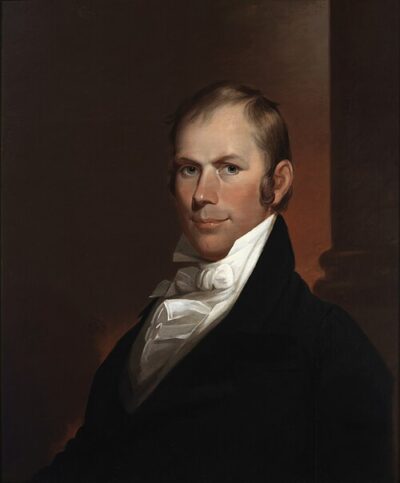
Henry Clay
Henry Clay was an American politician from Kentucky. Born April 12, 1777, in Hanover County. Died June 29, 1852, in Washington, D.C.. Positions held include United States representative (1823–1825), United States Secretary of State (1825–1829) and Speaker of the United States House of Representatives (1823–1825). Educated at College of William & Mary.
Facts
34 facts · 2 confirmed by two sources · 11 cited · 21 from one source
Where this comes from
Papalocal keeps its own record. It started from these sources; what each one said is kept here as it was copied, so a change on their side never changes this page by itself. Tap one to read its version.
What Wikidata says · copied November 13, 2026 · revision 2562945236
- Described as
- American politician from Kentucky (1777-1852)
- Other names
- Henry Clay Sr., Henry Clay, Sr.
- Born
- April 12, 1777 · 8 references
- Died
- June 29, 1852 · 8 references
- Born in
- Hanover County
- Died in
- Washington, D.C. · 1 reference
- Buried in
- Lexington Cemetery
- Citizen of
- United States
- Occupation
- politician · 2 references; lawyer · 1 reference; diplomat; writer · 1 reference; jurist · 1 reference
- Positions held
- United States representative (1823–1825); United States Secretary of State (1825–1829); Speaker of the United States House of Representatives (1823–1825); United States senator (4 times) (1806–1852) · 1 reference; member of the Kentucky House of Representatives; senator · 1 reference
- Political party
- Democratic-Republican Party; Whig Party; National Republican Party
- Education
- College of William & Mary
- Member of
- American Antiquarian Society; Great Triumvirate · 1 reference
- Spouse
- Lucretia Hart Clay · 1 reference
- Children
- Henry Clay; James Brown Clay; Thomas Hart Clay; John Morrison Clay; Theodore Wythe Clay
- Father
- John Moore Clay · 1 reference
- Siblings
- Porter Clay
- Religion
- Episcopal Church
- Lived in
- Richmond · 1 reference; Lexington · 1 reference
- Wikipedias with a page
- 46
Wikidata item Q319630 (wikidata.org/wiki/Q319630), public domain (CC0). Copied November 13, 2026.
What Wikipedia says · copied November 13, 2026 · revision 1381542705
Henry Clay (April 12, 1777 – June 29, 1852) was an American lawyer, statesman, and diplomat who represented Kentucky in both the United States House of Representatives and the United States Senate. He was the seventh House speaker as well as the ninth secretary of state. Clay unsuccessfully ran for president in the 1824, 1832, and 1844 elections. He helped found both the National Republican Party and the Whig Party. For his role in defusing sectional crises, he earned the appellation of the "Great Compromiser" and was part of the "Great Triumvirate" of Congressmen, alongside fellow Whig Daniel Webster and Democrat John C. Calhoun.
Clay was born in Hanover County, Virginia, in 1777, and began his legal career in Lexington, Kentucky, in 1797. As a member of the Democratic-Republican Party, he won election to the Kentucky state legislature in 1803 and to the U.S. House of Representatives in 1810. Clay was chosen as Speaker of the House in early 1811 and, along with President James Madison, led the United States into the War of 1812 against Great Britain. In 1814, he helped negotiate the Treaty of Ghent, which brought an end to the War of 1812, and then after the war, Clay returned to his position as Speaker of the House and developed the American System, which called for federal infrastructure investments, support for the national bank, and high protective tariff rates. During 1820, Clay helped bring an end to a sectional crisis over slavery for many years by leading the passage of the Missouri Compromise. He finished with the fourth-most electoral votes in the multi-candidate 1824–1825 presidential election and used his position as speaker to help John Quincy Adams win the contingent election held to select the president. President Adams then appointed him to the position of Secretary of State. As a result, critics alleged that the two had agreed to a "corrupt bargain".
Adams was defeated by Democrat Andrew Jackson in the bitter 1828 presidential election. Clay won election to the U.S. Senate in 1831 and ran as the National Republican nominee in the 1832 presidential election. Clay was defeated decisively by President Jackson primarily due to his support for the national bank, which Jackson vehemently opposed. After the 1832 election, Clay helped bring an end to the nullification crisis by leading passage of the Tariff of 1833. During Jackson's second term, opponents of the president including Clay, Webster, and William Henry Harrison created the Whig Party, and Clay became a leading congressional Whig.
Clay sought the presidency in the 1840 election but was passed over at the Whig National Convention in favor of Harrison. When Harrison died and his vice president John Tyler ascended to office in 1841, Clay clashed with Tyler, who broke with Clay and other congressional Whigs. Clay resigned from the Senate in 1842 and won the 1844 Whig presidential nomination, but he was narrowly defeated in the general election by Democrat James K. Polk, who made the annexation of the Republic of Texas his top issue. Clay strongly criticized the subsequent Mexican–American War, where his son Henry Clay Jr. was killed at the Battle of Buena Vista, and sought the Whig presidential nomination in 1848 but was passed over in favor of General Zachary Taylor who went on to win the election. After returning to the Senate in 1849, Clay played a key role in passing the Compromise of 1850, which postponed a crisis over the status of slavery in the territories.
- Born, in its opening lines
- April 12, 1777
- Died, in its opening lines
- June 29, 1852
From the Wikipedia article “Henry Clay” (en.wikipedia.org/wiki/Henry_Clay), by its contributors, under CC BY-SA 4.0 (creativecommons.org/licenses/by-sa/4.0/). Copied November 13, 2026; not changed.
Confirmed Two sources agree. Cited One source, and it names where it got it. One source One source, without a reference of its own. Sources disagree The sources disagree. We show the best-supported value and keep theirs below.
