
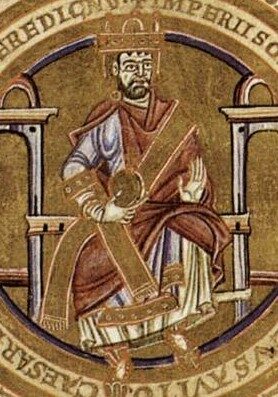
Henry II, Holy Roman Emperor
Henry II, Holy Roman Emperor was a Holy Roman Emperor from 1014 to 1024. Born May 6, 973, in Bad Abbach. Died July 13, 1024, in Grone. Positions held include Holy Roman Emperor (1014–1024), Monarch of Italy (1004–1024) and King of the Romans (1002–1024).
Facts
20 facts · 2 confirmed by two sources · 9 cited · 9 from one source
Where this comes from
Papalocal keeps its own record. It started from these sources; what each one said is kept here as it was copied, so a change on their side never changes this page by itself. Tap one to read its version.
What Wikidata says · copied November 16, 2026 · revision 2569083655
- Described as
- Holy Roman Emperor from 1014 to 1024
- Other names
- Henry II, Holy Roman Emperor Heinrich II, Holy Roman Emperor Henry II, Saint Henry, Heinrich II, Holy Roman Emperor, Henricus II
- Born
- May 6, 973 · 2 references
- Died
- July 13, 1024 · 2 references
- Born in
- Bad Abbach · 1 reference
- Died in
- Grone · 1 reference
- Buried in
- Bamberg Cathedral
- Citizen of
- Germany · 1 reference
- Occupation
- ruler; emperor · 1 reference
- Positions held
- Holy Roman Emperor (1014–1024); Monarch of Italy (1004–1024); King of the Romans (1002–1024); Duke of Bavaria (995–1004)
- Member of
- Saints Henry and Cunigunde
- Spouse
- Cunigunde of Luxembourg · 1 reference
- Father
- Henry II, Duke of Bavaria · 3 references
- Mother
- Gisela of Burgundy · 1 reference
- Siblings
- Bruno of Augsburg · 1 reference; Gisela of Hungary · 1 reference; Brigitta of Bavaria · 1 reference
- Religion
- Catholic Church
- Wikipedias with a page
- 65
Wikidata item Q103556 (wikidata.org/wiki/Q103556), public domain (CC0). Copied November 16, 2026.
What Wikipedia says · copied November 16, 2026 · revision 1385882524
Henry II (German: Heinrich II.; Italian: Enrico II; Latin: Henricus; 6 May 973 – 13 July 1024), also known as Saint Henry, Obl. S. B., was Holy Roman Emperor (Latin: Romanorum Imperator) from 1014. He died without an heir in 1024 and was the last ruler of the Ottonian line. As Duke of Bavaria, appointed in 995, Henry became King of the Romans (Latin: Rex Romanorum) following the sudden death of his second cousin, Emperor Otto III in 1002, was made King of Italy (Latin: Rex Italiae) in 1004, and crowned emperor by Pope Benedict VIII in 1014.
The son of Henry II, Duke of Bavaria, and Gisela of Burgundy, Henry was a great-grandson of German king Henry the Fowler and a member of the Bavarian branch of the Ottonian dynasty. Since his father had rebelled against two previous emperors, the younger Henry spent long periods of time in exile, where he turned to Christianity at an early age, first finding refuge with Bishop Abraham of Freising and later during his education at the cathedral school in Hildesheim. He succeeded his father as Duke of Bavaria in 995 as Henry IV (Henry III having briefly interrupted his father's rule). As duke, he attempted to join his second cousin, Emperor Otto III, in suppressing a revolt against imperial rule in Italy in 1002. Before Henry could arrive, however, Otto III died of fever, leaving no heir. After defeating several contenders to the throne, he was crowned Henry II, King of Germany, on 9 July 1002 as the first in a line of kings to adopt the title Rex Romanorum as an antedate to his coronation in Rome as Imperator Romanorum. On 15 May 1004, he was anointed King of Italy (Rex Italiae). In that same year, Henry II joined Duke Jaromír of Bohemia in his struggle against the Poles, thus effectively incorporating the Duchy of Bohemia into the Holy Roman Empire.
Unlike his predecessor Otto III, who had imposed plans on sovereign administration and active political involvement in Italy, Henry spent most of his reign concerned with the renovation ("renewal") of the imperial territories north of the Alps, a policy summed up on his seal as Renovatio regni Francorum, which replaced Otto's Renovatio imperii Romanorum. A series of conflicts with the Polish Duke Bolesław I, who had already conquered a number of countries surrounding him, required Henry II's full attention and years of political and military maneuvering. Henry did, however, lead three expeditions into Italy to enforce his feudal claim (Honor Imperii): twice to suppress secessionist revolts and once to address Byzantine attempts to obtain dominance over southern Italy. On 14 February 1014, Pope Benedict VIII crowned Henry Holy Roman Emperor in Rome.
The rule of Henry II has been characterized as a period of centralized authority throughout the Holy Roman Empire. He consolidated his power by cultivating personal and political ties with the Catholic Church. He greatly expanded the Ottonian dynasty's custom of employing clerics as counterweights against secular nobles. Through donations to the Church and the establishment of new dioceses, Henry strengthened imperial rule across the Empire and increased control over ecclesiastical affairs. He stressed service to the Church and promoted monastic reform. For his remarkable personal piety and enthusiastic promotion of the Church, he was canonized by Pope Eugene III in 1146. He is the only medieval German monarch ever to have been honoured as a saint. Henry II's wife was the equally pious Empress Cunigunde, who was canonized in 1200 by Pope Innocent III. As the union produced no children, the German nobles elected Conrad II, a great-great-grandson of Emperor Otto I, to succeed him after he died in 1024. Conrad was the first of the Salian dynasty of emperors.
- Born, in its opening lines
- May 6, 973
- Died, in its opening lines
- July 13, 1024
From the Wikipedia article “Henry II, Holy Roman Emperor” (en.wikipedia.org/wiki/Henry_II,_Holy_Roman_Emperor), by its contributors, under CC BY-SA 4.0 (creativecommons.org/licenses/by-sa/4.0/). Copied November 16, 2026; not changed.
Confirmed Two sources agree. Cited One source, and it names where it got it. One source One source, without a reference of its own. Sources disagree The sources disagree. We show the best-supported value and keep theirs below.
