
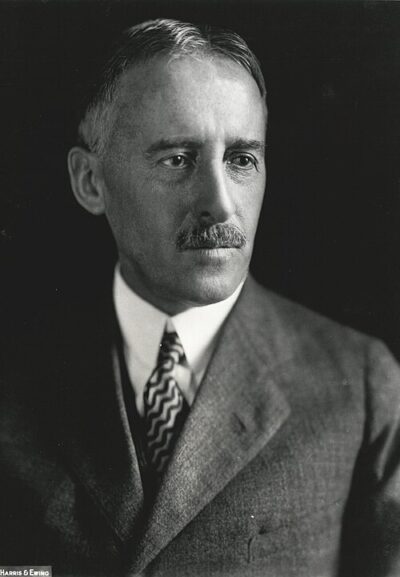
Henry L. Stimson
Henry L. Stimson was an United States Secretary of War. Born September 21, 1867, in New York City. Died October 20, 1950, in Huntington. Positions held include United States Secretary of War (2 times) (1911–1945), Governor-General of the Philippines (1927–1929) and United States Secretary of State (1929–1933). Educated at Yale College and Harvard Law School.
Facts
24 facts · 2 confirmed by two sources · 8 cited · 14 from one source
Where this comes from
Papalocal keeps its own record. It started from these sources; what each one said is kept here as it was copied, so a change on their side never changes this page by itself. Tap one to read its version.
What Wikidata says · copied November 13, 2026 · revision 2568764873
- Described as
- United States Secretary of War (1867-1950)
- Other names
- Henry Lewis Stimson, Henry Stimson
- Born
- September 21, 1867 · 9 references
- Died
- October 20, 1950 · 9 references
- Born in
- New York City · 2 references
- Died in
- Huntington · 1 reference
- Buried in
- Memorial Cemetery of St. John's Church
- Citizen of
- United States
- Occupation
- politician · 1 reference; lawyer; diplomat; jurist · 1 reference; foreign minister · 1 reference
- Positions held
- United States Secretary of War (2 times) (1911–1945); Governor-General of the Philippines (1927–1929); United States Secretary of State (1929–1933); defence minister · 1 reference
- Political party
- Republican Party
- Education
- Yale College; Harvard Law School; Phillips Academy · 1 reference
- Member of
- American Legion · 1 reference; Phi Beta Kappa Society
- Father
- Lewis Atterbury Stimson
- Mother
- Candace Thurber Stimson · 1 reference
- Religion
- Presbyterianism
- Wikipedias with a page
- 45
Wikidata item Q314826 (wikidata.org/wiki/Q314826), public domain (CC0). Copied November 13, 2026.
What Wikipedia says · copied November 13, 2026 · revision 1381369921
Henry Lewis Stimson (September 21, 1867 – October 20, 1950) was an American statesman, lawyer, and politician. Over his long career, he emerged as a leading figure in U.S. foreign policy by serving in both Republican and Democratic administrations. He served as Secretary of War (1911–1913) under President William Howard Taft, Secretary of State (1929–1933) under President Herbert Hoover, and again Secretary of War (1940–1945) under Presidents Franklin D. Roosevelt and Harry S. Truman, overseeing American military efforts during World War II.
The son of surgeon Lewis Atterbury Stimson and Candace C. Stimson (née Wheeler, daughter of Candace Thurber Wheeler), Stimson became a Wall Street lawyer after graduating from Harvard Law School. He served as a United States attorney under President Theodore Roosevelt, and prosecuted several antitrust cases. After he was defeated in the 1910 New York gubernatorial election, Stimson served as Secretary of War under Taft. He continued the reorganization of the United States Army that had begun under his mentor, Elihu Root. After the outbreak of World War I, Stimson became part of the Preparedness Movement. He served as an artillery officer in France after the United States entered the war. From 1927 to 1929, he served as governor-general of the Philippines under President Calvin Coolidge.
In 1929, President Hoover appointed Stimson as Secretary of State. Stimson sought to avoid a worldwide naval race, and thus helped negotiate the London Naval Treaty. He protested the Japanese invasion of Manchuria, which instituted the Stimson Doctrine of nonrecognition of international territorial changes that are executed by force.
After World War II broke out in Europe, Stimson accepted President Franklin Roosevelt's appointment to return as Secretary of War. After the U.S. entered the war, Stimson, working closely with Army Chief of Staff George C. Marshall, took charge of raising and training 13 million soldiers and airmen, supervised the spending of a third of the nation's GDP on the Army and the Air Forces, helped formulate military strategy, and oversaw the Manhattan Project to build the first atomic bombs. He supported the atomic bombings of Hiroshima and Nagasaki, but convinced Truman to take the historic city of Kyoto off the atom bomb target list. During and after the war, Stimson strongly opposed the Morgenthau Plan, which would have deindustrialized and partitioned Germany into several smaller states. He also insisted on judicial proceedings against Nazi war criminals, which led to the Nuremberg trials.
Stimson retired from office in September 1945 and died in 1950.
- Born, in its opening lines
- September 21, 1867
- Died, in its opening lines
- October 20, 1950
From the Wikipedia article “Henry L. Stimson” (en.wikipedia.org/wiki/Henry_L._Stimson), by its contributors, under CC BY-SA 4.0 (creativecommons.org/licenses/by-sa/4.0/). Copied November 13, 2026; not changed.
Confirmed Two sources agree. Cited One source, and it names where it got it. One source One source, without a reference of its own. Sources disagree The sources disagree. We show the best-supported value and keep theirs below.
