
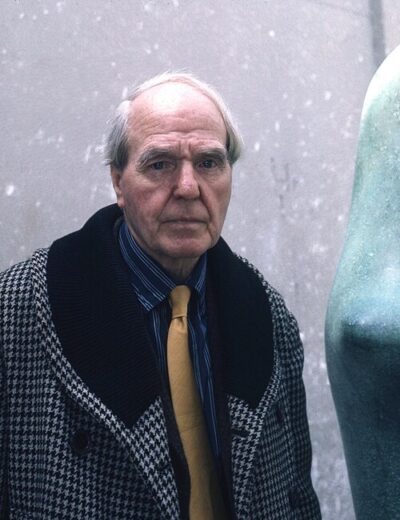
Henry Moore
Henry Moore was an English sculptor. Born July 30, 1898, in Castleford. Died August 31, 1986, in Perry Green. Known for Draped Seated Woman, Reclining Figure: Festival and Two-Piece Reclining Figure: Points. Educated at Royal College of Art and Castleford Academy. Awards include Pour le Mérite for Sciences and Arts order, Goslarer Kaiserring and Erasmus Prize.
Facts
45 facts · 2 confirmed by two sources · 17 cited · 26 from one source
Where this comes from
Papalocal keeps its own record. It started from these sources; what each one said is kept here as it was copied, so a change on their side never changes this page by itself. Tap one to read its version.
What Wikidata says · copied November 16, 2026 · revision 2569602863
- Described as
- English sculptor (1898–1986)
- Other names
- Henri Mor, Henry Moore II, Heng-li Mo-erh, Henari Mure, Henry II Moore, Henri Mur, Henry Spencer Moore
- Born
- July 30, 1898 · 18 references
- Died
- August 31, 1986 · 19 references
- Born in
- Castleford · 4 references
- Died in
- Perry Green · 1 reference
- Buried in
- St Thomas Churchyard · 1 reference
- Citizen of
- United Kingdom · 2 references; United Kingdom of Great Britain and Ireland (–1927)
- Occupation
- sculptor · 5 references; watercolorist · 1 reference; illustrator · 1 reference; printmaker · 2 references; bandmaster · 2 references; visual artist · 3 references; graphic artist · 2 references; architectural drafter · 1 reference
- Education
- Royal College of Art; Castleford Academy; Leeds Arts University
- Member of
- Serbian Academy of Sciences and Arts; Royal Swedish Academy of Fine Arts; British Academy; National Academy of Fine Arts (Argentina); Koninklijke Vlaamse Academie van België voor Wetenschappen en Kunsten · 1 reference; Académie des beaux-arts; American Philosophical Society (1980–)
- Genre
- abstract art · 2 references; Organic abstraction; figurative art · 2 references; public art · 1 reference
- Known for
- Draped Seated Woman; Reclining Figure: Festival; Two-Piece Reclining Figure: Points
- Awards
- Pour le Mérite for Sciences and Arts order; Goslarer Kaiserring (1975); Erasmus Prize (1968) · 1 reference; Fellow of the British Academy; Austrian Decoration for Science and Art (1978); honorary doctor of the University of Madrid Complutense (1981); Eugene McDermott Award in the Arts at MIT (1981) · 1 reference; Order of the Companions of Honour; Order of Merit
- Spouse
- Irina Radetsky; Irina Moore · 1 reference
- Military branch
- British Army
- Website
- https://www.henry-moore.org/ · 1 reference
- Wikipedias with a page
- 71
Wikidata item Q151097 (wikidata.org/wiki/Q151097), public domain (CC0). Copied November 16, 2026.
What Wikipedia says · copied November 16, 2026 · revision 1384503647
Henry Spencer Moore (30 July 1898 – 31 August 1986) was an English visual artist. He is best known for his semi-abstract monumental bronze sculptures which are located around the world as public works of art. Moore also produced many drawings, including a series depicting Londoners sheltering from the Blitz during the Second World War, along with other graphic works on paper.
His forms are usually abstractions of the human figure, typically depicting mother-and-child or reclining figures. Moore's works are usually suggestive of the female body, apart from a phase in the 1950s when he sculpted family groups. His forms are generally pierced or contain hollow spaces. Many interpreters liken the undulating form of his reclining figures to the landscape and hills of his Yorkshire birthplace.
Moore became well known through his carved marble and larger-scale abstract cast bronze sculptures, and was instrumental in introducing a particular form of modernism to the United Kingdom. His ability in later life to fulfil large-scale commissions made him exceptionally wealthy. Despite this, he lived frugally; most of the money he earned went towards endowing the Henry Moore Foundation, which continues to support education and promotion of the arts.
- Born, in its opening lines
- July 30, 1898
- Died, in its opening lines
- August 31, 1986
From the Wikipedia article “Henry Moore” (en.wikipedia.org/wiki/Henry_Moore), by its contributors, under CC BY-SA 4.0 (creativecommons.org/licenses/by-sa/4.0/). Copied November 16, 2026; not changed.
Confirmed Two sources agree. Cited One source, and it names where it got it. One source One source, without a reference of its own. Sources disagree The sources disagree. We show the best-supported value and keep theirs below.
