
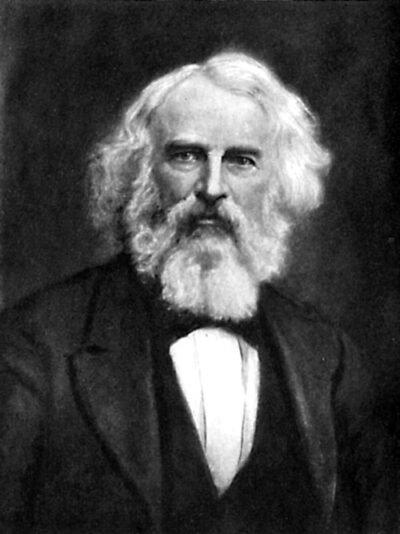
Henry Wadsworth Longfellow
Henry Wadsworth Longfellow was an American poet and educator. Born February 27, 1807, in Portland. Died March 24, 1882, in Cambridge. Known for The Song of Hiawatha, The Courtship of Miles Standish and Voices of the Night. Educated at Bowdoin College. Awards include Pour le Mérite for Sciences and Arts order and Fellow of the American Academy of Arts and Sciences.
Facts
48 facts · 2 confirmed by two sources · 15 cited · 31 from one source
Where this comes from
Papalocal keeps its own record. It started from these sources; what each one said is kept here as it was copied, so a change on their side never changes this page by itself. Tap one to read its version.
What Wikidata says · copied November 13, 2026 · revision 2567361296
- Described as
- American poet and educator (1807–1882)
- Other names
- H. W. Longfellow, Longfellow, Henry W. Longfellow
- Born
- February 27, 1807 · 14 references
- Died
- March 24, 1882 · 16 references
- Born in
- Portland · 1 reference
- Died in
- Cambridge · 1 reference
- Buried in
- Mount Auburn Cemetery · 1 reference
- Cause of death
- peritonitis
- Citizen of
- United States · 1 reference
- Occupation
- translator; poet · 1 reference; novelist; professor; writer · 2 references
- Worked for
- Harvard University
- Education
- Bowdoin College
- Member of
- American Academy of Arts and Sciences; Phi Beta Kappa Society
- Known for
- The Song of Hiawatha; The Courtship of Miles Standish; Voices of the Night; The Children's Hour; The Poet and his Songs; The Bridge; The Builders; The Old Clock on the Stairs; The Two Angels; The Rainy Day
- Awards
- Pour le Mérite for Sciences and Arts order; Fellow of the American Academy of Arts and Sciences
- Spouse
- Mary Storer Potter Longfellow · 1 reference; Fanny Appleton Longfellow · 2 references
- Children
- Alice Mary Longfellow; Ernest Wadsworth Longfellow · 1 reference; Edith Longfellow · 2 references; Frances Longfellow · 2 references; Charles Appleton Longfellow · 1 reference; Annie Longfellow Thorp
- Father
- Stephen Longfellow · 1 reference
- Mother
- Zilpah Wadsworth · 1 reference
- Siblings
- Samuel Longfellow · 1 reference; Anne Longfellow Pierce; Mary Longfellow Greenleaf; Stephen Longfellow; Alexander Wadsworth Longfellow
- Lived in
- Cambridge; Portland; Maine; Brattle Street; Kirkland Street · 1 reference
- Wikipedias with a page
- 116
Wikidata item Q152513 (wikidata.org/wiki/Q152513), public domain (CC0). Copied November 13, 2026.
What Wikipedia says · copied November 13, 2026 · revision 1383832975
Henry Wadsworth Longfellow (February 27, 1807 – March 24, 1882) was an American poet and educator. His original works include the poems "Paul Revere's Ride", The Song of Hiawatha, and Evangeline. He was the first American to completely translate Dante Alighieri's Divine Comedy and was one of the fireside poets from New England.
Longfellow was born in Portland, District of Maine, Massachusetts (now Portland, Maine). He graduated from Bowdoin College and became a professor there and, later, at Harvard College after studying in Europe. His first major poetry collections were Voices of the Night (1839) and Ballads and Other Poems (1841). He retired from teaching in 1854 to focus on his writing, and he lived the remainder of his life in the Revolutionary War headquarters of George Washington in Cambridge, Massachusetts.
Longfellow's first wife, Mary Potter, died in 1835 after a miscarriage. His second wife, Frances Appleton, died in 1861 after sustaining burns when her dress caught fire. After her death, he had difficulty writing poetry for a time and focused on translating works from foreign languages. Longfellow died in 1882.
Longfellow wrote many lyric poems known for their musicality and often presenting stories of mythology and legend. He became the most popular American poet of his day and had success overseas. After his death, his poetry declined in popularity and came to be criticized as too sentimental and too derivative of European poetic styles.
- Born, in its opening lines
- February 27, 1807
- Died, in its opening lines
- March 24, 1882
From the Wikipedia article “Henry Wadsworth Longfellow” (en.wikipedia.org/wiki/Henry_Wadsworth_Longfellow), by its contributors, under CC BY-SA 4.0 (creativecommons.org/licenses/by-sa/4.0/). Copied November 13, 2026; not changed.
Confirmed Two sources agree. Cited One source, and it names where it got it. One source One source, without a reference of its own. Sources disagree The sources disagree. We show the best-supported value and keep theirs below.
