
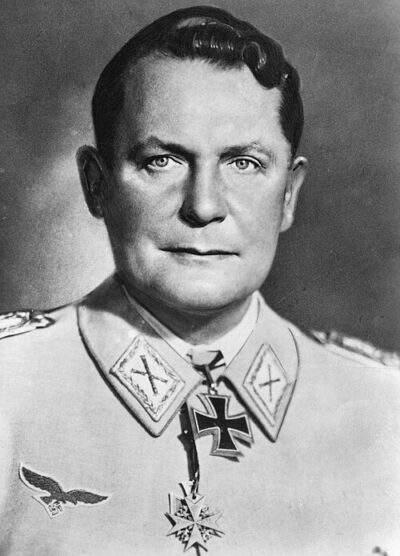
Hermann Göring
Hermann Göring was a German Nazi politician, military leader, and convicted war criminal. Born January 12, 1893, in Rosenheim. Died October 15, 1946, in Nuremberg Court Prison. Positions held include member of the Reichstag of the Weimar Republic, member of the Reichstag of Nazi Germany and Vice-Chancellor of Germany (1941–1945). Known for Gestapo. Educated at LMU Munich and Royal Prussian Main Cadet Institute. Awards include Pour le Mérite, Knight's Cross of the Iron Cross and Order of the Rising Sun with Paulownia Flowers, 1st class.
Facts
57 facts · 2 confirmed by two sources · 22 cited · 33 from one source
Where this comes from
Papalocal keeps its own record. It started from these sources; what each one said is kept here as it was copied, so a change on their side never changes this page by itself. Tap one to read its version.
What Wikidata says · copied November 16, 2026 · revision 2563976383
- Described as
- German Nazi politician, military leader, and convicted war criminal (1893–1946)
- Other names
- Field Marshal Hermann Goering, Hermann Wilhelm Goering, Hermann Goering, Hermann Wilhelm Göring, Herman Göring, Hermann Goring, Göring
- Born
- January 12, 1893 · 10 references
- Died
- October 15, 1946 · 12 references
- Born in
- Rosenheim · 3 references
- Died in
- Nuremberg Court Prison · 2 references
- Buried in
- Wenzbach · 1 reference
- Cause of death
- cyanide poisoning · 1 reference
- Name at birth
- Hermann Wilhelm Göring
- Citizen of
- German Empire · 1 reference; Nazi Germany; Germany · 1 reference
- Occupation
- politician · 3 references; aircraft pilot; art collector · 3 references; war criminal; air force officer; military officer · 2 references; fighter pilot · 2 references; minister · 2 references
- Positions held
- member of the Reichstag of the Weimar Republic; member of the Reichstag of Nazi Germany; Vice-Chancellor of Germany (1941–1945); Minister President of Prussia (1933–1945); Reichsstatthalter (1933–1945); member of parliament · 1 reference
- Political party
- Nazi Party (2 times) (1922–1945) · 2 references
- Education
- LMU Munich (1922–1923) · 2 references; Royal Prussian Main Cadet Institute (1909–1914) · 1 reference; Royal Prussian Cadet House Karlsruhe (1905–1909) · 1 reference
- Member of
- Sturmabteilung
- Known for
- Gestapo · 1 reference
- Awards
- Pour le Mérite (1918); Knight's Cross of the Iron Cross; Order of the Rising Sun with Paulownia Flowers, 1st class; Collar of the Imperial Order of the Red Arrows (1938) · 1 reference; Grand Cross of the Iron Cross (1939) (1940–1945) · 2 references; Golden Party Badge; Blood Order; Order of the Rising Sun, 1st class; Royal Order of the Sword; Knight Grand Cross of the Order of Saint Stephen of Hungary; Order of the Most Holy Annunciation; Knight Grand Cross of the Order of Saints Maurice and Lazarus; Knight grand cross of the order of the crown of Italy; Grand Cross with Collar of the Order of the White Rose of Finland (1941) · 1 reference; knight of the Royal House Order of Hohenzollern with Swords (1917) · 1 reference
- Spouse
- Carin Göring (1923–1931) · 1 reference; Emmy Göring (1935–1946) · 1 reference
- Children
- Edda Göring
- Father
- Heinrich Ernst Göring
- Mother
- Franziska Tiefenbrunn · 1 reference
- Siblings
- Albert Göring · 1 reference
- Religion
- Lutheranism · 1 reference
- Military branch
- Luftwaffe
- Military rank
- Reichsmarschall (1940–); Generalfeldmarschall (1938–1940)
- Lived in
- Reichstagspräsidentenpalais (1932–)
- Height
- 1.78 m (5 ft 10 in) · 1 reference
- Wikipedias with a page
- 111
Wikidata item Q47906 (wikidata.org/wiki/Q47906), public domain (CC0). Copied November 16, 2026.
What Wikipedia says · copied November 16, 2026 · revision 1384062474
Hermann Wilhelm Göring (or Goering; German: [ˈhɛʁman ˈvɪlhɛlm ˈɡøːʁɪŋ] ; 12 January 1893 – 15 October 1946) was a German politician, aviator, military commander, and convicted war criminal. He was one of the most powerful figures in the Nazi Party, which controlled Germany from 1933 to 1945. He also served as Oberbefehlshaber der Luftwaffe (Supreme Commander of the Air Force), a position he held until the final days of the regime.
He was born in Rosenheim, Bavaria. A veteran World War I fighter pilot ace, Göring was a recipient of the Pour le Mérite. He served as the last commander of Jagdgeschwader 1 (JG I), the fighter wing once led by Manfred von Richthofen. An early member of the Nazi Party, Göring was among those wounded in Adolf Hitler's failed Beer Hall Putsch in 1923. While receiving treatment for his injuries, he developed an addiction to morphine that persisted until the last year of his life. After Hitler became Chancellor of Germany in 1933, Göring was named as minister without portfolio in the new government. One of his first acts as a cabinet minister was to oversee the creation of the Gestapo, which he ceded to Heinrich Himmler in 1934.
Following the establishment of the Nazi state, Göring amassed power and political capital to become the second most powerful man in Germany. Upon being named Plenipotentiary of the Four Year Plan in 1936, Göring was entrusted with the task of mobilising all sectors of the economy for war, an assignment which brought numerous government agencies under his control. In September 1939, Hitler gave a speech to the Reichstag designating him as his successor. After the Fall of France in 1940, he was bestowed the specially created rank of Reichsmarschall, which gave him seniority over all officers in Germany's armed forces.
By 1941, Göring was at the peak of his power and influence. As the Second World War progressed, Göring's standing with Hitler and the German public declined after the Luftwaffe proved incapable of preventing the Allied bombing of Germany's cities and resupplying surrounded Axis forces in Stalingrad. Around that time, Göring increasingly withdrew from military and political affairs to devote his attention to collecting property and artwork, much of which was stolen from Jewish victims of the Holocaust. Informed on 22 April 1945 that Hitler intended to commit suicide, Göring sent a telegram to Hitler requesting his permission to assume leadership of the Reich. Considering his request an act of treason, Hitler removed Göring from all his positions, expelled him from the party and ordered his arrest.
After the war, Göring was convicted of conspiracy, crimes against peace, war crimes, and crimes against humanity at the Nuremberg trials in 1946. He requested at trial an execution by firing squad, but was denied; instead, he was sentenced to death by hanging. He died of suicide by ingesting cyanide the night before his scheduled execution.
- Born, in its opening lines
- January 12, 1893
- Died, in its opening lines
- October 15, 1946
From the Wikipedia article “Hermann Göring” (en.wikipedia.org/wiki/Hermann_Göring), by its contributors, under CC BY-SA 4.0 (creativecommons.org/licenses/by-sa/4.0/). Copied November 16, 2026; not changed.
Confirmed Two sources agree. Cited One source, and it names where it got it. One source One source, without a reference of its own. Sources disagree The sources disagree. We show the best-supported value and keep theirs below.
