
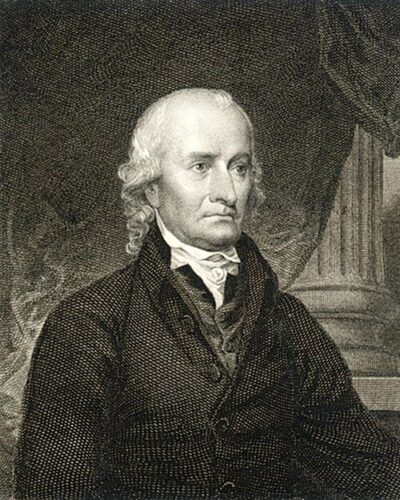
Hugh Williamson
Hugh Williamson was an American politician. Born December 5, 1735, in West Nottingham Township. Died May 22, 1819, in New York City. Positions held include United States representative (1790–1793) and Delegate to the United States Constitutional Convention (1787). Educated at University of Pennsylvania and Utrecht University.
Facts
15 facts · 2 confirmed by two sources · 2 cited · 11 from one source
Where this comes from
Papalocal keeps its own record. It started from these sources; what each one said is kept here as it was copied, so a change on their side never changes this page by itself. Tap one to read its version.
What Wikidata says · copied November 18, 2026 · revision 2564516041
- Described as
- American politician (1735-1819)
- Born
- December 5, 1735 · 2 references
- Died
- May 22, 1819 · 2 references
- Born in
- West Nottingham Township
- Died in
- New York City
- Buried in
- Trinity Church Cemetery · 1 reference
- Citizen of
- United States
- Occupation
- politician · 2 references
- Positions held
- United States representative (1790–1793); Delegate to the United States Constitutional Convention (1787) · 1 reference
- Political party
- Federalist Party
- Education
- University of Pennsylvania; Utrecht University
- Member of
- American Philosophical Society; American Antiquarian Society
- Spouse
- Maria Apthorp Williamson
- Wikipedias with a page
- 16
Wikidata item Q663151 (wikidata.org/wiki/Q663151), public domain (CC0). Copied November 18, 2026.
What Wikipedia says · copied November 18, 2026 · revision 1383144748
Hugh Williamson (December 5, 1735 – May 22, 1819) was an American Founding Father, medical doctor, and politician. He is best known as a signatory to the U.S. Constitution and for representing North Carolina at the Constitutional Convention.
Williamson was well known as a scholar, bringing him into contact with some of the leading intellectuals of the Patriot cause and, in turn, with the political ideas that eventually found expression in the Constitution. During the American Revolution, Williamson contributed his talents as a physician and natural scientist to the American war effort. His experiences during the revolution transformed him from a scholar into a politician and leader in the campaign for effective national government. Williamson's leadership was evident not only at the Convention in Philadelphia but also during the ratification debates in North Carolina.
Born on the frontier, he lived for significant periods of his life in three different regions of the country. That mobility contributed to the development of his nationalistic outlook, strengthened by wartime service with interstate military forces and reinforced by the interests of the planters and merchants that formed his North Carolina constituency. His experiences convinced him that only a strong central government could adequately protect and foster the political, economic, and intellectual future of the new nation.
- Born, in its opening lines
- December 5, 1735
- Died, in its opening lines
- May 22, 1819
From the Wikipedia article “Hugh Williamson” (en.wikipedia.org/wiki/Hugh_Williamson), by its contributors, under CC BY-SA 4.0 (creativecommons.org/licenses/by-sa/4.0/). Copied November 18, 2026; not changed.
Confirmed Two sources agree. Cited One source, and it names where it got it. One source One source, without a reference of its own. Sources disagree The sources disagree. We show the best-supported value and keep theirs below.
