
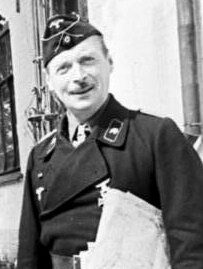
Hyazinth Graf Strachwitz von Gross-Zauche und Camminetz
Hyazinth Graf Strachwitz von Gross-Zauche und Camminetz was a German World War II general and Nazi party member. Born July 30, 1893, in Kamień Śląski. Died April 25, 1968, in Trostberg. Awards include Knight's Cross of the Iron Cross with Oak Leaves, Swords and Diamonds and German Cross in Gold.
Facts
16 facts · 2 confirmed by two sources · 7 cited · 7 from one source
What’s different
- Died: we show April 25, 1968 (Confirmed). Wikidata also lists April 26, 1968
Where this comes from
Papalocal keeps its own record. It started from these sources; what each one said is kept here as it was copied, so a change on their side never changes this page by itself. Tap one to read its version.
What Wikidata says · copied November 16, 2026 · revision 2569066689
- Described as
- German World War II general and Nazi party member (1893-1968)
- Other names
- Hyazinth von Strachwitz, Hyazinth Graf Strachwitz
- Born
- July 30, 1893 · 3 references
- Died
- April 25, 1968; April 26, 1968 · 1 reference
- Born in
- Kamień Śląski · 1 reference
- Died in
- Trostberg · 1 reference
- Cause of death
- lung cancer
- Citizen of
- Germany
- Occupation
- military personnel
- Political party
- Nazi Party (1932–) · 1 reference
- Member of
- Schutzstaffel · 1 reference
- Awards
- Knight's Cross of the Iron Cross with Oak Leaves, Swords and Diamonds; German Cross in Gold
- Field
- World War II · 1 reference; armored unit · 1 reference
- Military branch
- Imperial German Army · 1 reference
- Military rank
- Generalleutnant; general · 1 reference
- Wikipedias with a page
- 29
Wikidata item Q60722 (wikidata.org/wiki/Q60722), public domain (CC0). Copied November 16, 2026.
What Wikipedia says · copied November 16, 2026 · revision 1385975427
Hyacinth Graf Strachwitz von Groß-Zauche und Camminetz (30 July 1893 – 25 April 1968) was a German Army officer of aristocratic descent. Strachwitz saw action in World War I, but rose to fame for his command of armoured forces in World War II. For these services he was awarded the Knight's Cross of the Iron Cross with Oak Leaves, Swords and Diamonds (German: Ritterkreuz des Eisernen Kreuzes mit Eichenlaub, Schwertern und Brillanten). At the time of its presentation to Strachwitz it was Nazi Germany's highest military decoration.
Strachwitz was born in 1893 on his family estate in Silesia. He was educated at various Prussian military academies and served with distinction as a cavalry officer in the opening weeks of World War I. He was captured by the French in October 1914 and almost executed on the spot for wearing civilian clothes. He was later sentenced to forced labour and after an odyssey through various French prisons and several escape attempts he returned to Germany after the war in 1918. In the aftermath of World War I, Strachwitz fought with the Freikorps in the Spartacist uprising of the German Revolution in Berlin, and in the Silesian Uprisings against the Poles and Polish Silesians of Upper Silesia. In the mid-1920s he took over the family estate, Groß Stein, from his father and became a member of the Nazi Party and the Allgemeine SS. As an officer in the reserves, he participated in various military exercises during the 1930s.
At the outbreak of World War II, Strachwitz was appointed ordnance officer in his unit. He participated in the Invasion of Poland and later in the Battle of France. Transferred to the 16th Panzer Division he fought in the Invasion of Yugoslavia and Operation Barbarossa, the German invasion of the Soviet Union. He fought with distinction on the Eastern Front which led to the presentation of high awards such as the Knight's Cross of the Iron Cross with Oak Leaves, for the destruction of more than 270 Soviet tanks and artillery pieces within 48 hours in the tank battle of Kalach. He was given command of Panzer-Regiment "Großdeutschland" and received the Swords to his Knight's Cross, for his contribution in the counterattack at Kharkov. He then fought in the Battle of Kursk and the German retreat to the Dnieper. While commanding a battle group at Narva front in early 1944 he was awarded the Diamonds to his Knight's Cross on 15 April. He was wounded 12 times during the war, and was also injured in an automobile accident.
In 1945, he surrendered to US forces and was taken into custody. By the time of his release in June 1947, his youngest son had been killed in action, his wife had been killed in a road accident, and his Silesian estate had been confiscated by Poland. He remained in West Germany, married again and briefly worked for the Syrian Armed Forces as a military consultant. He lived on an estate in Bavaria from 1951 until his death from lung cancer on 25 April 1968. He was buried with military honours in Grabenstätt, Bavaria.
- Born, in its opening lines
- July 30, 1893
- Died, in its opening lines
- April 25, 1968
From the Wikipedia article “Hyacinth Graf Strachwitz” (en.wikipedia.org/wiki/Hyacinth_Graf_Strachwitz), by its contributors, under CC BY-SA 4.0 (creativecommons.org/licenses/by-sa/4.0/). Copied November 16, 2026; not changed.
Confirmed Two sources agree. Cited One source, and it names where it got it. One source One source, without a reference of its own. Sources disagree The sources disagree. We show the best-supported value and keep theirs below.
