
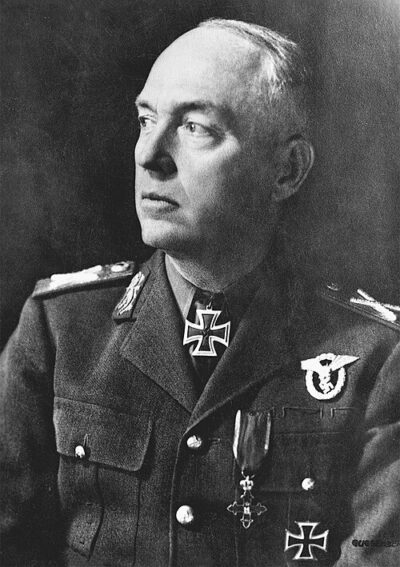
Ion Antonescu
Ion Antonescu was a prime minister of Romania during World War II; self-proclaimed "Leader" of the Romanian state between 1940–1944, executed for war crimes. Born June 2, 1882, in Pitești. Died June 1, 1946, in Jilava. Positions held include Prime Minister of Romania (1940–1944), Chief of the Romanian General Staff (1933–1934) and Minister of Foreign Affairs of Romania. Educated at École Spéciale Militaire de Saint-Cyr. Awards include Order of Michael the Brave, Grand Cross of the Order of the German Eagle in Gold with Swords and Grand Cross of the Order of the White Rose of Finland.
Facts
25 facts · 1 confirmed by two sources · 8 cited · 15 from one source · 1 where the sources disagree
What’s different
- Born: we show June 2, 1882 (Sources disagree). Wikipedia says June 14, 1882
Where this comes from
Papalocal keeps its own record. It started from these sources; what each one said is kept here as it was copied, so a change on their side never changes this page by itself. Tap one to read its version.
What Wikidata says · copied November 16, 2026 · revision 2565464361
- Described as
- prime minister of Romania during World War II; self-proclaimed "Leader" of the Romanian state between 1940–1944, executed for war crimes (1882–1946)
- Born
- June 2, 1882 · 3 references
- Died
- June 1, 1946 · 9 references
- Born in
- Pitești · 2 references
- Died in
- Jilava · 1 reference
- Cause of death
- gunshot wound
- Citizen of
- Kingdom of Romania
- Occupation
- politician · 1 reference; military personnel · 1 reference; diplomat · 1 reference
- Positions held
- Prime Minister of Romania (1940–1944) · 1 reference; Chief of the Romanian General Staff (1933–1934); Minister of Foreign Affairs of Romania
- Political party
- independent politician · 1 reference
- Education
- École Spéciale Militaire de Saint-Cyr
- Awards
- Order of Michael the Brave; Grand Cross of the Order of the German Eagle in Gold with Swords (1942) · 1 reference; Grand Cross of the Order of the White Rose of Finland (1941) · 1 reference; Grand Cross of the Order of the Cross of Liberty (1943) · 1 reference; Crimea Shield in Gold (1943) · 2 references; Iron Cross (1939), 2nd class (1941) · 1 reference; Iron Cross (1939), 1st class (1941) · 1 reference; Knight's Cross of the Iron Cross (1941) · 1 reference
- Spouse
- Maria Antonescu (1927–1946)
- Military branch
- Romanian Land Forces · 1 reference
- Military rank
- marshal
- Wikipedias with a page
- 69
Wikidata item Q152030 (wikidata.org/wiki/Q152030), public domain (CC0). Copied November 16, 2026.
What Wikipedia says · copied November 16, 2026 · revision 1378681333
Ion Antonescu (; Romanian: [iˈon antoˈnesku] ; 14 June [O.S. 2 June] 1882 – 1 June 1946) was a Romanian military officer and marshal who presided over two successive wartime dictatorships as Prime Minister and Conducător during most of World War II. Having been responsible for facilitating the Holocaust in Romania, he was overthrown in 1944, before being tried for war crimes and executed two years later in 1946.
A Romanian Army career officer who made his name during the 1907 peasants' revolt and the World War I Romanian campaign, the antisemitic Antonescu sympathised with far-right and fascist politics. He was a military attaché to France and later Chief of the General Staff, briefly serving as Defence Minister in the National Christian cabinet of Octavian Goga as well as the subsequent First Cristea cabinet, in which he also served as Air and Marine Minister. During the late 1930s, his political stance brought him into conflict with King Carol II and led to his detainment. Antonescu rose to political prominence during the political crisis of 1940, and established the National Legionary State, an uneasy partnership with Horia Sima of the Iron Guard. After entering Romania into an alliance with Nazi Germany, he eliminated the Guard following their Legionary Rebellion of 1941. In addition to being Prime Minister, he served as his own Foreign Minister and Defence Minister. Soon after Romania joined the Axis in Operation Barbarossa, recovering Bessarabia, Northern Bukovina and the Hertsa region, which had been occupied one year earlier by the Soviet Union, Antonescu also became Marshal of Romania.
An atypical figure among Holocaust perpetrators, Antonescu enforced policies independently responsible for the deaths of as many as 400,000 people, most of them Bessarabian, Ukrainian and Romanian Jews, as well as Romanian Romani. The regime's complicity in the Holocaust combined pogroms and mass murders such as the Odessa massacre with ethnic cleansing and systematic deportations to occupied Transnistria. The system in place was nevertheless characterized by singular inconsistencies, prioritizing plunder over killing, showing leniency toward most Jews in the Old Kingdom, and ultimately refusing to adopt the Final Solution. This was made possible by the fact that Romania, as an ally of Nazi Germany, was not occupied by the Wehrmacht and preserved a degree of political autonomy.
Aerial attacks on Romania by the Allies in 1944 and heavy casualties on the Eastern Front prompted Antonescu to open peace negotiations with the Allies, which were inconclusive. On 23 August 1944, King Michael I led a coup d'état against Antonescu, who was arrested; after the war he was convicted of war crimes, being executed in June 1946. His involvement in the Holocaust was officially reasserted and condemned following the 2003 Wiesel Commission report.
- Born, in its opening lines
- June 14, 1882
- Died, in its opening lines
- June 1, 1946
From the Wikipedia article “Ion Antonescu” (en.wikipedia.org/wiki/Ion_Antonescu), by its contributors, under CC BY-SA 4.0 (creativecommons.org/licenses/by-sa/4.0/). Copied November 16, 2026; not changed.
Confirmed Two sources agree. Cited One source, and it names where it got it. One source One source, without a reference of its own. Sources disagree The sources disagree. We show the best-supported value and keep theirs below.
