
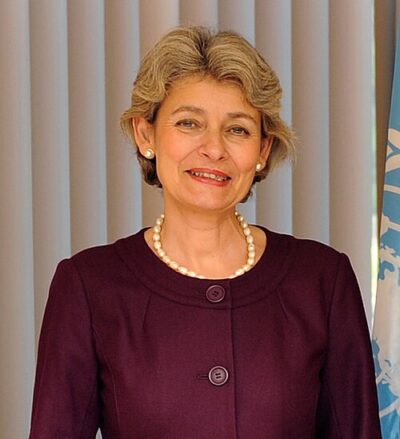
Irina Bokova
Irina Bokova is a Bulgarian diplomat. Born July 12, 1952, in Sofia. Positions held include Minister of Foreign Affairs (1996–1997), Director-General of UNESCO (2009–2017) and Ambassador of Bulgaria to France (2005–2009). Educated at Moscow State Institute of International Relations and John F. Kennedy School of Government. Awards include Commander of the Legion of Honour, Hilal-e-Pakistan and Officer of the National Order of Quebec.
Facts
42 facts · 1 confirmed by two sources · 12 cited · 29 from one source
Where this comes from
Papalocal keeps its own record. It started from these sources; what each one said is kept here as it was copied, so a change on their side never changes this page by itself. Tap one to read its version.
What Wikidata says · copied November 16, 2026 · revision 2568798607
- Described as
- Bulgarian diplomat
- Other names
- Irina Georgieva Bokova, Irina Gueorguieva Bokova
- Born
- July 12, 1952 · 5 references
- Born in
- Sofia · 2 references
- Citizen of
- Bulgaria
- Occupation
- diplomat; politician · 1 reference; social activist; ambassador · 1 reference
- Positions held
- Minister of Foreign Affairs (1996–1997); Director-General of UNESCO (2009–2017); Ambassador of Bulgaria to France (2005–2009); Special Guest of the Parliamentary Assembly of the Council of Europe (1990–1992) · 1 reference; administrator (2021); member of the Bulgarian National Assembly (1990–) · 1 reference
- Political party
- Bulgarian Socialist Party
- Worked for
- UNESCO · 1 reference
- Education
- Moscow State Institute of International Relations; John F. Kennedy School of Government; First English Language School
- Member of
- Parliamentary Assembly of the Council of Europe; Academia Europaea (2010–) · 1 reference; American Academy of Arts and Sciences
- Awards
- Commander of the Legion of Honour; Hilal-e-Pakistan (2014); Officer of the National Order of Quebec (2017) · 1 reference; Duke of Edinburgh Conservation Award (2016); Order of Stara Planina (2014) · 1 reference; Grand Cross of the Order of the Sun of Peru; Order of Merit of Benin; Officer of the Order of Cultural Merit; Order of José Matías Delgado; Order of Juan Mora Fernández; Order of Diplomatic Service Merit; Commander of the Order of Ouissam Alaouite (2014) · 1 reference; Order of Valour (2014) · 1 reference; Dostyk Order of grade I (2014) · 1 reference; Order of the Polar Star (2015) · 1 reference
- Field
- politics; diplomacy; diplomat · 1 reference
- Father
- Georgi Bokov
- Siblings
- Philip Bokov
- Website
- http://www.irinabokova.com/
- Wikipedias with a page
- 57
Wikidata item Q230850 (wikidata.org/wiki/Q230850), public domain (CC0). Copied November 16, 2026.
What Wikipedia says · copied November 16, 2026 · revision 1373160063
Irina Georgieva Bokova (Bulgarian: Ирина Георгиева Бокова; born 12 July 1952) is a Bulgarian politician and a former Director-General of UNESCO (2009–2017). During her political and diplomatic career in Bulgaria, she served, among others, two terms as a member of the National parliament, and deputy minister of foreign affairs and minister of foreign affairs ad interim under Prime Minister Zhan Videnov. She also served as Bulgaria's ambassador to France and to Monaco, and was Bulgaria's Permanent Delegate to UNESCO. Bokova was also the personal representative of Bulgaria's president to the Organisation internationale de la Francophonie (2005–2009).
On 15 November 2009, she took office as the ninth Director-General of UNESCO, marking two firsts: she became both the first female and the first Southeastern European to head the agency. At UNESCO, Bokova advocated for gender equality, improved education and preventing funding for terrorism, especially by enforcing the protection of intellectual goods. Currently, she is co-founder and member of GWL Voices.
- Born, in its opening lines
- July 12, 1952
From the Wikipedia article “Irina Bokova” (en.wikipedia.org/wiki/Irina_Bokova), by its contributors, under CC BY-SA 4.0 (creativecommons.org/licenses/by-sa/4.0/). Copied November 16, 2026; not changed.
Confirmed Two sources agree. Cited One source, and it names where it got it. One source One source, without a reference of its own. Sources disagree The sources disagree. We show the best-supported value and keep theirs below.
