
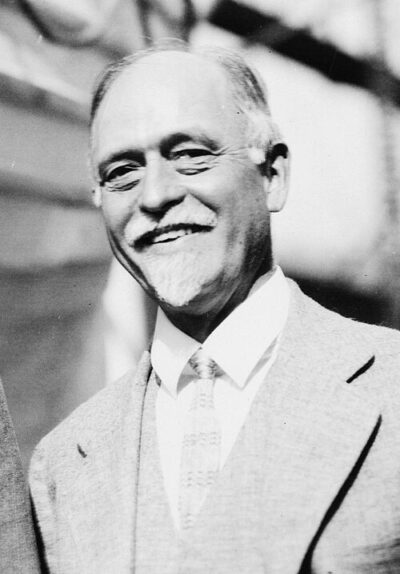
Irving Fisher
Irving Fisher was an American economist and statistician. Born February 27, 1867, in Saugerties. Died April 29, 1947, in New York City. Positions held include president. Known for quantity theory of money. Educated at Yale University. Awards include Josiah Willard Gibbs Lectureship, Fellow of the Econometric Society and Fellow of the Institute of Mathematical Statistics.
Facts
24 facts · 2 confirmed by two sources · 8 cited · 14 from one source
What’s different
- Born: we show February 27, 1867 (Confirmed). Wikidata also lists February 7, 1867
Where this comes from
Papalocal keeps its own record. It started from these sources; what each one said is kept here as it was copied, so a change on their side never changes this page by itself. Tap one to read its version.
What Wikidata says · copied November 13, 2026 · revision 2565530097
- Described as
- American economist and statistician (1867–1947)
- Born
- February 27, 1867 · 6 references; February 7, 1867 · 1 reference
- Died
- April 29, 1947 · 7 references
- Born in
- Saugerties
- Died in
- New York City · 1 reference
- Buried in
- Evergreen Cemetery · 1 reference
- Citizen of
- United States
- Occupation
- economist · 1 reference; statistician; inventor · 1 reference
- Positions held
- president
- Worked for
- Yale University
- Education
- Yale University
- Member of
- American Academy of Arts and Sciences; Accademia Nazionale dei Lincei (1921–) · 1 reference; Institute of Mathematical Statistics (1938–) · 1 reference; Econometric Society (1933–) · 1 reference; American Philosophical Society (1927–)
- Known for
- quantity theory of money · 1 reference
- Awards
- Josiah Willard Gibbs Lectureship (1929); Fellow of the Econometric Society (1933) · 1 reference; Fellow of the Institute of Mathematical Statistics (1938) · 1 reference
- Field
- economics
- Children
- Irving Norton Fisher · 1 reference
- Religion
- atheism
- Wikipedias with a page
- 46
Wikidata item Q312739 (wikidata.org/wiki/Q312739), public domain (CC0). Copied November 13, 2026.
What Wikipedia says · copied November 13, 2026 · revision 1379800518
Irving Fisher (February 27, 1867 – April 29, 1947) was an American economist, statistician, inventor, eugenicist and progressive social campaigner. He was one of the earliest American neoclassical economists, though his later work on debt deflation has been embraced by the post-Keynesian school. Joseph Schumpeter described him as "the greatest economist the United States has ever produced", an assessment later repeated by James Tobin and Milton Friedman.
Fisher made important contributions to utility theory and general equilibrium. He was also a pioneer in the rigorous study of intertemporal choice in markets, which led him to develop a theory of capital and interest rates. His research on the quantity theory of money inaugurated the school of macroeconomic thought known as "monetarism". Fisher was also a pioneer of econometrics, including the development of index numbers. Some concepts named after him include the Fisher equation, the Fisher hypothesis, the international Fisher effect, the Fisher separation theorem and Fisher market.
Fisher was perhaps the first celebrity economist, but his reputation during his lifetime was irreparably harmed by his public statement, just nine days before the Wall Street Crash of 1929, that the stock market had reached "a permanently high plateau". His subsequent theory of debt deflation as an explanation of the Great Depression, as well as his advocacy of full-reserve banking and alternative currencies, were largely ignored in favor of the work of John Maynard Keynes. Fisher's reputation has since recovered in academic economics, particularly after his theoretical models were rediscovered in the late 1960s to the 1970s, a period of increasing reliance on mathematical models within the field. Interest in him has also grown in the public due to an increased interest in debt deflation after the Great Recession.
Fisher was one of the foremost proponents of the full-reserve banking, which he advocated as one of the authors of A Program for Monetary Reform where the general proposal is outlined.
- Born, in its opening lines
- February 27, 1867
- Died, in its opening lines
- April 29, 1947
From the Wikipedia article “Irving Fisher” (en.wikipedia.org/wiki/Irving_Fisher), by its contributors, under CC BY-SA 4.0 (creativecommons.org/licenses/by-sa/4.0/). Copied November 13, 2026; not changed.
Confirmed Two sources agree. Cited One source, and it names where it got it. One source One source, without a reference of its own. Sources disagree The sources disagree. We show the best-supported value and keep theirs below.
