
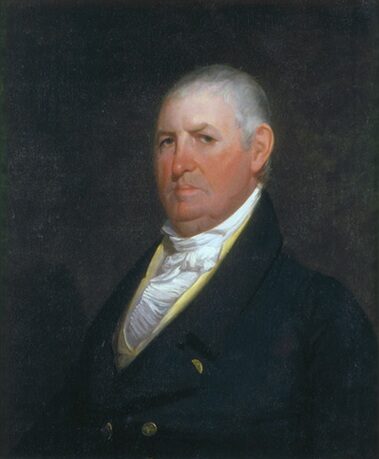
Isaac Shelby
Isaac Shelby was an American politician. Born December 11, 1750, in Frederick County. Died July 18, 1826, in Lincoln County. Positions held include Governor of Kentucky (2 times) (1792–1816), member of the North Carolina House of Commons and member of the Virginia House of Delegates. Awards include Congressional Gold Medal.
Facts
20 facts · 2 confirmed by two sources · 2 cited · 16 from one source
Where this comes from
Papalocal keeps its own record. It started from these sources; what each one said is kept here as it was copied, so a change on their side never changes this page by itself. Tap one to read its version.
What Wikidata says · copied November 18, 2026 · revision 2544777448
- Described as
- American politician (1750-1826)
- Born
- December 11, 1750 · 3 references
- Died
- July 18, 1826 · 3 references
- Born in
- Frederick County
- Died in
- Lincoln County
- Cause of death
- stroke
- Citizen of
- Kingdom of Great Britain; United States
- Occupation
- politician · 2 references; farmer
- Positions held
- Governor of Kentucky (2 times) (1792–1816); member of the North Carolina House of Commons; member of the Virginia House of Delegates · 1 reference
- Political party
- Democratic-Republican Party
- Awards
- Congressional Gold Medal
- Spouse
- Susannah Shelby
- Children
- Sarah Shelby McDowell; Letitia Shelby Todd; Susannah Hart Shelby McDowell Shannon McKinney Fishback; Thomas Hart Shelby
- Siblings
- Moses Shelby
- Wikipedias with a page
- 17
Wikidata item Q878398 (wikidata.org/wiki/Q878398), public domain (CC0). Copied November 18, 2026.
What Wikipedia says · copied November 18, 2026 · revision 1376089242
Isaac Shelby (December 11, 1750 – July 18, 1826) was an American politician and military officer who was the first and fifth governor of Kentucky and served in the state legislatures of Virginia and North Carolina. He also fought in Lord Dunmore's War, the American Revolutionary War, and the War of 1812. While governor, he led the Kentucky militia in the Battle of the Thames, an action that was rewarded with a Congressional Gold Medal. Counties in nine states, and several cities and military bases, have been named in his honor. His fondness for John Dickinson's "The Liberty Song" is believed to be the reason Kentucky adopted the state motto "United we stand, divided we fall".
Shelby's military service began when he served as second-in-command to his father at the Battle of Point Pleasant, the only major battle of Lord Dunmore's War. He gained the reputation of an expert woodsman and surveyor and spent the early part of the Revolutionary War gathering supplies for the Continental Army. Later in the war, he and John Sevier led expeditions over the Appalachian Mountains against British forces in North Carolina. He played a pivotal role in the American victory at the Battle of Kings Mountain. For his service, Shelby was presented with a ceremonial sword and a pair of pistols by the North Carolina legislature, and the nickname "Old Kings Mountain" followed him the rest of his life.
Following the war, Shelby relocated to Kentucky on lands awarded to him for his military service and became involved in Kentucky's transition from a county of Virginia to a separate state. His heroism made him popular with the state's citizens, and the Kentucky electoral college unanimously elected him governor in 1792. He secured Kentucky from Indian attacks and organized its first government. He used the Citizen Genêt affair to convince the Washington administration to conclude an agreement with the Spanish Empire for free trade on the Mississippi River.
At the end of his gubernatorial term, Shelby retired from public life, but he was called back into politics by the impending War of 1812. Kentuckians urged Shelby to run for governor again and lead them through the anticipated conflict. He was elected easily and, at the request of General William Henry Harrison, commanded troops from Kentucky at the Battle of the Thames. After the war, he declined President James Monroe's offer to become Secretary of War. In his last act of public service, Shelby and Andrew Jackson acted as commissioners to negotiate the Jackson Purchase from the Chickasaw Indian tribe. Shelby died at his estate in Lincoln County, Kentucky on July 18, 1826.
- Born, in its opening lines
- December 11, 1750
- Died, in its opening lines
- July 18, 1826
From the Wikipedia article “Isaac Shelby” (en.wikipedia.org/wiki/Isaac_Shelby), by its contributors, under CC BY-SA 4.0 (creativecommons.org/licenses/by-sa/4.0/). Copied November 18, 2026; not changed.
Confirmed Two sources agree. Cited One source, and it names where it got it. One source One source, without a reference of its own. Sources disagree The sources disagree. We show the best-supported value and keep theirs below.
