
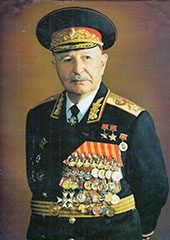
Ivan Bagramyan
Ivan Bagramyan was a Marshal of the Soviet Union. Born November 20, 1897, in Çardaqlı. Died September 21, 1982, in Moscow. Positions held include deputy of the Supreme Soviet of the Soviet Union. Educated at Military Academy of the General Staff of the Armed Forces of Russia and M.V. Frunze Military Academy. Awards include Hero of the Soviet Union (2 times), Gold Star medal (2 times) and Order of Lenin (7 times).
Facts
36 facts · 1 confirmed by two sources · 3 cited · 31 from one source · 1 where the sources disagree
What’s different
- Born: we show November 20, 1897 (Sources disagree). Wikipedia says December 2, 1897
Where this comes from
Papalocal keeps its own record. It started from these sources; what each one said is kept here as it was copied, so a change on their side never changes this page by itself. Tap one to read its version.
What Wikidata says · copied November 16, 2026 · revision 2569026346
- Described as
- Marshal of the Soviet Union (1897-1982)
- Other names
- Ivan Khristoforovich Bagramyan, Hovhannes Khachaturi Baghramyan, Hovhannes Baghramyan
- Born
- November 20, 1897 · 1 reference
- Died
- September 21, 1982 · 5 references
- Born in
- Çardaqlı
- Died in
- Moscow · 1 reference
- Buried in
- Kremlin Wall Necropolis
- Citizen of
- Russian Empire; First Republic of Armenia; Soviet Union
- Occupation
- politician · 1 reference; military officer; colonel · 1 reference
- Positions held
- deputy of the Supreme Soviet of the Soviet Union
- Political party
- Communist Party of the Soviet Union
- Education
- Military Academy of the General Staff of the Armed Forces of Russia (1936–1938); M.V. Frunze Military Academy (1931–1934)
- Member of
- Central Committee of the Communist Party of the Soviet Union
- Awards
- Hero of the Soviet Union (2 times) (1944, 1977); Gold Star medal (2 times) (1944, 1977); Order of Lenin (7 times) (1944, 1945, 1947, 1957, 1967, 1972, 1977); Order of the October Revolution (1968); Order of the Red Banner (3 times) (1941, 1944, 1951); Order of Suvorov, 1st class (2 times) (1943, 1945); Order of Kutuzov, 1st class (1943); Order "For Service to the Homeland in the Armed Forces of the USSR", 3rd class (1975); Jubilee Medal "In Commemoration of the 100th Anniversary of the Birth of Vladimir Ilyich Lenin"; Medal "For the Defence of Kyiv"; Medal "For the Victory over Germany in the Great Patriotic War 1941–1945"; Jubilee Medal "Twenty Years of Victory in the Great Patriotic War 1941–1945"; Jubilee Medal "Thirty Years of Victory in the Great Patriotic War 1941–1945"; Medal "For the Capture of Königsberg"; Medal "Veteran of the Armed Forces of the USSR"
- Military branch
- infantry; artillery branch
- Military rank
- Marshal of the Soviet Union (1955–); colonel (1935–); major general (1941–)
- Wikipedias with a page
- 56
Wikidata item Q48112 (wikidata.org/wiki/Q48112), public domain (CC0). Copied November 16, 2026.
What Wikipedia says · copied November 16, 2026 · revision 1375169699
Ivan Khristoforovich Bagramyan, born Hovhannes Baghramyan (2 December [O.S. 20 November] 1897 – 21 September 1982), was a Soviet military commander of Armenian origin who held the rank of Marshal of the Soviet Union. As commander of the 1st Baltic Front, he orchestrated the offensives which pushed German forces out of the Baltic countries on the Eastern Front of World War II.
Bagramyan was the second non-Slavic military officer, after Latvian Max Reyter, to become a commander of a front. He was among several high-ranking Armenian officers serving in the Soviet Army during the war. Bagramyan's experience in military planning as a chief of staff allowed him to distinguish himself as a capable commander in the early stages of the Soviet counter-offensives against Nazi Germany. He was given his first command of a unit in 1942, and in November 1943 received his most prestigious command as the commander of the 1st Baltic Front.
He did not immediately join the Communist Party after the consolidation of the October Revolution, becoming a member only in 1941, a move atypical for a Soviet military officer. After the war, he served as a deputy of the Supreme Soviets of the Latvian Soviet Socialist Republic and Armenian Soviet Socialist Republic and was a regular attendee of the Party Congresses. In 1952, he became a candidate for entry into the Central Committee and, in 1961, was inducted as a full member. For his contributions during the war, he was widely regarded as a national hero in the Soviet Union, and continues to hold such esteemed status among Armenians and Russians today.
- Born, in its opening lines
- December 2, 1897
- Died, in its opening lines
- September 21, 1982
From the Wikipedia article “Ivan Bagramyan” (en.wikipedia.org/wiki/Ivan_Bagramyan), by its contributors, under CC BY-SA 4.0 (creativecommons.org/licenses/by-sa/4.0/). Copied November 16, 2026; not changed.
Confirmed Two sources agree. Cited One source, and it names where it got it. One source One source, without a reference of its own. Sources disagree The sources disagree. We show the best-supported value and keep theirs below.
