
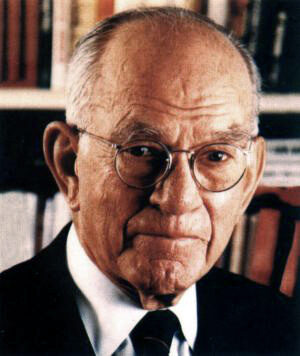
J. William Fulbright
J. William Fulbright was an American politician. Born April 9, 1905, in Sumner. Died February 9, 1995, in Washington, D.C.. Positions held include president (1939–1941), United States senator (1945–1974) and United States representative (1943–1945). Educated at University of Arkansas and George Washington University. Awards include Presidential Medal of Freedom, Four Freedoms Award – Freedom from Fear and Benjamin Franklin Medal.
Facts
40 facts · 2 confirmed by two sources · 19 cited · 19 from one source
Where this comes from
Papalocal keeps its own record. It started from these sources; what each one said is kept here as it was copied, so a change on their side never changes this page by itself. Tap one to read its version.
What Wikidata says · copied November 15, 2026 · revision 2567353336
- Described as
- American politician (1905–1995)
- Other names
- William Fulbright, James William Fulbright
- Born
- April 9, 1905 · 11 references
- Died
- February 9, 1995 · 11 references
- Born in
- Sumner
- Died in
- Washington, D.C. · 1 reference
- Buried in
- Evergreen Cemetery · 1 reference
- Cause of death
- stroke
- Citizen of
- United States
- Occupation
- politician · 1 reference; lawyer (1934–) · 1 reference; instructor (1935–) · 1 reference; lecturer (1936–1939) · 1 reference; banker · 1 reference; farmer · 1 reference
- Positions held
- president (1939–1941) · 1 reference; United States senator (1945–1974) · 1 reference; United States representative (1943–1945) · 2 references
- Political party
- Democratic Party
- Worked for
- University of Arkansas School of Law
- Education
- University of Arkansas; George Washington University; University College, Oxford; Pembroke College · 1 reference
- Member of
- American Academy of Arts and Sciences; Phi Beta Kappa Society; American Philosophical Society · 1 reference
- Teams
- Arkansas Razorbacks football · 1 reference
- Awards
- Presidential Medal of Freedom (1993) · 1 reference; Four Freedoms Award – Freedom from Fear (1989) · 1 reference; Benjamin Franklin Medal (1977); Commander with Star of the Order of Merit of the Republic of Poland; Rhodes Scholarship (1925) · 1 reference; Grand Cross of the Order of Civil Merit (1993) · 1 reference; honorary doctor of the Norwegian University of Science and Technology; honorary doctor of the University of Miami (1987) · 1 reference; doctor honoris causa from the University of Dijon (1957) · 1 reference
- Spouse
- Harriet Mayor Fulbright
- Father
- Jay Fulbright · 1 reference
- Mother
- Roberta Fulbright
- Siblings
- Roberta Fulbright Swanson
- Religion
- Christian Church (Disciples of Christ)
- Wikipedias with a page
- 31
Wikidata item Q550255 (wikidata.org/wiki/Q550255), public domain (CC0). Copied November 15, 2026.
What Wikipedia says · copied November 15, 2026 · revision 1384728166
James William Fulbright (April 9, 1905 – February 9, 1995) was an American politician, academic, and statesman who served as a United States Senator from Arkansas from 1945 until his resignation in 1974. As of 2023, Fulbright is the longest-serving chairman in the history of the United States Senate Committee on Foreign Relations. A member of the Democratic Party, he is best known for his strong multilateralist positions on international issues, opposition to American involvement in the Vietnam War, and the creation of the international fellowship program bearing his name, the Fulbright Program.
Fulbright was an admirer of Woodrow Wilson and an avowed anglophile. He was an early advocate for American entry into World War II and aid to Great Britain, first as a college professor and then as an elected member of the U.S. House of Representatives, where he authored the Fulbright Resolution expressing support for international peacekeeping initiatives and American entry into the United Nations.
After joining the Senate, Fulbright expressed support for Europeanism and the formation of a federal European union. He envisioned the Cold War as a struggle between nations – the United States and imperialist Russia – rather than ideologies. He therefore dismissed Asia as a peripheral theater of the conflict, focusing on containment of Soviet expansion into Central and Eastern Europe. He also stressed the possibility of nuclear annihilation, preferring political solutions over military solutions to Soviet aggression. After the Cuban Missile Crisis, his position moderated further to one of détente.
His political stances and powerful position as Chairman of the Senate Foreign Relations Committee made him one of the most visible critics of American involvement in the Vietnam War. Although he was persuaded by President Lyndon Johnson to sponsor the Gulf of Tonkin Resolution in 1964, his relationship with the President soured after the 1965 U.S. escalation of the war in Vietnam and Fulbright's opposition to the war took root. Beginning in 1966, he chaired high-profile hearings investigating the conduct and progress of the war, which may have influenced the eventual American withdrawal.
On domestic issues, Fulbright was a Southern Democrat and signatory to the Southern Manifesto, though his views on segregation were more moderate than most of his Southern colleagues. Fulbright opposed the anti-Communist crusades of Joseph McCarthy and the similar investigations by the House Un-American Activities Committee.
- Born, in its opening lines
- April 9, 1905
- Died, in its opening lines
- February 9, 1995
From the Wikipedia article “J. William Fulbright” (en.wikipedia.org/wiki/J._William_Fulbright), by its contributors, under CC BY-SA 4.0 (creativecommons.org/licenses/by-sa/4.0/). Copied November 15, 2026; not changed.
Confirmed Two sources agree. Cited One source, and it names where it got it. One source One source, without a reference of its own. Sources disagree The sources disagree. We show the best-supported value and keep theirs below.
