
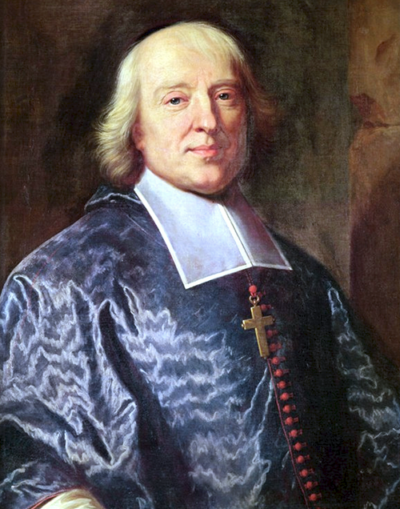
Jacques Bénigne Bossuet
Jacques Bénigne Bossuet was a French bishop and theologian. Born September 27, 1627, in Dijon. Died April 12, 1704, in Paris. Positions held include bishop of Condom (1669–1671), diocesan bishop (1669–1671) and Roman Catholic Bishop of Meaux (1681–1704). Educated at University of Paris and Moeritherium.
Facts
23 facts · 2 confirmed by two sources · 11 cited · 10 from one source
Where this comes from
Papalocal keeps its own record. It started from these sources; what each one said is kept here as it was copied, so a change on their side never changes this page by itself. Tap one to read its version.
What Wikidata says · copied November 16, 2026 · revision 2568731788
- Described as
- French bishop and theologian (1627-1704)
- Other names
- Jacques-Benigne Bossuet, Eagle of Meaux
- Born
- September 27, 1627 · 9 references
- Died
- April 12, 1704 · 11 references
- Born in
- Dijon · 2 references
- Died in
- Paris · 1 reference
- Buried in
- Meaux Cathedral · 1 reference
- Citizen of
- France
- Occupation
- historian · 1 reference; writer · 3 references; literary critic; poet; Catholic priest (1652–) · 1 reference; politician · 1 reference; philosopher · 2 references; orator · 1 reference
- Positions held
- bishop of Condom (1669–1671); diocesan bishop (1669–1671) · 2 references; Roman Catholic Bishop of Meaux (1681–1704) · 2 references; Member of the Académie française (1671–1704) · 2 references
- Education
- University of Paris; Moeritherium; Collège des Godrans
- Member of
- Académie Française (1671–1704) · 2 references
- Religion
- Catholic Church · 1 reference
- Wikipedias with a page
- 58
Wikidata item Q294100 (wikidata.org/wiki/Q294100), public domain (CC0). Copied November 16, 2026.
What Wikipedia says · copied November 16, 2026 · revision 1380349559
Jacques-Bénigne Lignel Bossuet (French: [bɔsɥɛ]; 27 September 1627 – 12 April 1704) was a French Catholic prelate and theologian who served as Bishop of Meaux from 1681 until his death in 1704. Renowned for his sermons, addresses and literary works, he is regarded as a brilliant orator and literary stylist of the French language.
A native of Dijon, Bossuet was educated at a Jesuit school before enrolling in the College of Navarre in Paris, where he studied philosophy and theology. In 1652, he was ordained a priest and became a Doctor of Divinity. He spent the next seven years at Metz, where he honed his skills in oratory and politics, before returning to Paris and establishing his reputation as a great preacher. By the early 1660s, Bossuet was preaching regularly before the court of King Louis XIV at Versailles. He was appointed tutor to the Dauphin in 1670 and elected to the Académie Française a year later.
In 1681, he was appointed Bishop of Meaux, a position he held until his death. Bossuet was a strong advocate of political absolutism and the divine right of kings. Later in his life, he was also involved in the controversies over Gallicanism and Quietism, and supported the king's revocation of the Edict of Nantes, which abolished the rights of the Huguenot Protestant minority. Bossuet died in 1704 at the age of 76.
The works of Bossuet best known to English speakers are three great orations delivered at the funerals of Queen Henrietta Maria, widow of Charles I of England (1669); of her daughter Henriette, Duchess of Orléans (1670) and of the outstanding military commander Le Grand Condé (1687). He published his Discours sur l'histoire universelle (Discourse on Universal History) in 1681.
- Born, in its opening lines
- September 27, 1627
- Died, in its opening lines
- April 12, 1704
From the Wikipedia article “Jacques-Bénigne Bossuet” (en.wikipedia.org/wiki/Jacques-Bénigne_Bossuet), by its contributors, under CC BY-SA 4.0 (creativecommons.org/licenses/by-sa/4.0/). Copied November 16, 2026; not changed.
Confirmed Two sources agree. Cited One source, and it names where it got it. One source One source, without a reference of its own. Sources disagree The sources disagree. We show the best-supported value and keep theirs below.
