
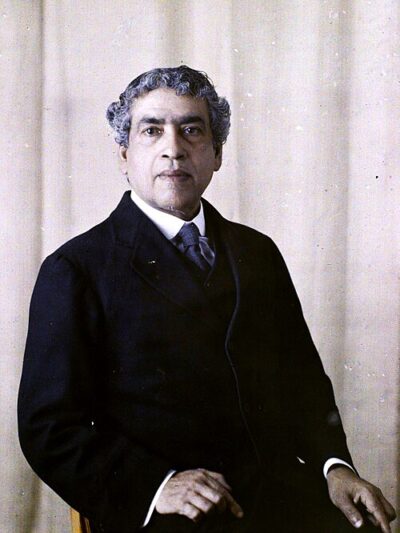
Jagadish Chandra Bose
Jagadish Chandra Bose was a Bengali polymath, physicist, and biologist. Born November 30, 1858, in Bikrampur. Died November 23, 1937, in Giridih. Known for Abyakta. Educated at Christ's College and University College London. Awards include Fellow of the Royal Society, Companion of the Order of the Indian Empire and Companion of the Order of the Star of India.
Facts
37 facts · 2 confirmed by two sources · 4 cited · 31 from one source
Where this comes from
Papalocal keeps its own record. It started from these sources; what each one said is kept here as it was copied, so a change on their side never changes this page by itself. Tap one to read its version.
What Wikidata says · copied November 16, 2026 · revision 2563963025
- Described as
- Bengali polymath, physicist, and biologist (1858–1937)
- Other names
- Jagadis Chunder, Sir Jagadish Chandra Bose, Acharya Jagariis Chunder Bose
- Born
- November 30, 1858 · 5 references
- Died
- November 23, 1937 · 5 references
- Born in
- Bikrampur
- Died in
- Giridih · 1 reference
- Citizen of
- British Raj
- Occupation
- botanist · 1 reference; university teacher; physicist · 1 reference; archaeologist · 1 reference; writer · 1 reference; chemist · 1 reference; essayist; short story writer
- Worked for
- Presidency University; University of Cambridge; University of London
- Education
- Christ's College; University College London; St. Xavier's College, Kolkata; Hare School; University of London · 1 reference; St. Xavier's Collegiate School
- Member of
- Royal Society of London; Indian National Science Academy
- Known for
- Abyakta
- Awards
- Fellow of the Royal Society; Companion of the Order of the Indian Empire (1903) · 1 reference; Companion of the Order of the Star of India (1912) · 1 reference; honorary doctor of the University of Calcutta; Knight Bachelor
- Field
- physics; biophysics; botany; archaeology
- Spouse
- Abala Bose (1887–) · 2 references
- Siblings
- Labanyaprabha Bose
- Religion
- Hinduism
- Wikipedias with a page
- 61
Wikidata item Q314267 (wikidata.org/wiki/Q314267), public domain (CC0). Copied November 16, 2026.
What Wikipedia says · copied November 16, 2026 · revision 1384658166
Sir Jagadish Chandra Bose (; IPA: [d͡ʒɔɡod̪iʃ t͡ʃɔn̪d̪ro boʃu]; 30 November 1858 – 23 November 1937) was a polymath with interests in biology, physics and writing science fiction. He was a pioneer in the investigation of radio microwave optics, made significant contributions to botany, and was a major force behind the expansion of experimental science on the Indian subcontinent. Bose is considered the father of Bengali science fiction. A crater on the Moon was named in his honour. He founded the Bose Institute, a premier research institute in India and also one of its oldest. Established in 1917, the institute was the first interdisciplinary research centre in Asia. He served as the Director of Bose Institute from its inception until his death.
Born in Mymensingh, Bengal Presidency (present-day Bangladesh), during British governance of India, Bose graduated from St. Xavier's College, Calcutta (now Kolkata, West Bengal, India). Prior to his enrollment at St. Xavier's College, Calcutta, Bose attended Pabna Zilla School and Dhaka Collegiate School, where he began his educational journey. He attended the University of London to study medicine, but had to give it up due to health problems. Instead, he conducted research with Nobel Laureate, Lord Rayleigh at the University of Cambridge. Bose returned to India to join the Presidency College of the University of Calcutta as a professor of physics. There, despite racial discrimination and a lack of funding and equipment, Bose carried on his scientific research. He made progress in his research into radio waves in the microwave spectrum and was the first to use semiconductor junctions to detect radio waves.
Bose made pioneering discoveries in plant physiology. He used his own invention, the crescograph, to measure plant response to various stimuli and proved parallelism between animal and plant tissues. Bose filed for a patent for one of his inventions because of peer pressure, but he was generally critical of the patent system. To facilitate his research, he constructed automatic recorders capable of registering extremely slight movements; these instruments produced some striking results, such as quivering of injured plants, which Bose interpreted as a power of feeling in plants. His books include Response in the Living and Non-Living (1902) and The Nervous Mechanism of Plants (1926). In a 2004 BBC poll to name the Greatest Bengali of All Time, Bose placed seventh.
- Born, in its opening lines
- November 30, 1858
- Died, in its opening lines
- November 23, 1937
From the Wikipedia article “Jagadish Chandra Bose” (en.wikipedia.org/wiki/Jagadish_Chandra_Bose), by its contributors, under CC BY-SA 4.0 (creativecommons.org/licenses/by-sa/4.0/). Copied November 16, 2026; not changed.
Confirmed Two sources agree. Cited One source, and it names where it got it. One source One source, without a reference of its own. Sources disagree The sources disagree. We show the best-supported value and keep theirs below.
