
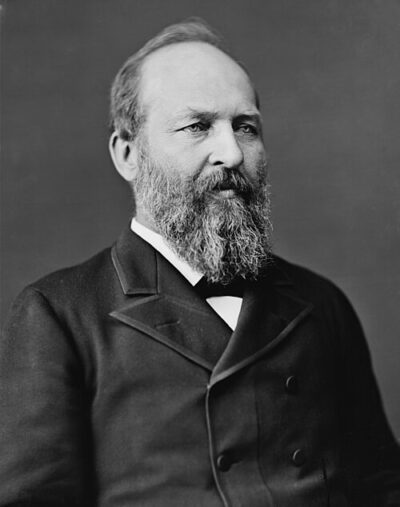
James A. Garfield
James A. Garfield was a president of the United States in 1881. Born November 19, 1831, in Moreland Hills. Died September 19, 1881, in Elberon. Positions held include President of the United States (1881), United States representative (1863–1880) and President-elect of the United States (1880–1881). Educated at Hiram College and Williams College.
Facts
39 facts · 2 confirmed by two sources · 10 cited · 26 from one source · 1 where the sources disagree
What’s different
- Cause of death: we show gunshot wound (Sources disagree). Wikidata also lists aneurysm
Where this comes from
Papalocal keeps its own record. It started from these sources; what each one said is kept here as it was copied, so a change on their side never changes this page by itself. Tap one to read its version.
What Wikidata says · copied November 13, 2026 · revision 2567580893
- Described as
- president of the United States in 1881
- Other names
- J. Garfield, President Garfield, J. A. Garfield, James Garfield
- Born
- November 19, 1831 · 12 references
- Died
- September 19, 1881 · 11 references
- Born in
- Moreland Hills
- Died in
- Elberon · 1 reference
- Buried in
- Lake View Cemetery
- Cause of death
- gunshot wound · 1 reference; aneurysm
- Name at birth
- James Abram Garfield
- Citizen of
- United States
- Occupation
- politician · 1 reference; lawyer; statesperson; writer · 1 reference; military personnel; major general · 1 reference; jurist · 1 reference
- Positions held
- President of the United States (1881); United States representative (1863–1880); President-elect of the United States (1880–1881); member of the State Senate of Ohio
- Political party
- Republican Party
- Education
- Hiram College (1851–1854); Williams College
- Member of
- Literary Society of Washington; Delta Upsilon
- Spouse
- Lucretia Garfield (1858–1881) · 1 reference
- Children
- Eliza Garfield; Harry Augustus Garfield · 1 reference; James Rudolph Garfield; Abram Garfield; Mary Garfield Stanley-Brown · 1 reference; Irvin McDowell Garfield · 1 reference; Edward Garfield · 1 reference
- Father
- Abram Garfield
- Mother
- Eliza Ballou
- Military branch
- Union Army; United States Army
- Military rank
- major general
- Lived in
- James A. Garfield House (1862–1874) · 1 reference
- Height
- 1.83 m (6 ft 0 in) · 1 reference
- Wikipedias with a page
- 148
Wikidata item Q34597 (wikidata.org/wiki/Q34597), public domain (CC0). Copied November 13, 2026.
What Wikipedia says · copied November 13, 2026 · revision 1384988773
James Abram Garfield (November 19, 1831 – September 19, 1881) was the 20th president of the United States, serving from March 1881 until his death in September that year after being shot in July. A preacher, lawyer, and Civil War general, Garfield served nine terms in the United States House of Representatives and is the only sitting member of the House to be elected president. Before he ran for president, the Ohio General Assembly had elected him to the U.S. Senate, a position he declined upon becoming president-elect.
Garfield was born into poverty in a log cabin and grew up in northeast Ohio. After graduating from Williams College in 1856, he studied law and became an attorney. Garfield was a preacher in the Restoration Movement and president of the Western Reserve Eclectic Institute, affiliated with the Disciples. He was elected as a Republican member of the Ohio State Senate in 1859, serving until 1861. Garfield opposed Confederate secession, was a major general in the Union Army during the American Civil War, and fought in the battles of Middle Creek, Shiloh, and Chickamauga. He was elected to Congress in 1862 to represent Ohio's 19th district. Throughout his congressional service, Garfield firmly supported the gold standard and gained a reputation as a skilled orator. He initially agreed with Radical Republican views on Reconstruction but later favored a Moderate Republican–aligned approach to civil rights enforcement for freedmen. Garfield's aptitude for mathematics extended to his own proof of the Pythagorean theorem, published in 1876, and his advocacy of using statistics to inform government policy.
At the 1880 Republican National Convention, delegates chose Garfield, who had not sought the White House, as a compromise presidential nominee on the 36th ballot. In the 1880 presidential election, he conducted a low-key front porch campaign and narrowly defeated the Democratic nominee, Winfield Scott Hancock. Garfield's accomplishments as president included his assertion of presidential authority against senatorial courtesy in executive appointments, a purge of corruption in the Post Office, and his appointment of a Supreme Court justice. He advocated for agricultural technology, an educated electorate, and civil rights for African Americans. He also proposed substantial civil service reforms, which were passed by Congress in 1883 as the Pendleton Civil Service Reform Act and signed into law by his successor, Chester A. Arthur. Garfield was a member of the intraparty "Half-Breed" faction that used the powers of the presidency to defy the powerful "Stalwart" Senator Roscoe Conkling from New York. He did this by appointing Blaine faction leader William H. Robertson to the lucrative post of Collector of the Port of New York. The ensuing political battle resulted in Robertson's confirmation and the resignations of Conkling and Thomas C. Platt from the Senate.
On July 2, 1881, Garfield was shot by Charles J. Guiteau, a deluded office seeker. He died on September 19 from infections related to the wounds and was succeeded by Vice President Chester A. Arthur. Due to Garfield's brief term in office and lack of major changes during his tenure, historians tend to rank him as a below-average president or omit his name entirely from rankings, though some view Garfield's potential favorably, praising him for his anti-corruption and pro-civil rights stances.
- Born, in its opening lines
- November 19, 1831
- Died, in its opening lines
- September 19, 1881
From the Wikipedia article “James A. Garfield” (en.wikipedia.org/wiki/James_A._Garfield), by its contributors, under CC BY-SA 4.0 (creativecommons.org/licenses/by-sa/4.0/). Copied November 13, 2026; not changed.
Confirmed Two sources agree. Cited One source, and it names where it got it. One source One source, without a reference of its own. Sources disagree The sources disagree. We show the best-supported value and keep theirs below.
