
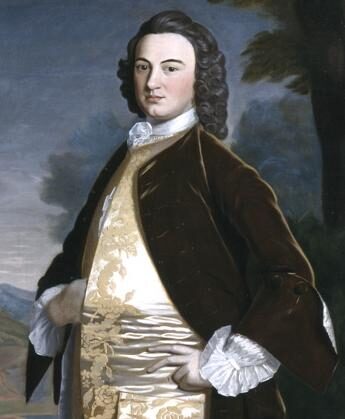
James Bowdoin
James Bowdoin was an American leader during the American Revolution. Born August 7, 1726, in Boston. Died November 6, 1790, in Boston. Positions held include Governor of Massachusetts (1785–1787). Educated at Harvard University and Harvard College. Awards include Fellow of the Royal Society and Fellow of the American Academy of Arts and Sciences.
Facts
22 facts · 2 confirmed by two sources · 6 cited · 14 from one source
Where this comes from
Papalocal keeps its own record. It started from these sources; what each one said is kept here as it was copied, so a change on their side never changes this page by itself. Tap one to read its version.
What Wikidata says · copied November 18, 2026 · revision 2568782951
- Described as
- American leader during the American Revolution (1726-1790)
- Other names
- James Bowdoin II
- Born
- August 7, 1726 · 4 references
- Died
- November 6, 1790 · 4 references
- Born in
- Boston · 1 reference
- Died in
- Boston · 1 reference
- Buried in
- Granary Burying Ground
- Cause of death
- tuberculosis
- Citizen of
- United States
- Occupation
- politician · 1 reference; governor · 1 reference
- Positions held
- Governor of Massachusetts (1785–1787)
- Education
- Harvard University; Harvard College
- Member of
- Royal Society of London (1788–); American Academy of Arts and Sciences; American Philosophical Society (1787–)
- Awards
- Fellow of the Royal Society; Fellow of the American Academy of Arts and Sciences (1780–)
- Spouse
- Elizabeth Irving
- Children
- James Bowdoin III; Elizabeth Bowdoin · 1 reference
- Father
- James Bowdoin
- Mother
- Hannah Portage · 1 reference
- Wikipedias with a page
- 18
Wikidata item Q888645 (wikidata.org/wiki/Q888645), public domain (CC0). Copied November 18, 2026.
What Wikipedia says · copied November 18, 2026 · revision 1385567045
James Bowdoin II ( BOH-din; August 7, 1726 – November 6, 1790) was an American politician and merchant who served as governor of Massachusetts from 1785 to 1787. Born in Boston in what was then colonial Massachusetts into a wealthy mercantile family, he rose to prominence by following his father's career. Between the 1750s and 1770s Bowdoin served in both branches of the Massachusetts General Court, where he was initially a supporter of the colony's royal governors before opposing British policy towards its North American colonies and eventually becoming an prominent advocate of colonial independence. Bowdoin authored a highly politicized report on the 1770 Boston Massacre which has been described as one of the most influential pieces of writing that shaped colonial public opinion.
From 1775 to 1777, Bowdoin served as president of the Massachusetts Provincial Congress's executive council, the de facto head of the Massachusetts government during the American Revolutionary War. He was elected president of the Constitutional Convention that drafted the state's constitution in 1779, and ran unsuccessfully for governor in 1780, losing to John Hancock. In 1785, following Hancock's resignation, Bowdoin was elected governor. Due to the large debts Massachusetts incurred from the Revolutionary War, he ran on a platform of fiscal responsibility. During his two years in office, a combination of poor economic conditions and the harsh fiscal policy laid down by Bowdoin's administration led to Shays' Rebellion. Bowdoin personally funded militia forces that were instrumental in putting down the uprising. His high-handed treatment of the rebels may have contributed to his loss of the 1787 election, in which the populist Hancock was returned to office.
In addition to his political activities, Bowdoin was active in scientific pursuits, collaborating with Benjamin Franklin in his pioneering research on electricity. He was elected as a fellow of the Royal Society and was elected a member of the American Philosophical Society in 1787. He was a founder and first president of the American Academy of Arts and Sciences, to whom he bequeathed his library. Bowdoin College in Maine was named in his honor after a bequest by his son James Bowdoin III.
- Born, in its opening lines
- August 7, 1726
- Died, in its opening lines
- November 6, 1790
From the Wikipedia article “James Bowdoin” (en.wikipedia.org/wiki/James_Bowdoin), by its contributors, under CC BY-SA 4.0 (creativecommons.org/licenses/by-sa/4.0/). Copied November 18, 2026; not changed.
Confirmed Two sources agree. Cited One source, and it names where it got it. One source One source, without a reference of its own. Sources disagree The sources disagree. We show the best-supported value and keep theirs below.
