
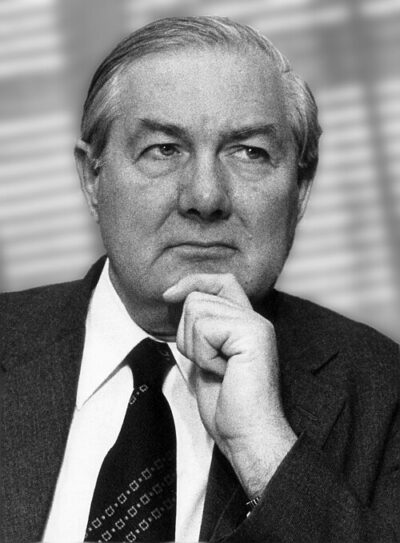
James Callaghan
James Callaghan was a former prime minister of the United Kingdom. Born March 27, 1912, in Copnor. Died March 26, 2005, in Ringmer. Positions held include Prime Minister of the United Kingdom (1976–1979), Leader of the Opposition (1979–1980) and Leader of the Labour Party (1976–1980). Awards include Knight of the Garter and honorary doctorate.
Facts
35 facts · 2 confirmed by two sources · 12 cited · 21 from one source
Where this comes from
Papalocal keeps its own record. It started from these sources; what each one said is kept here as it was copied, so a change on their side never changes this page by itself. Tap one to read its version.
What Wikidata says · copied November 16, 2026 · revision 2569138697
- Described as
- former prime minister of the United Kingdom (1912–2005)
- Other names
- Lord Callaghan, Jim Callaghan, Lord Callaghan of Cardiff, James Callaghan, Baron Callaghan, James, Baron Callaghan, Leonard James Callaghan, Leonard James, Baron Callaghan
- Born
- March 27, 1912 · 13 references
- Died
- March 26, 2005 · 11 references
- Born in
- Copnor · 1 reference
- Died in
- Ringmer · 1 reference
- Cause of death
- pneumonia
- Citizen of
- United Kingdom
- Occupation
- economist; politician · 1 reference; trade unionist · 1 reference
- Positions held
- Prime Minister of the United Kingdom (1976–1979); Leader of the Opposition (1979–1980); Leader of the Labour Party (1976–1980); Secretary of State for Foreign and Commonwealth Affairs (1974–1976); Shadow Foreign Secretary (1972–1974); Shadow Secretary of State for Employment (1971–1972); Shadow Home Secretary (1970–1971); Home Secretary (1967–1970); Chancellor of the Exchequer (1964–1967); Shadow Chancellor of the Exchequer (1961–1964); Secretary to the Admiralty (1950–1951); Parliamentary Secretary to the Ministry of Transport (1947–1950); Member of the Privy Council of the United Kingdom; member of the 49th Parliament of the United Kingdom (1983–1987) · 1 reference; member of the 48th Parliament of the United Kingdom (1979–1983) · 1 reference
- Political party
- Labour Party
- Awards
- Knight of the Garter (1987); honorary doctorate (1996) · 1 reference
- Spouse
- Audrey Callaghan, Baroness Callaghan of Cardiff (1938–2005) · 1 reference
- Children
- Margaret Jay, Baroness Jay of Paddington · 1 reference; Julia Elizabeth Callaghan · 1 reference; Michael James Callaghan · 1 reference
- Father
- James Callaghan · 1 reference
- Mother
- Charlotte Gertrude Cundy · 1 reference
- Military branch
- Royal Navy
- Military rank
- lieutenant
- Wikipedias with a page
- 93
Wikidata item Q9576 (wikidata.org/wiki/Q9576), public domain (CC0). Copied November 16, 2026.
What Wikipedia says · copied November 16, 2026 · revision 1384704006
Leonard James Callaghan, Baron Callaghan of Cardiff ( KAL-ə-han; 27 March 1912 – 26 March 2005) was Prime Minister of the United Kingdom from 1976 to 1979 and Leader of the Labour Party from 1976 to 1980. Callaghan is the only person to have held all four Great Offices of State, having also served as Chancellor of the Exchequer from 1964 to 1967, Home Secretary from 1967 to 1970 and Foreign Secretary from 1974 to 1976. He was a member of Parliament (MP) from 1945 to 1987.
Born into a working-class family in Portsmouth, Callaghan left school early and began his career as a tax inspector, before becoming a trade union official in the 1930s. He served as a sub-lieutenant in the Royal Navy during the Second World War. He was elected to Parliament at the 1945 election, and was at that time regarded as being on the left wing of the Labour Party. He was appointed to the Attlee government as a parliamentary secretary in 1947, and began to move increasingly towards the right wing of the Labour Party, while maintaining his reputation as a "Keeper of the Cloth Cap" – that is, seen as maintaining close ties between Labour and the trade unions. Following Labour's defeat at the 1951 election, Callaghan increasingly became regarded as a leader of the right wing of the Labour Party, and stood for the positions of deputy leader in 1960 and for leader in 1963, but was defeated by George Brown for the former and Harold Wilson for the latter.
Following Labour's victory at the 1964 election, Wilson appointed Callaghan as Chancellor of the Exchequer; his tenure coincided with a turbulent period for the British economy, during which Callaghan had to tackle both a chronic balance of payments deficit and various speculative attacks on the pound sterling, with its exchange rate to other currencies being fixed by the Bretton Woods system. On 18 November 1967, having initially denied that it would do so, the Government devalued the pound sterling. In the wake of the decision, Wilson moved Callaghan to the role of Home Secretary. During this time, Callaghan was responsible for overseeing the operations of the British Army to support the police in Northern Ireland, following a request from the Northern Ireland government. Callaghan remained in the Shadow Cabinet during Labour's period in Opposition from 1970 to 1974; upon Labour's victory at the 1974 election, Wilson appointed Callaghan as Foreign Secretary. Callaghan was responsible for renegotiating the terms of Britain's membership of the European Communities (EC), and strongly supported the successful "Yes" vote campaign in the 1975 referendum, which confirmed the UK's membership of the EC.
When Wilson suddenly announced his retirement in March 1976, Callaghan defeated five other candidates to be elected Leader of the Labour Party; he was appointed Prime Minister on 5 April 1976. Labour had won a narrow majority in the House of Commons at the October 1974 election but, through by-election defeats, had lost this by the time Callaghan became prime minister; and several by-election defeats and defections in his early months of power forced him to strike a confidence and supply agreement with the Liberal Party. This had ended by the time of significant industrial disputes and widespread strikes in the 1978–79 "Winter of Discontent"–which, followed by the defeat of the referendum on devolution for Scotland, led to minor parties joining with the Conservative Party to pass a motion of no-confidence in Callaghan on 28 March 1979. Although remaining personally popular in opinion polls, he led Labour to defeat at the 1979 election and was replaced by Conservative Margaret Thatcher. The 1979 defeat marked the beginning of 18 years in opposition for the Labour Party, the longest in its history.
Callaghan carried on as Labour leader and Leader of the Opposition until November 1980, during which time he attempted to reform the process by which Labour elected its leader. After leaving the leadership he returned to the backbenches, and between 1983 and 1987 was Father of the House of Commons. On retiring from the Commons in 1987, he was elevated to the House of Lords as Baron Callaghan of Cardiff. He died in 2005 at the age of 92, and remains to date the UK's longest-lived former prime minister. He is the most recent prime minister to have served in the British Armed Forces and the only prime minister to have served in the Royal Navy.
- Born, in its opening lines
- March 27, 1912
- Died, in its opening lines
- March 26, 2005
From the Wikipedia article “James Callaghan” (en.wikipedia.org/wiki/James_Callaghan), by its contributors, under CC BY-SA 4.0 (creativecommons.org/licenses/by-sa/4.0/). Copied November 16, 2026; not changed.
Confirmed Two sources agree. Cited One source, and it names where it got it. One source One source, without a reference of its own. Sources disagree The sources disagree. We show the best-supported value and keep theirs below.
