
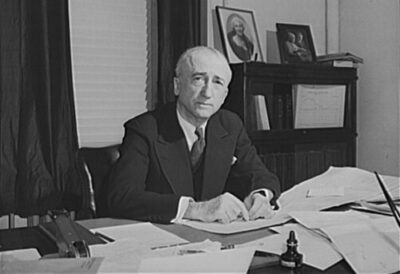
James F. Byrnes
James F. Byrnes was an American politician. Born May 2, 1882, in Charleston. Died April 9, 1972, in Columbia. Positions held include United States representative (1911–1925), Governor of South Carolina (1951–1955) and United States Secretary of State (1945–1947). Educated at Clemson University.
Facts
25 facts · 2 confirmed by two sources · 12 cited · 11 from one source
Where this comes from
Papalocal keeps its own record. It started from these sources; what each one said is kept here as it was copied, so a change on their side never changes this page by itself. Tap one to read its version.
What Wikidata says · copied November 13, 2026 · revision 2568248147
- Described as
- American politician (1882–1972)
- Other names
- James Francis Byrnes, James Byrnes
- Born
- May 2, 1882 · 2 references
- Died
- April 9, 1972 · 4 references
- Born in
- Charleston · 2 references
- Died in
- Columbia · 1 reference
- Buried in
- Trinity Episcopal Cathedral Cemetery · 1 reference
- Citizen of
- United States
- Occupation
- politician · 2 references; judge · 1 reference; diplomat; lawyer; governor · 1 reference; jurist · 1 reference; prosecutor · 1 reference; foreign minister · 1 reference
- Positions held
- United States representative (1911–1925); Governor of South Carolina (1951–1955); United States Secretary of State (1945–1947) · 1 reference; Associate Justice of the Supreme Court of the United States (1941–1942); United States senator (1931–1941) · 1 reference; senator · 1 reference
- Political party
- Democratic Party; Republican Party
- Education
- Clemson University
- Spouse
- Maude Byrnes (1906–) · 2 references
- Religion
- Episcopal Church
- Wikipedias with a page
- 43
Wikidata item Q432726 (wikidata.org/wiki/Q432726), public domain (CC0). Copied November 13, 2026.
What Wikipedia says · copied November 13, 2026 · revision 1381242972
James Francis Byrnes (US: BURNZ; May 2, 1882 – April 9, 1972) was an American jurist and politician from South Carolina. A member of the Democratic Party, he served in the U.S. Congress and on the U.S. Supreme Court, as well as in the executive branch, most prominently as the 49th U.S. Secretary of State under President Harry S. Truman. Byrnes was also the 104th governor of South Carolina.
Born and raised in Charleston, South Carolina, Byrnes pursued a legal career with the help of his cousin, Governor Miles Benjamin McSweeney. Byrnes won election to the U.S. House of Representatives and served from 1911 to 1925. He became a close ally of President Woodrow Wilson and a protégé of Senator Benjamin Tillman. He sought election to the U.S. Senate in 1924 but narrowly lost a runoff election to Coleman Livingston Blease, who had the backing of the Ku Klux Klan. Byrnes then moved his law practice to Spartanburg, South Carolina and prepared for a political comeback. He narrowly defeated Blease in the 1930 Democratic primary and was elected to the Senate in 1931.
Historian George E. Mowry called Byrnes "the most influential Southern member of Congress between John Calhoun and Lyndon Johnson". In the Senate, Byrnes supported the policies of his longtime friend, President Franklin D. Roosevelt. Byrnes championed the New Deal and sought federal investment in South Carolina water projects, in addition to supporting Roosevelt's foreign policy, calling for a hard line against the Axis powers. However, he also opposed some of the labor laws proposed by Roosevelt, such as the Fair Labor Standards Act, which established a minimum wage that hurt his state's competitive advantage of very low factory wages. Roosevelt appointed Byrnes to the Supreme Court in 1941 but asked him to join the executive branch after America's entry into World War II after only 1 year and 87 days, making him the shortest-serving Supreme Court justice in history. Byrnes was also the last Supreme Court justice not to earn a law degree. During the war, Byrnes led the Office of Economic Stabilization and the Office of War Mobilization. He was a candidate to replace Henry A. Wallace as Roosevelt's running mate in the 1944 election, but instead Harry S. Truman was nominated by the 1944 Democratic National Convention.
After Roosevelt's death, Byrnes served as a close adviser to Truman and became U.S. Secretary of State in July 1945. In that capacity, Byrnes attended the Potsdam Conference and the Paris Peace Treaties, 1947. However, relations between Byrnes and Truman soured, and Byrnes resigned from the Cabinet in January 1947. He returned to elective politics in 1950 by winning the election as the governor of South Carolina. As governor, he opposed the Supreme Court decision in Brown v. Board of Education and sought to establish "separate but equal" as a realistic alternative to the desegregation of schools.
- Born, in its opening lines
- May 2, 1882
- Died, in its opening lines
- April 9, 1972
From the Wikipedia article “James F. Byrnes” (en.wikipedia.org/wiki/James_F._Byrnes), by its contributors, under CC BY-SA 4.0 (creativecommons.org/licenses/by-sa/4.0/). Copied November 13, 2026; not changed.
Confirmed Two sources agree. Cited One source, and it names where it got it. One source One source, without a reference of its own. Sources disagree The sources disagree. We show the best-supported value and keep theirs below.
