
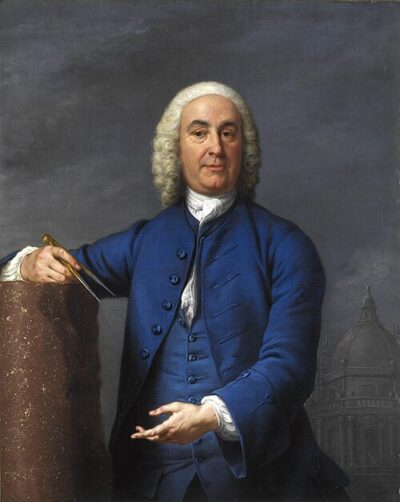
James Gibbs
James Gibbs was a Scottish architect. Born December 23, 1682, in Aberdeen. Died August 5, 1754, in London. Known for St Martin-in-the-Fields, St Mary le Strand, Westminster and St Peter, Vere Street. Educated at University of Aberdeen and Aberdeen Grammar School. Awards include Fellow of the Royal Society.
Facts
16 facts · 2 confirmed by two sources · 4 cited · 10 from one source
Where this comes from
Papalocal keeps its own record. It started from these sources; what each one said is kept here as it was copied, so a change on their side never changes this page by itself. Tap one to read its version.
What Wikidata says · copied November 18, 2026 · revision 2569991417
- Described as
- Scottish architect (1683–1754)
- Born
- December 23, 1682 · 7 references
- Died
- August 5, 1754 · 12 references
- Born in
- Aberdeen · 1 reference
- Died in
- London · 2 references
- Buried in
- St. Marylebone Churchyard · 1 reference
- Citizen of
- Kingdom of Great Britain
- Occupation
- architect · 1 reference
- Education
- University of Aberdeen; Aberdeen Grammar School
- Member of
- Royal Society of London
- Known for
- St Martin-in-the-Fields; St Mary le Strand, Westminster; St Peter, Vere Street; Radcliffe Camera; Ditchley
- Awards
- Fellow of the Royal Society
- Wikipedias with a page
- 22
Wikidata item Q1352355 (wikidata.org/wiki/Q1352355), public domain (CC0). Copied November 18, 2026.
What Wikipedia says · copied November 18, 2026 · revision 1372349328
James Gibbs (23 December 1682 – 5 August 1754) was a Scottish architect. Born in Aberdeen, he trained as an architect in Rome, and practised mainly in England. He is an important figure whose work spanned the transition between English Baroque architecture and Georgian architecture heavily influenced by Andrea Palladio. Among his most important works are St Martin-in-the-Fields (at Trafalgar Square), the cylindrical, domed Radcliffe Camera at Oxford University, and the Senate House at Cambridge University.
Gibbs very privately was a Roman Catholic and a Tory. Because of this and his age, he had a somewhat removed relation to the Palladian movement which came to dominate English architecture during his career. The Palladians were largely Whigs, led by Lord Burlington and Colen Campbell, a fellow Scot who developed a rivalry with Gibbs. Gibbs' professional Italian training under the Baroque master Carlo Fontana also set him uniquely apart from the Palladian school. However, despite being unfashionable, he gained a number of Tory patrons and clients, and became hugely influential through his published works, which became popular as pattern books for architecture. The naming of the Gibbs surround for doors and windows, which he certainly did not invent, testifies to this influence.
His architectural style did incorporate Palladian elements, as well as forms from Italian Baroque and Inigo Jones (1573–1652), but was most strongly influenced by the work of Sir Christopher Wren (1632–1723), who was an early supporter of Gibbs. Overall, Gibbs was an individual who formed his own style independently of current fashions. Architectural historian John Summerson describes his work as the fulfilment of Wren's architectural ideas, which were not fully developed in his own buildings. Despite the influence of his books, Gibbs, as a stylistic outsider, had little effect on the later direction of British architecture, which saw the rise of Neoclassicism shortly after his death.
- Born, in its opening lines
- December 23, 1682
- Died, in its opening lines
- August 5, 1754
From the Wikipedia article “James Gibbs” (en.wikipedia.org/wiki/James_Gibbs), by its contributors, under CC BY-SA 4.0 (creativecommons.org/licenses/by-sa/4.0/). Copied November 18, 2026; not changed.
Confirmed Two sources agree. Cited One source, and it names where it got it. One source One source, without a reference of its own. Sources disagree The sources disagree. We show the best-supported value and keep theirs below.
