
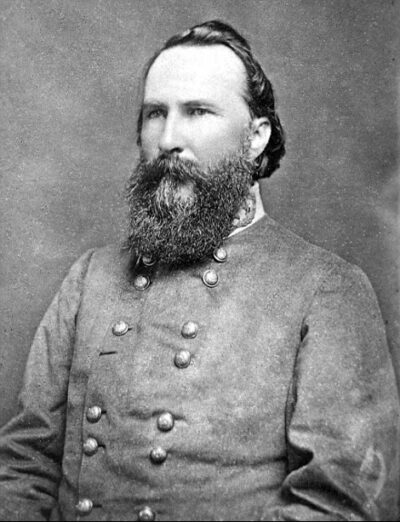
James Longstreet
James Longstreet was a Confederate Army general. Born January 8, 1821, in Edgefield County. Died January 2, 1904, in Gainesville. Positions held include United States Ambassador to Turkey and ambassador. Educated at United States Military Academy and Academy of Richmond County.
Facts
24 facts · 2 confirmed by two sources · 8 cited · 14 from one source
Where this comes from
Papalocal keeps its own record. It started from these sources; what each one said is kept here as it was copied, so a change on their side never changes this page by itself. Tap one to read its version.
What Wikidata says · copied November 15, 2026 · revision 2524026726
- Described as
- Confederate Army general (1821–1904)
- Other names
- James. Longstreet, James, Lt. Gen. Longstreet
- Born
- January 8, 1821 · 4 references
- Died
- January 2, 1904 · 4 references
- Born in
- Edgefield County · 1 reference
- Died in
- Gainesville · 1 reference
- Buried in
- Alta Vista Cemetery · 1 reference
- Citizen of
- United States; Confederate States of America
- Occupation
- diplomat; military officer · 1 reference; military personnel · 1 reference; army officer; ambassador · 1 reference
- Positions held
- United States Ambassador to Turkey; ambassador
- Political party
- Republican Party
- Education
- United States Military Academy; Academy of Richmond County · 1 reference
- Spouse
- Helen Dortch Longstreet
- Father
- James Longstreet
- Mother
- Mary Anne Dent · 1 reference
- Military branch
- United States Army; Confederate States Army
- Military rank
- lieutenant general; general · 1 reference
- Wikipedias with a page
- 37
Wikidata item Q311514 (wikidata.org/wiki/Q311514), public domain (CC0). Copied November 15, 2026.
What Wikipedia says · copied November 15, 2026 · revision 1385567450
James Longstreet (January 8, 1821 – January 2, 1904) was a Confederate general during the American Civil War and was the principal subordinate to General Robert E. Lee. He served under Lee as a corps commander for most of the battles fought by the Army of Northern Virginia in the eastern theater, and briefly with Braxton Bragg in the Army of Tennessee in the western theater.
After graduating from the United States Military Academy in West Point, Longstreet served in the United States Army during the Mexican–American War. He was wounded at the Battle of Chapultepec, and during recovery married Louise Garland. Throughout the 1850s, he served on frontier duty in the American Southwest. In June 1861, Longstreet resigned his U.S. Army commission and joined the Confederate Army. He commanded Confederate troops during an early victory at Blackburn's Ford in July and played a minor role at the First Battle of Bull Run.
Longstreet made significant contributions to most major Confederate victories, primarily in the eastern theater. He performed poorly at Seven Pines by accidentally marching his men down the wrong road, causing them to arrive late, but played an important role in the Confederate success of the Seven Days Battles in the summer of 1862, where he helped supervise repeated attacks that drove the Union army away from the Confederate capital of Richmond. Longstreet led a devastating counterattack that routed the Union army at Second Bull Run in August. His men held their ground in defensive roles at Antietam and Fredericksburg. He did not participate in the Confederate victory at Chancellorsville, as he and most of his soldiers had been detached on the comparatively minor siege of Suffolk. Longstreet's most controversial service was at the Battle of Gettysburg in July 1863, where he openly disagreed with Lee on the tactics to be employed and reluctantly supervised several unsuccessful attacks on Union forces. Afterward, Longstreet was, at his own request, sent to the western theater to fight under Braxton Bragg, where his troops launched a ferocious assault on the Union lines at Chickamauga that carried the day. Afterward, his performance in semi-autonomous command during the Knoxville campaign resulted in a Confederate defeat. Longstreet's tenure in the western theater was marred by his central role in numerous conflicts amongst Confederate generals. Unhappy serving under Bragg, Longstreet and his men were sent back to Lee. He ably commanded troops during the Battle of the Wilderness in 1864, where he was seriously wounded by friendly fire. He later served under Lee in the siege of Petersburg and the Appomattox campaign.
Longstreet enjoyed a successful post-war career working for the U.S. government as a diplomat, civil servant, and administrator. His support for the Republican Party and his cooperation with his pre-war friend President Ulysses S. Grant, as well as critical comments he wrote about Lee's wartime performance, made him anathema to many of his former Confederate colleagues. His reputation in the South further suffered when he led African-American militia against the anti-Reconstruction White League at the Battle of Liberty Place in 1874. Authors of the Lost Cause movement focused on Longstreet's actions at Gettysburg as a principal reason for why the South lost the Civil War. As an elderly man, he married Helen Dortch Longstreet, who worked to restore her husband's image after his death. Since the late 20th century, Longstreet's reputation has undergone a slow reassessment. Many Civil War historians now consider him among the war's most gifted tactical commanders.
- Born, in its opening lines
- January 8, 1821
- Died, in its opening lines
- January 2, 1904
From the Wikipedia article “James Longstreet” (en.wikipedia.org/wiki/James_Longstreet), by its contributors, under CC BY-SA 4.0 (creativecommons.org/licenses/by-sa/4.0/). Copied November 15, 2026; not changed.
Confirmed Two sources agree. Cited One source, and it names where it got it. One source One source, without a reference of its own. Sources disagree The sources disagree. We show the best-supported value and keep theirs below.
