
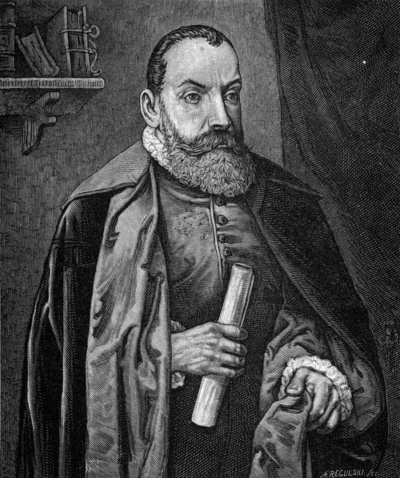
Jan Kochanowski
Jan Kochanowski was a Polish Renaissance poet. Born 1530, in Sycyna Północna. Died August 22, 1584, in Lublin. Positions held include provost (1564–1574), Sandomierz Wojski (1579–1584) and king's secretary at the Polish court (1564–). Known for Fraszki, The Dismissal of the Greek Envoys and David's Psalter. Educated at University of Königsberg and University of Padua.
Facts
41 facts · 2 confirmed by two sources · 3 cited · 36 from one source
Where this comes from
Papalocal keeps its own record. It started from these sources; what each one said is kept here as it was copied, so a change on their side never changes this page by itself. Tap one to read its version.
What Wikidata says · copied November 16, 2026 · revision 2567360998
- Described as
- Polish Renaissance poet (1530–1584)
- Other names
- Ioannes Cochanovius
- Born
- 1530 · 3 references
- Died
- August 22, 1584 · 8 references
- Born in
- Sycyna Północna
- Died in
- Lublin · 3 references
- Cause of death
- myocardial infarction
- Citizen of
- Crown of the Kingdom of Poland; Polish–Lithuanian Commonwealth
- Occupation
- poet; writer · 2 references; translator · 1 reference; playwright
- Positions held
- provost (1564–1574); Sandomierz Wojski (1579–1584); king's secretary at the Polish court (1564–); Polish elector (1573–)
- Education
- University of Königsberg (1555–1556); University of Padua (1552–1555); Jagiellonian University (1544–)
- Genre
- phrase; drama; narrative poetry; complaint; epitaph; ode
- Known for
- Fraszki; The Dismissal of the Greek Envoys; David's Psalter; Laments; Chess
- Field
- fiction · 1 reference
- Spouse
- Dorota Podlodowska (1575–)
- Children
- Urszula Kochanowska; Hanna Kochanowska; Jan Kochanowski
- Father
- Piotr Kochanowski
- Mother
- Anna Białaczowska
- Siblings
- Kasper Kochanowski; Mikołaj Kochanowski; Andrzej Kochanowski
- Religion
- Catholicism
- Lived in
- Czarnolas (1575–1584)
- Wikipedias with a page
- 51
Wikidata item Q59737 (wikidata.org/wiki/Q59737), public domain (CC0). Copied November 16, 2026.
What Wikipedia says · copied November 16, 2026 · revision 1385564863
Jan Kochanowski (Polish: [ˈjan kɔxaˈnɔfskʲi]; 23 June 1530 – 22 August 1584) was a Polish Renaissance poet who wrote in Latin and Polish and established poetic patterns that would become integral to the Polish literary language.
He has been called the greatest Polish poet before Adam Mickiewicz (the latter, a leading Romantic writer) and one of the most influential Slavic poets prior to the 19th century.
In his youth, Kochanowski traveled to Italy, where he studied at the University of Padua, and to France. In 1559 he returned to Poland, where he made the acquaintance of political and religious notables including Jan Tarnowski, Piotr Myszkowski (whom he briefly served as a courtier), and members of the influential Radziwiłł family.
From about 1563 Kochanowski served as secretary to King Sigismund II Augustus. He accompanied the king to several noteworthy events, including the Sejm of 1569 (held in Lublin), which enacted the Union of Lublin, formally establishing the Polish–Lithuanian Commonwealth. In 1564 he was made provost of Poznań Cathedral. By the mid-1570s he had largely retired to his estate at Czarnolas. He died suddenly in 1584, while staying in Lublin.
Throughout his life Kochanowski was a prolific writer. Works of his that are pillars of the Polish literary canon include the 1580 Treny (Laments), a series of nineteen threnodies (elegies) on the death of his daughter Urszula; the 1578 tragedy Odprawa posłów greckich (The Dismissal of the Greek Envoys), inspired by Homer; and Kochanowski's Fraszki (Epigrams), a collection of 294 short poems written during the 1560s and 1570s, published in three volumes in 1584. One of his major stylistic contributions was the adaptation and popularization of Polish-language verse forms.
- Born, in its opening lines
- June 23, 1530
- Died, in its opening lines
- August 22, 1584
From the Wikipedia article “Jan Kochanowski” (en.wikipedia.org/wiki/Jan_Kochanowski), by its contributors, under CC BY-SA 4.0 (creativecommons.org/licenses/by-sa/4.0/). Copied November 16, 2026; not changed.
Confirmed Two sources agree. Cited One source, and it names where it got it. One source One source, without a reference of its own. Sources disagree The sources disagree. We show the best-supported value and keep theirs below.
