
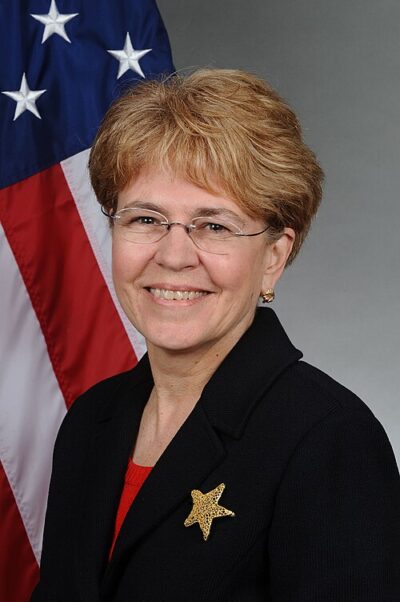
Jane Lubchenco is an American ecologist. Born December 4, 1947, in Denver. Positions held include Under Secretary of Commerce for Oceans and Atmosphere (2009–2013) and chairperson (1992–1993). Educated at Colorado College and Harvard University. Awards include MacArthur Fellows Program, Tyler Prize for Environmental Achievement and Nierenberg Prize.
Facts
36 facts · 1 confirmed by two sources · 19 cited · 16 from one source
Where this comes from
Papalocal keeps its own record. It started from these sources; what each one said is kept here as it was copied, so a change on their side never changes this page by itself. Tap one to read its version.
What Wikidata says · copied November 18, 2026 · revision 2567115542
- Described as
- American ecologist
- Born
- December 4, 1947 · 1 reference
- Born in
- Denver · 1 reference
- Citizen of
- United States
- Occupation
- zoologist; university teacher; marine biologist · 1 reference; ecologist; oceanographer · 1 reference; environmentalist
- Positions held
- Under Secretary of Commerce for Oceans and Atmosphere (2009–2013); chairperson (1992–1993) · 1 reference
- Worked for
- Oregon State University
- Education
- Colorado College; Harvard University (–1975) · 1 reference; University of Washington (–1971) · 1 reference
- Member of
- National Academy of Sciences (1996–) · 1 reference; American Academy of Arts and Sciences; National Science Board (1996–2006) · 1 reference; Royal Society of London (2004) · 1 reference
- Awards
- MacArthur Fellows Program (1993) · 1 reference; Tyler Prize for Environmental Achievement (2015) · 1 reference; Nierenberg Prize (2003); Blue Planet Prize (2011) · 1 reference; Eminent Ecologist Award (2014) · 1 reference; ECI Prize (2016); BBVA Foundation Frontiers of Knowledge Award (2012); NAS Public Welfare Medal (2017) · 1 reference; Women in Technology Hall of Fame (2012) · 1 reference; Fellow of the Ecological Society of America (2012) · 1 reference; Heinz Award (2002) · 1 reference; Fellow of the American Association for the Advancement of Science; Foreign Member of the Royal Society (2004) · 1 reference; Stephen H. Schneider Award (2014); George Mercer Award (1979) · 1 reference
- Field
- marine ecosystem · 1 reference
- Spouse
- Bruce A. Menge · 1 reference
- Wikipedias with a page
- 18
Wikidata item Q241155 (wikidata.org/wiki/Q241155), public domain (CC0). Copied November 18, 2026.
What Wikipedia says · copied November 18, 2026 · revision 1385994903
Jane Lubchenco (born December 4, 1947) is a decorated American environmental scientist, marine ecologist, and U.S. government executive.
From 2009 to 2013, she was appointed by President Obama to serve as the 9th Administrator of NOAA and Under Secretary of Commerce for Oceans and Atmosphere. In February 2021, she was appointed by President Joe Biden to serve as deputy director for Climate and Environment in the White House Office of Science and Technology Policy.
She currently teaches and conducts academic research at Oregon State University. Her research includes interactions between the environment and human well-being, biodiversity, climate change, and sustainable use of oceans and the planet.
During her time at NOAA, she was the Mimi and Peter Haas Distinguished Visitor in Public Service at Stanford University (March–June 2013). In June 2013, she returned to Oregon State University where she was on the faculty prior to being invited by President-Elect Obama to serve on his 'science team.' Her many awards include the MacArthur 'genius' award in 1993 and more than 20 Honorary Degrees.
In 2002, Discover magazine recognized Lubchenco as one of the 50 most important women in science. In 2010, she was named as the scientific journal Nature's first Newsmaker of the Year.
- Born, in its opening lines
- December 4, 1947
From the Wikipedia article “Jane Lubchenco” (en.wikipedia.org/wiki/Jane_Lubchenco), by its contributors, under CC BY-SA 4.0 (creativecommons.org/licenses/by-sa/4.0/). Copied November 18, 2026; not changed.
Confirmed Two sources agree. Cited One source, and it names where it got it. One source One source, without a reference of its own. Sources disagree The sources disagree. We show the best-supported value and keep theirs below.
