
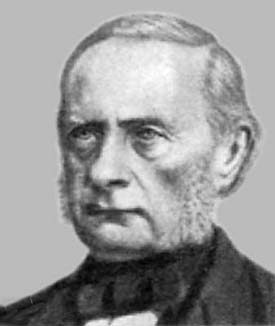
Jean-Marie Duhamel
Jean-Marie Duhamel was a French mathematician and physicist. Born February 5, 1797, in Saint-Malo. Died April 29, 1872, in Paris. Positions held include president of the French Academy of Sciences (1862). Known for Duhamel's integral, Duhamel's principle and Raabe's test. Educated at École polytechnique and University of Rennes. Awards include Commander of the Legion of Honour.
Facts
29 facts · 2 confirmed by two sources · 17 cited · 10 from one source
Where this comes from
Papalocal keeps its own record. It started from these sources; what each one said is kept here as it was copied, so a change on their side never changes this page by itself. Tap one to read its version.
What Wikidata says · copied November 18, 2026 · revision 2567456943
- Described as
- French mathematician and physicist (1797–1872)
- Other names
- Jean-Marie Constant Duhamel, Jean-Marie-Constant Duhamel
- Born
- February 5, 1797 · 5 references
- Died
- April 29, 1872 · 5 references
- Born in
- Saint-Malo · 1 reference
- Died in
- Paris · 1 reference
- Buried in
- cimetière du Nord · 2 references
- Name at birth
- Jean-Marie Constant Duhamel · 2 references
- Citizen of
- France
- Occupation
- mathematician · 1 reference; physicist · 1 reference; university teacher · 1 reference
- Positions held
- president of the French Academy of Sciences (1862) · 1 reference
- Worked for
- University of Paris (1851–) · 1 reference; École polytechnique (1830–1869) · 2 references; Lycée Louis-le-Grand (–1829) · 1 reference; Institution Massin (–1829) · 1 reference; Collège Sainte-Barbe (1829–) · 1 reference
- Education
- École polytechnique (1814–1816) · 1 reference; University of Rennes (1816–) · 1 reference
- Member of
- Société Philomathique de Paris; French Academy of Sciences; Saint Petersburg Academy of Sciences; Royal Prussian Academy of Sciences
- Known for
- Duhamel's integral; Duhamel's principle; Raabe's test
- Awards
- Commander of the Legion of Honour
- Field
- mathematics; physics · 1 reference; mechanics · 1 reference
- Wikipedias with a page
- 22
Wikidata item Q957069 (wikidata.org/wiki/Q957069), public domain (CC0). Copied November 18, 2026.
What Wikipedia says · copied November 18, 2026 · revision 1361121753
Jean-Marie Constant Duhamel (; French: [dy.amɛl]; 5 February 1797 – 29 April 1872) was a French mathematician and physicist.
His studies were affected by the troubles of the Napoleonic era. He went on to form his own school École Sainte-Barbe. Duhamel's principle, a method of obtaining solutions to inhomogeneous linear evolution equations, is named after him. He was primarily a mathematician but did studies on the mathematics of heat, mechanics, and acoustics. He also did work in calculus using infinitesimals. Duhamel's theorem for infinitesimals says that the sum of a series of infinitesimals is unchanged by replacing the infinitesimal with its principal part.
In 1853 he published about an early recording device he called a vibroscope. Like other similar devices, the vibroscope was a type of measuring device similar to an oscilloscope, and could not play back the etchings it recorded.
- Born, in its opening lines
- February 5, 1797
- Died, in its opening lines
- April 29, 1872
From the Wikipedia article “Jean-Marie Duhamel” (en.wikipedia.org/wiki/Jean-Marie_Duhamel), by its contributors, under CC BY-SA 4.0 (creativecommons.org/licenses/by-sa/4.0/). Copied November 18, 2026; not changed.
Confirmed Two sources agree. Cited One source, and it names where it got it. One source One source, without a reference of its own. Sources disagree The sources disagree. We show the best-supported value and keep theirs below.
